That's what the Tibetans call it, when you try to force your delusions on objective reality.
You find a snake. It's an animal; it should have legs. But where are they? It has no hair in which to hide them, no feathers, no shell.
Well, they must be inside.
So you squeeze. I picture the unoffending reptile, coiled around my wrist: bug-eyed, silent, indignant.
You want it to have legs. You'd feel better if it had legs. You insist it have legs. In the end, you'd rather it were dead, than to go on existing without legs.
But the thing is, it has no legs.
And that's only a problem for you.
(Adapted from Rough Around the Edges [manuscript in progress]. Photo of Epicrates cenchria, the rainbow boa, courtesy of Rawpixel.com and a generous photographer.)
As non-Vajrayana Western converts to Buddhism will tell you, we have a slightly awkward relationship with Tibet. Not that we have any real bone to pick with our Tantric brothers and sisters. It's mostly just a difference of style. Practice models in the three other common convert denominations – Zen, Vipassana, Theravada – are pretty stripped-down, with Zen probably being the most "gorgeous" of the very Puritan lot. Tibetan forms, meanwhile, are downright High Church.
More prosaic is the simple fact that the Dalai Lama is the only Buddhist most Westerners can name, and since our media regularly imply that he's the "boss of Buddhism", we're all generally believed to owe him fealty. Thus, non-Buddhists are often surprised to learn that I don't really follow the guy's news – he's fine as far as august spiritual figures go, but carries no greater weight with me than the Pope or other sincere religious celebrities.
Similarly, Tibetan Buddhist stereotypes often pass for Buddhist, full stop. Yet I rarely chant "om"; I don't own a copy of the Tibetan Book of the Dead; my Zen teaching embraces transmigration (which I don't necessarily buy, either) rather than reincarnation; and therefore we don't believe past masters can inhabit children.
All of which to say, non-Tantric Neo-Buddhists tend to know fairly little about that tradition or its teachings.
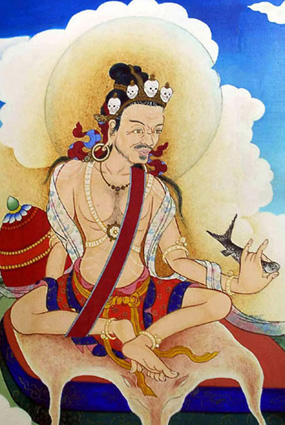
So I was grateful when a fellow Mastodonian shared a particularly provocative passage from Tilopa, an Indian sage whose wisdom looms large in Tibet. Upon further exploration I learned that the posted lines are actually the heart statement of the great Tantra master's programme.
The interpretation presented can be traced to Alan Watts, and reads as follows:
No thought, no reflection, no analysis,
No cultivation, no intention;
Let it settle itself.
Certainly a Zen-friendly sentiment, in that we-say-these-things-a-lot-but-never-do-them kind of way. And other translations found elsewhere enrich the context:
Don’t recall.
Don’t imagine.
Don’t think.
Don’t examine.
Don’t control.
Rest.
A bit more Soto in flavour than Watts' Rinzai-esque lines, perhaps, consisting of nuts and bolts exhortations ("act this way") rather than a self-absent explication of phenomena. But taken together – as is usually the case with these two schools of Japanese Zen – they bring greater insight.
And finally, this fraternal take:
Let go of what has passed.
Let go of what may come.
Let go of what is happening now.
Don’t try to figure anything out.
Don’t try to make anything happen.
Relax, right now, and rest.
(Both of the non-Watts translations quoted here are the work of Tibetan Buddhism teacher Ken Mcleod.)
So I'm paying this forward, as a particularly valuable meditation for Zenners, regardless of source.
Because it's not just good stuff, it's Zen stuff. And also good Zen stuff.
(Tableau of Tilopa courtesy of Wikimedia Commons and a generous photographer.)

(Readers who are new to meditation might find How to Meditate useful. More experienced meditators might also appreciate Meditation Tips.)
Our Ancestors, from the Buddha forward, gave specific instructions for setting up a meditative environment. The particulars are as universal as they are basic:
Sit lotus or facsimile on a cushion in a darkened, but not dark, room.* Maintain temperatures on the cool but not cold side. Exclude distracting sights, sounds, and smells. And (in some versions) close all doors and windows to prevent stray breezes from breaking your concentration.
(*Cœnobites generally insist on sitting indoors. Since they also do most of the teaching, the "conventional" instructions reflect their values. Hermits, for our part, typically accept, and may even prefer, sitting outdoors. For a brief discussion of this difference, see the end of this post.)
I can testify that these instructions work. In fact they're thunderously effective, and once you've created such a setting and positioned yourself in the midst of it, it's harder to avoid zazen than to embrace it.
'Course if I had ready access to such an environment, I wouldn't need enlightenment. I'd just move in and call it a life.
So for my neighbours here south of the long-lived god realm, I'd like to kick off this new year of practice by sharing some hard-earned pointers for hacking meditative space out of an unmeditative existence.
Unhelpful sounds are one of the most common and troublesome challenges. If you can't get away from them or wall them out, you'll find modern headphone technology a godsend. Queue up something contemplative on your iPod, computer, or other device and turn it up just far enough to allow you to meditate. Ideally the masking material will not include human voices (though unintelligible chanting may work for some) and will not otherwise draw your attention in any persistent way.
The result isn't pure zazen, but it beats no sitting at all.
Nature sound recordings (surf, forest, rain) work best for me. Wordless ASMR videos are good too, though they can turn into a relaxation session if you're sensitive to ASMR. This isn't the end of the world either, as long it doesn't replace zazen practice entirely.
Though New Age or religious music often markets itself as a meditation aid, I find it stimulates discursive brain function and prevents zazen.
Finally, by all means don't overlook good old earplugs. For some reason this simple, cheap solution is largely unknown to a large segment of the population, but those disposable foam plugs working people use to avoid going deaf on the job clear all kinds of sound-borne obstructions. They're most effective on low-pitched noises, such as machinery, but greatly attenuate music, television, and voices as well.
Foam earplugs can be had at any hardware store. Having a pair ready on the nightstand can mean the difference between a sleep interrupted and a sleep ruined.
Physical inconvenience is yet another pernicious trial, particularly if you're infirm, or far from your zafu. Meditating in a modern office chair can solve this. Scientifically-designed to distribute your weight as widely as possible, these ubiquitous devices are fully equivalent to a buckwheat zafu and good zabuton. They're a great fall-back for us cushion-sitters, and if you can't sit lotus at all, they flat-out give you your practice back.
Use is straightforward: lower the seat until your feet are flat on the floor. Place your hands in mudra, if comfortable; if not, rest them on your thighs. Meditate.
There may not be any statues of the Buddha sitting in a polyester swivel chair, but you're doing exactly what he did all the same, and that's all that matters.
Note: most how-to-meditate guides say that if you sit in a chair, you must not touch the back. I've sat both ways in an office chair and enjoyed equal success. I still usually sit bolt-upright, because I'm a macho puritanical Japanese-trained Zen Buddhist and there's an angel in heaven who keeps track of these things and will reward me after death. But if you'd rather sit comfortably, research suggests there ain't one difference.
Bad smells are something beginners seldom anticipate, but for my money they're the hardest thing to sit with; all the more since zazen strops your sense of smell to a razor's edge. Trouble is, barring hard-helmet diving gear, you can't insulate yourself from the atmosphere and live.
I've already covered the value of incense for mitigating stench, even deeply nauseating ones like sewage and cigarettes. The trick is to pony up for the good stuff; cheap incense is one of the stinks we're trying to escape.
Different religions (Christian, Buddhist) and traditions (Tibetan, Japanese) cultivate different vibes, so you might have to shop around to find an incense that works for you. But high-grade Vajrayana, Zen, and Roman Catholic incense have all worked for me. Hippy Crap®, on the other hand, makes me gag.
Sometimes you can't sit. (Like, at all.) Maybe your rooming situation won't permit it. Maybe your schedule makes seated zazen impossible. In such situations it's legal to meditate in other positions and places. My two favourites are in the bath and in bed.
For the bath, fill the tub with hot water, sit down in it, fold your legs lotus-style, and lie down on your back. This has the further benefit of enveloping you in a warm, soundproof, weightless cocoon. I've had some fabulous "sits" like this.
For the bed, same drill: tuck self in comfortably, assume position, and meditate.
You're likely to fall asleep in both cases – I actually do it on purpose at night – but you'll get in some good meditation in the meantime. (You might also drown, in the bath tub. So far I've always woken up, coughing and spitting, before that happened, but if you have some kind of condition that might preclude this, you should probably avoid bath-sitting.)
And of course there's always real meditation. Instructions be damned, the Ancestors advised us to meditate with our surroundings, not apart from them. Try befriending your irritations, looking deeply, understanding your annoyance, and accepting them and it. Doesn't always grow corn, but I've had some ringing successes. At any rate, sitting with my own frustration is one of the most useful practices I do.
Which brings me at last to the indoor-outdoor question. The Buddha sat outdoors. Bodhidharma sat half outdoors: facing the wall beneath a tree in an enclosed courtyard.
Yeah, there are more distractions outside. Stuff falls on your head. Wildlife walks by. It gets hotter and colder. Bugs, uh… bug you.
But I like it. These reminders that "the world" isn't a synonym for humanity powerfully support my practice. Also, sitting lotus in a stifling meditation hall, as I've been constrained to do at the zendo, with sweat soaking my clothes and heart-rate turned up to 11 by the sauna-like air, because going outside would "distract" me, is dumb.
And nothing that's dumb is Buddhist.
But whatever your perspective, do what works, without fail. If you find manufactured discomfort spiritually useful, have at it. And if Norwegian death metal creates mindful space for you, then by all means, with my delighted brotherly blessing, bang your head in good health.
(Photograph courtesy of Stuart Heath and Flickr.)

Decrying the forms of others. (Inwardly, I mean; at least I don't do that market preacher thing, where you call down others aloud, as if that's going to advance anyone's programme.) Sadly, some don't share my life experience; they cling to forms I find fatuous and unproductive. If only they were as insightful as I, they'd stand a chance of being as enlightened as… (wait; where was I going with this?)
Exactly. I hold my practice to a high standard; I crop out stuff that sets me back, and embrace stuff that works. But there's this annoying corollary: others realise similar progress doing things I've thrown off, or never fell for in the first place. The fact that these forms make no sense to me is immaterial. Zen is a results-based religion.
But critiquing others provides that power rush we monkeys crave. It's heroin we distil from the opium of ego.
Confusing form with practice. When I sit for a long time, I feel like a good monk. If the session is unsettled, or short, or I don't maintain a schedule, I begin to feel like a sham. To some extent, this is useful; it keeps me on the path. But the fact is, enlightenment is non-attachment. And playing look-how-Zen-I-am is attachment to approval, if only your own. Throw in onlookers, and you multiply the delusion exponentially.
Zen is about acceptance. Sometimes you can't sit as well, or as often, as you'd like. Others you can, but you don't. But sitting is just a form. Practice is looking deeply, understanding cause and effect, adjusting what can be adjusted, and letting the rest go.
I can only do what's humanly possible, whether that's limited by outside obstacles or my own shortcomings.
Confusing religious conviction with political or social values. Like everyone, I selected my religious path largely because it complemented my existing beliefs. Zen practice has helped me grind off some sharp corners, but my principles are essentially the same ones I was born and raised with.
Fact is, morality is human and individual; religion can influence it, but is powerless to establish it, even in the ostensibly devout. It's too easy to mine scripture for self-justification, or sign your liability away to some charismatic leader who will, you implicitly believe, take the karma hit if her teaching turns out to be unskilful. (She won't. It's like your tax return: you can't sign away liability.)
Yet I tend to view those who cause suffering while espousing some other religion or theory as benighted; if only they possessed the Awesome Buddhist Truth, like me.
So what am I to do about Asia? Buddhism's been going on there for 2500 years. In many Asian countries it is, or was historically, the dominant faith; it packs at least swing-vote sway in virtually all of them to this day. So nirvana on earth must have been established somewhere in Asia by now.
Go on, Google it. I'll wait.
Right understanding means distinguishing between virtue and religion. Zen doesn't recognise any secret Masonic handshake that gets us out of dutch at the hour of our death. You either practice, or you don't. What you choose to call yourself while doing so is immaterial.
Thus the world is full of satanic Buddhists and angelic nonbelievers. When everything goes to hell, I'd rather answer to a Dietrich Bonhoeffer than a Saw Maung.
This is the irony all seekers must meditate upon and transform into insight.
(Photo of Tibetan delusion chopper courtesy of Wikimedia Commons and Walters Art Museum.)
(The white, red, and black cord stands for each of the three Tibetan bardos of death. Hung by the grave of a canine friend.)
 "Believing something is not an accomplishment.
"I grew up thinking that beliefs are something to be proud of, but they’re really nothing but opinions one refuses to reconsider. Beliefs are easy. The stronger your beliefs are, the less open you are to growth and wisdom, because 'strength of belief' is only the intensity with which you resist questioning yourself.
"As soon as you are proud of a belief, as soon as you think it adds something to who you are, then you’ve made it a part of your ego. […] It is gratifying to speak forcefully, it is gratifying to be agreed with, and this high is what the die-hards are chasing…
"Take on the beliefs that stand up to your most honest, humble scrutiny, and never be afraid to lose them."
David Cain
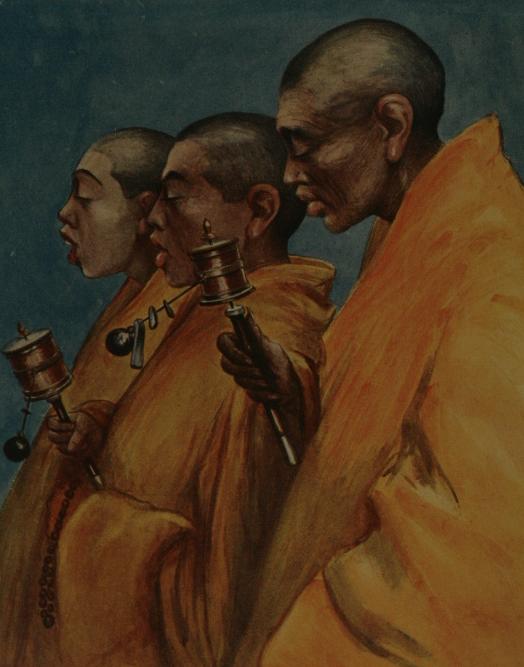
(Photo of 1905 illustration of Buddhist monks with prayer wheels courtesy of Wikimedia Commons and Arnold Henry Savage Landor.)
The unedited version of this photo documents two vultures eating a human body in a Tibetan burial ground. I use it for asubha. I've edited out the scary parts and declined announcing this post in other fora so as not to impose on anybody.
I look at this picture every day. In fact, it's the desktop picture on my computer.
Sometimes when I look at it, I see the woman who used and abused me and left me for dead. I got bad news, babydoll: you ain't all that and a bag of chips. Just ask my friends, here. You're just the bag of chips. Same as us all.
Sometimes I see the man who worked violence on me to get his own way. It's hard to hate you when I see where all your scheming is going to get you.
Sometimes I see someone I love and cherish, someone without whom I might not have made it this far. The time to love is now.
Sometimes I see the Buddha, because this is precisely what happened even to his enlightened backside.
But mostly, I just see me.
Brothers and sisters: don't waste time.


