Showing posts with label Charles Darwin. Show all posts

Thursday, 1 February 2024

The Trilobite Koan

Let's clear up a pernicious gaffe.

The fundamental tenet of Darwinian theory is not that the strongest survive.

That's been arrogant-prick propaganda from day one.

Rather, the fundamental tenet of Darwin's hypothesis is that the fittest survive.

Among humans, fitness boils down to one thing: living in a group that prioritises coöperation. Members of that group not possessing this instinct weaken the unit's ability to meet survival challenges; something our species only does collectively.

If obsolete members gain too much influence, whether through numbers or other means, and so draw below parity the group's ability to overcome environmental obstacles, your band collapses, leaving you to fend for yourself. In our species, that usually means dying without (further) offspring.

If, on the other hand, you're lucky and/or sufficiently evolved, you might earn membership in a new group. Thus the trend among human cultures has been to privilege coöperating individuals over those who compete. (In-house, at any rate.)

Spooling forward, we find humanity overall becoming less churlish by comparison with ancestor species; more drawn to novel others whose very difference suggests obtainable value, and less given to reflexive fear and attack.

(Note that these generalisations, like all evolutionary principles, apply only to the species as a whole. They don't apply to individuals – or, in the case of humans, individual cultures – and take no account of the infinite temporary tidal patterns within the gene pool.)

When the bulk of our community becomes unable to apply the essential human survival tool of sociability in amounts sufficient to clear the next hurdle, our species will lie down with the trilobite and never been seen again.

In view of this scientific fact, I propose a question:

In what ways must our Zen practice – each one – change to meet this existential imperative?


(Photo courtesy of the Houston Museum of Natural Science, Wikimedia Commons, and a generous photographer.)

Thursday, 3 February 2011

The Sputnik of Salamanders

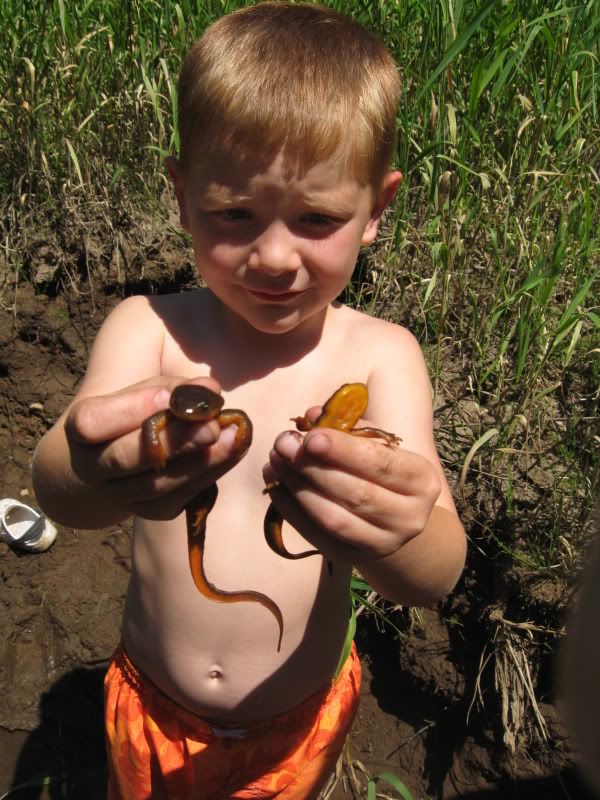
This is an ensatina. I found her while clearing some rotten wood out from under the lower deck.

Ensatinas are found only on the Pacific Coast of North America, and very common here. The local race is this nondescript, nightcrawler-like colour, which is what I thought she was at first. They're about the most inoffensive of creatures, and certainly the gentlest of predators, in the rainforest. Ensatinas are capable of making a creaking noise, though they seldom do; they can also move very quickly if they feel they must, but they rarely do. You can reach out and pick one up without the least fear or haste; all you'll get is a reproachful look from those limpid eyes. Very occasionally, if you're out well after dark on a moist night, or you open the door of a clammy shed, you'll see one of these little fellows afoot on the moss, looking for something to kill. Which it will do, very cautiously, if the opportunity arises. Generally they prefer to hide under logs and leaves, even on the hunt.

Ensatinas especially like rotten wood, because it attracts termites and other prey they can eat without leaving home. It also retains moisture, and since they have no lungs, their skin must remain hydrated or they will suffocate.

Getting by without a respiratory system is just one of the astounding skills of my seemingly insignificant little sister. Unlike most other amphibians, she will lay her eggs on the ground, under rotten wood if at all possible, and generally just three of them. When the time comes, these will hatch into tiny perfect salamanders. No immersion, no egg mass, no tadpole stage. Indeed, generations of ensatinas may rise, thrive, and die before any of them happens, quite by chance, to take a swim. Therefore, though she may not look like much, this ensatina represents a decisive step forward in bio-engineering, away from the newts and toward the lizards. In evolutionary terms, she's the Sputnik of salamanders.

Nor is the Wankel bit the only point of interest this local-girl-made-good holds for evolutionary biology. Some of her nation in Central California have formed what's called a "ring species," a linear progression of geographically-related subspecies that proceed in observable, stair-step fashion through measurable variations, until the first and last are no longer capable of interbreeding. (Some of those Californians are real lookers, too. Big deal. Ours have more heart.) In other words, you can actually document ensatina evolution, not through the fossil record, but across a living, (non-)breathing population. And that's where it all started, brothers and sisters: it was Darwin's study of a similar ring of finches that lead to his famous kensho.

I've been a fan of life all my life. As a kid I especially liked amphibians, and particularly salamanders. Ensatinas were not my favourite; in those days I preferred bigger, flashier entries, like water dogs, redbacks, and mud puppies.

A guy gets older, and looks deeper.


Cereal box prize: 
Feed me, Seymour!

Venus fly traps. Easily the coolest plants in North America, possibly the world. Every little boy has had one. Every little boy has killed one. Most adults consider them unkeepable.

Not so! These folks keep hundreds of them! Outdoors! In Oregon! Read all about it.