Showing posts with label Ryokan. Show all posts

Thursday, 6 November 2025

Bashō's Frog

Frogs in the Balance (15770882427) Matsuo Bashō (芭蕉) was a wandering Zen hermit of the Edo period, as well as an accomplished poet. Popularly considered the father of modern haiku, many of his verses are accepted as teaching in Zen circles today. The readily-memorised haiku format may drive some of this posterity, but there's no denying that Bashō's work often encodes palpable koanic insight.

Interestingly, his status as a self-trained free-range monk is rarely mentioned in our discussions of him, though we're happy to claim Bashō as the "Zen one" of Japan's Four Great Haikunists.

Thus do conservatives lay claim to the dissenters of yore.

Yet the eremitical nature of Bashō's practice is clearly evident in much of his work. Particularly his most famous poem, which is not merely lauded as Bashō's best, but in fact as the most awesomest haiku ever written, by anyone.

Feel up to it?

OK, clear your mind.

Ready?
the old pond
a frog jumps in
plop

That's it.

That's the poem.


Stuff to Notice

To begin with, this translation (Alan Watts, this time) is only one of dozens if not hundreds available; about which, more later. But I especially value Alan's take, emphasising as it does the humour that's central to Bashō's perspective.

Note also that while haiku – at least the classic kind – is supposed to contain references to nature, this one has nature coming out of its ears. I mean, there's no moonlight or cherry blossoms or summer rain or drifting snow. Nothing pretty, you dig. But nature? Yeah. It's got that in spades.

In his sardonic hermit way, Bashō seems to be saying, "I got yer nature, RIGHT HEAH!"

And then there's the Zen.

You may be thinking, "Big deal. Frog jumps in water. There's a noise. Nothing to see here."

And you may be right. I mean, you can get that kind of stuff anywhere, for cheap or free. Nothing unique is going on here. Nothing special.

Scared frog jumps in water, goes splash; not a headline you're likely to see in the Times.

Meanwhile, concentric circles are expanding in the water, lapping at the edges, returning through other circles approaching from behind. Frog resurfaces, climbs out. More circles. Wet frog drips, log gets wet, water runs off into pond.

The concentric circles expand and retract forever. The whole pond is implicated. And also its environs. And their environs. And all the environs beyond that.

And that's just one possible response. Maybe there's some suchness in there. Maybe some satori. Some admirers see all seven Zen principles of composition in these three banal lines.

Which is why they're sometimes called the most perfect haiku ever penned.

But not by its author, of course. We should also bear that in mind.


Language Matters

While we also remember language.

To start with, Bashō never wrote the poem reproduced above. And if by chance he had happened on it, none of that chicken scratch would have meant a thing to him. Because his text (per this source) was actually this:

古池や
蛙飛こむ
水の音

Which works out to:

furuike ya
kawazu tobikomu
mizu no oto

You don't need any Japanese to feel the visceral difference between this and literally anything it might have inspired in English. In fact, if you want to see just how thoroughly we anglophones can mess something up, check out the 32 translations catalogued here.

Robert Aitken's commentary on that page is also well worth the read, as is his stab at the source material:

The old pond has no walls;
a frog just jumps in;
do you say there is an echo?

And if you really want a plunge into the abyss, try Geoffrey Wilkinson, who starts with an acerbic comment on this whole frog thing, and then… well…

Go see for yourself. By the time Wilkinson's done he's taken you on a fascinating street tour of the haiku form and this one in particular, including several parodies by Japanese monks and poets over the past 500 years.

For example:

Old pond—
Bashō jumps in
the sound of water

– Zen master Sengai Gibon, 1750–1837.


Master Bashō,
at every plop
stops walking

– Anon, 18th century.


...while fellow hermit Ryōkan (1758–1831) had this to add:

The new pond—
not so much as the sound of
a frog jumping in


To say nothing of the fellow who wrote a limerick. (Yes, really.)

So if you're a fan of haiku, or hermits, or haiku-writing hermits, take a good surf into the lore of Bashō's frog. By the end of the evening you will have visited many corners of Zen, Japan, poetry, and history, and learned a great deal about the practice value of small bodies of water.


(Photo courtesy of Wikimedia Commons and a generous photographer.)

Thursday, 26 November 2015

Good Book: Meditation in the Wild

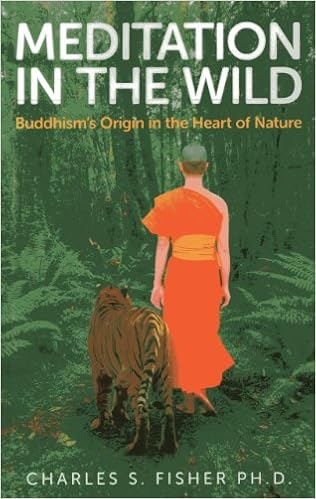
In Meditation in the Wild: Buddhism's Origin in the Heart of Nature, Charles S. Fisher writes:
"Buddhism was born in the forests of India. [...] The Buddha found his original revelation while practicing as a forest monk. [...] He developed an understanding of nature which would become part of the remedy he proposed for the problem of human discontent. [...] He chose wild nature - the evolutionary context in which humans arose - as the place to do this. [...] He went to the place in the human mind where there is understanding without words."
The next 315 pages go on to prove his thesis.

Not that it's easy; as a quotation from Theravada scholar Richard Gombrich points out:
"So much of the material attributed to [the Buddha]… is so obviously inauthentic that we can suspect almost everything. In fact, it seems impossible to establish what the Buddha really taught. We can only know what early Buddhists believed he taught."
And this, as it happens, is very different from what we've been told. For example, some of their records maintain that Gautama encountered his famous Four Sights on the way to the forest, where he sat and pondered what he saw. Others suggest that the pivotal debate between Mara and Gautama on the eve of his Enlightenment was actually about the Devil's contention that the young man had no right to strive to end suffering. All those statues of him touching the earth, they contend, depict him saying, "Check it out, dipstick: I'm home. Go find someone who cares."

But outdoor practice was hard – even harder than it is now – with dangerous wildlife and tribal warriors still ruling the outback, and the impulse to organise was strong. Yet The Kindred Sayings of Kassapa show the Buddha "bemoan[ing] the passing of the forest way of life and criticis[ing] those who depart from it"; he may have gone so far as to advocate a straight-up return to hunter-gathering, according to texts that describe his sangha living off the land, hunting game, and never returning to the Red Dust World. The fact that Buddhism spread to new lands precisely as Indian forests were clearcut leads one to wonder what exactly the motivations of those first "missionaries" were. (It also throws intriguing light on the Bodhidharma story. Canon holds that when asked why he came all the way to China to sit under a tree, he replied: "Because this is the best tree in the world." Perhaps his actual words were something like, "Because you still have trees.")

Conjecture aside, the founding generation of Buddhists exhorted aspirants to imitate Gautama literally. Mahakasyapa, a member of the Buddha's inner circle, died a loud and proud hermit, as did no less than Sariputra, of Heart Sutra fame. Finally, reports of early Western observers – Greek travellers – confirm that the first Buddhists were itinerants, without clergy or temples.

But as the movement grew respectable and sedentary, hermits were increasingly viewed as "unsocial, possibly antisocial, and potentially dangerous to established Buddhism." This last repeated pious tales of the Buddha's forest practice, but openly discouraged others from emulating it. Old-school monks, known as "mahallas", were accused of backsliding and dissolution and reviled by the ordained. (Some verses quoted in Wild are stunningly similar to the rant St. Benedict unleashed on Sarabaites and Gyrovagues at an identical stage in Christian history.)

To be sure, over the past 2500 years Buddhist back-to-the-landers have continued to crop up; modern Zen and Theravada are remnants of two such rebellions. Possibly Wild's greatest gift is the two and half millennia of these forgotten reformers it lifts from obscurity. Along the way its author weighs the relative merit of individual cases. He reviews Issa's suburban eremiticism, which echoes most current hermit practices, with guarded approval, but – interestingly – takes Bashō, Ryokan, and Kamo No Chomei firmly to the woodshed.

And that's where I get off the train. In these passages, Fisher reminds me of Thoreau's critics, calling down suspects for claims they never made. His indictment of Bashō does ring, but he repeatedly spins individual innovation in self-directed practices as weak or duplicitous; in the case of Ikkyu, he indulges in crass bourgeois morality. Somehow, in all of his research on us, he missed our core vow: "I will neither take nor give orders." I may raise an eyebrow at others (OK: I do raise an eyebrow at others) but ultimately I have no right to deplore them. Licence to judge is a delusion of the ordained.

But this mild annoyance in no way diminishes the significance of Fisher's work. His journalism is both intrepid and thorough, penetrating the Thai forest lineage – a modern restoration movement – at length and documenting the gradual deterioration of Zen, from Bodhidharma's boldly-planted hermit flag, to the dismissal of 19th century hermit Ryokan (his own beefs with him aside) as a "lunatic". He finishes with an account of his own brushes with eremitical practice (Fisher is not a practising hermit per se, but is attracted to our forms) and a light survey of four contemporary American hermits. All in all, it's the most comprehensive treatment of the subject I've found anywhere.

And I found it impossible to put down. With any luck, Meditation in the Wild will stand for many years as Eremitical Buddhism 101 for sincere students of the Buddha's way.

Thursday, 6 August 2015

Enlightenment Kyôsaku

Toyokuni II - 8 Famous Views (Meisho Hakkei), Night Rain at Oyama (Maya Mountain)

Why chatter about enlightenment?
Listening to the night rain on my roof,
I sit comfortably, with both legs stretched out.

Ryokan


(Photo of woodblock print Night Rain at Oyama, by 二代目 歌川豊国 [Utagawa Toyokuni II], courtesy of William Pearl and Wikimedia Commons.)

Thursday, 19 June 2014

Hut Lust

You know when you're researching a blog article and then you run across something entirely unrelated thanks to Google's arcane search algorithms, but it's so awesome you stop writing about that other thing and write about this one instead?

I love that.

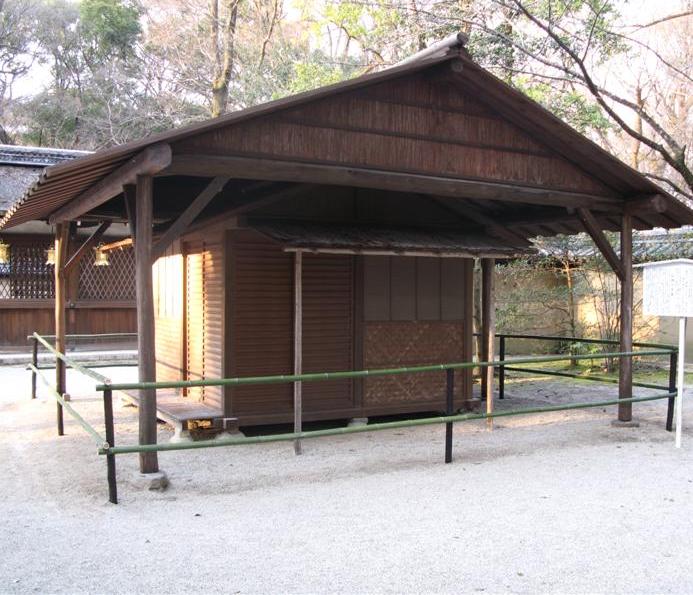
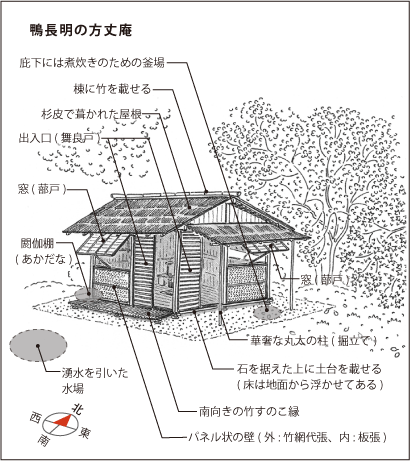
Some time ago I wrote a post about suitable shelters for forest practice. Now I find that some scholarship into that subject has already been done, thanks to interest in Kamo no Chômei. Buddhist hermit of indeterminate lineage, Chômei is most famous for his essay Hôjôki (方丈記), or The Ten Foot Square Hut. And you'll never guess what that essay is about.

To this day there's a certain amount of fascination with his accommodations among fans. Very few of whom, interestingly, are in the English-speaking world. That the most complete and succinct source I could find was Japanese is perhaps not so surprising, but even the runners-up were German and Hungarian. (One wonders if their appreciation of Chômei might be insight into their cultures.)

Anyway, having perused these blueprints in three languages, I'm prepared to certify them. Chômei's hut looks entirely serviceable, without being excessive, and a fitting counterpart to the similar cribs of Ryokan, Issa, and Thoreau.

Perhaps the man himself put it best:
But in this little impermanent hut of mine all is calm and there is nothing to fear. It may be small, but there is room to sleep at night, and to sit down in the day-time, so that for one person there is no inconvenience. […] If one knows himself and knows what the world is he will merely wish for quiet and be pleased when he has nothing to grieve about, wanting nothing and caring for nobody.


UPDATE, 21 June 2014: A reader directed me to this excellent video tour of Kamo no Chômei's hut. Check it out!


(Photo of Kamo no Chômei's preserved hut by David Dorsey; diagrams by アトリエかわしろ一級建築士事務所 and Carpe Diem Teaház.)

Thursday, 27 December 2012

New Year's Performance Review


Last year, a foolish monk.
This year, no change.

                     Ryokan

Friday, 11 February 2011

Bite Me, Batman!

Candid portrait of my practice:
written and recorded teachings;
 twine and rings for making fudos; 
 mat where my bowl rests; 
laptop, sole link with the outside.
I'm often questioned about my monastic practice, since I don't wear vestments or live in a monastery. It's a fair question. Here's a fair answer.

Christ and the Buddha defined monastics in astoundingly similar terms: They answer a unique call and walk a personal path. They reject personal ambition, and family and social obligation. Though encouraged to seek each other out for wisdom and solace, they are self-ordained. Neither Jesus nor Gautama recognised any other clerical model.

Such renunciates are called monks, from the morpheme mono-, meaning "single."

Unfortunately, as individuals who follow a personal call and have no use for human authority or the credentials it sells, we quickly fell afoul of power. As a result, The Man redefined the word as "one who lives in a monastery," that is, a "place where people are alone together." (Hey, don't look at me.) Monasteries are owned and operated by The Establishment, which claims sole right to train and ordain residents. Let's be clear: there is no scriptural basis for this presumption, or this practice.

Today, ordained monastics have all but wiped alternatives from memory, so that an old-school monk like me risks being labelled a fraud for claiming the title. But I do anyway.

Later we stick-and-sandal types took the term hermit, by way of clearing up the confusion, but this too has become problematic. For starters, it calls up images of a crotchety old man who hates people and lives in the woods and never bathes. And I'm not that crotchety.

By whatever name, monastics who live by a rule of their own authorship have been around since the first human suspected there was more to life than the opposable thumb. To my certain knowledge, only the Roman Catholic church recognises us officially today. And the Vatican has been under pressure to ordain us ever since, but so far, successive popes have defended the eremitic vocation.

I confess I'm a bit envious of my Catholic brothers and sisters. Thanks to papal protection, there is now a sanctioned hermit movement within the Church that helps to dampen, if not eradicate, the sniping. Most Catholics I meet have still never heard of us, but the ordained monastics have, and that's huge.

Zen, sadly, is another matter. Although one of the most hermit-bound traditions on earth, the current Zen establishment is largely hostile to free-range monks. It's koanic, really: the Buddha was a hermit; Bodhidharma was a hermit; Huineng, father of all extant Zen lineages, was arguably a hermit; Ryōkan, one of our most beloved ancestors, was a hermit; Ikkyū, whose teachings are an essential antidote to Buddhist hypocrisy, was a hermit. But the Asian cultures in which Zen is rooted have a demonstrable contempt for individual initiative, and that has led us into a cul-de-sac of guru-worship. Today, Zen hermits are often accused of imposture and egotism for living the Buddha's own given precepts. The resentment is mutual and conspicuous, particularly in the West, where autocracy is dimly viewed and self-sufficiency a virtue.

For the record, I consider ordained monasticism legitimate, and even necessary. Alright, it's not scriptural. So what? Stuff doesn't have to come from the sutras to be valid. If it weren't for monasteries, what would I study? Most Zen teachings are generated, and all are curated, by ordained monks. The typical hermit has been inside before. I have done, and am likely to do again. The monastery is an important touchstone, and a weighty counterbalance to the hippy-dippy narcissism of hermitry. I shudder to think what we would become without it. Finally, it's an effective, irreplaceable practice for many who are drawn to that path, as synonymous to their lives as mine is to mine.

In sum, if I had a million dollars, I'd give it to a monastery. What the hell is a hermit gonna do with money, anyway?

But when the ordained sangha dismiss us homeless brothers as heretics or wannabes, or insist that our sacred birthright path leads nowhere but astray, then I just have to say it, loud and clear:

"Yo, Batman! You got a problem, you talk it over with the Buddha. I got more important lives to live."