Showing posts with label cabin. Show all posts

Thursday, 21 September 2023

My Hermit Hut

I've been feeling a bit nostalgic about the old meditation shed I had down at the beach, and it struck me that I've never actually posted on it, though others' huts have appeared here several times. (I did upload a named exterior shot ten years ago on Wordless Wednesday, but the others that have appeared from time to time were illustrating other topics, and so not identified.)

So in the interest of completism, here it is.

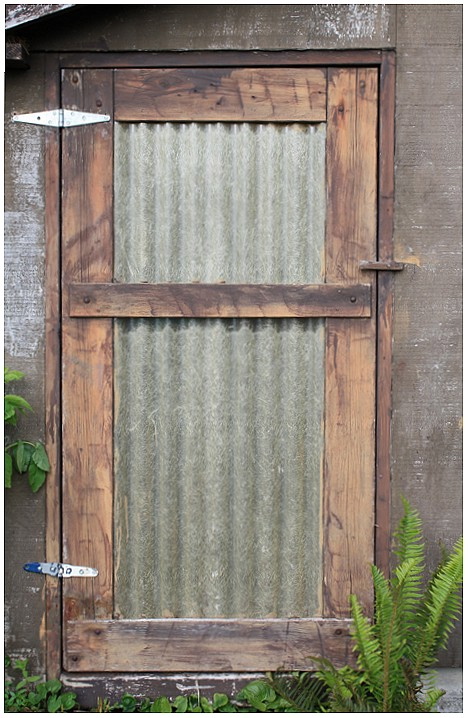
This tiny shack, the very picture of a true purist's definition of "hut", started life as my grandmother's potting shed. My grandfather carved it out of the bluff below their house, where I lived for ten years during the formative period of my Zen practice. When I arrived, the house and grounds were both in dire condition; eventually I hacked my way down to this cinderblock shanty, re-opening a steep, eroded goat trail through impenetrable brush. The door, which had been kicked in by a winter storm, lay on the floor inside; only the twisted wreckage of the lower hinge was still nominally attached.

In the intervening years blackberry and honeysuckle had invaded and filled the interior, along with bracken, lady fern, and infant trees, and the roof and wooden parts had rotted in places. Its concrete floor was completely saturated, covered with standing water and mud from infiltrated silt.

I really didn't need a place to sit, as the house – high on a bluff above the grey Pacific, with few neighbours – was already the best hermit hut in history. But rehabilitating one of my grandmother's work stations was an attractive premise, and the place would provide ground-level, fundamentally outdoor meditation, which I always prefer when available.

So I set-to, and after a lot of concentrated effort and scrounging of materials, ended up with this serviceable little squat. I even once sat an all-night sesshin there, hoping to glimpse the bear that left scat in front of it. (I didn't, but I did learn, not for the last time, that spring nights on the North Pacific are bitterly winter-cold.)

So here it is, my own hermit hut. Or to be perfectly accurate, my monastic playhouse. It might not have been strictly necessary, but I learned a lot of Zen there.

Wednesday, 14 September 2022

WW: Van Gogh's bedroom


(This is the bedroom in the cabin I posted about last Wednesday. It occupies the entire second storey, and is uncannily like stepping into a Van Gogh painting. The friends who built it say that was entirely unintentional.)

Appearing also on My Corner of the World.

Wednesday, 7 September 2022

WW: Remote radio shack

(Friends lent me this tiny cabin high on a forested ridge to use as a radio shack for two weeks. One of the nicest and most radio-friendly sites I've operated. And an excellent hermit hut.)

Appearing also on My Corner of the World.

Thursday, 30 July 2015

Hermits Arrive


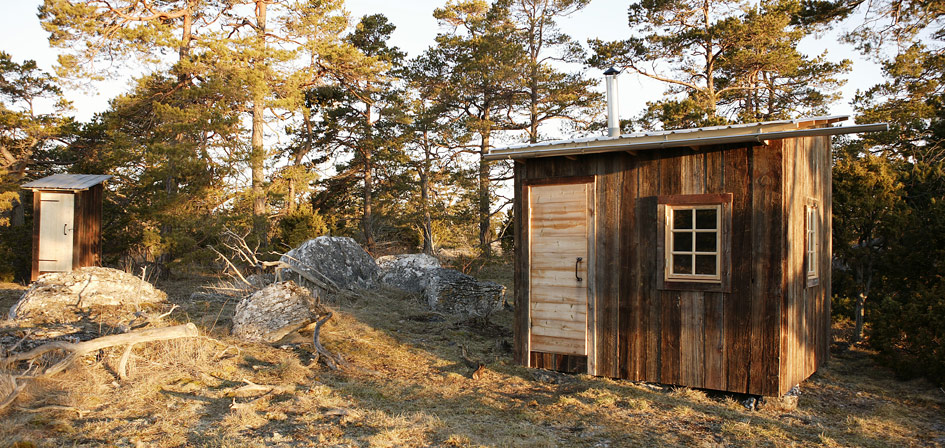
So I'm doodling around on the Enlightenment Superpath, and I surf into Arvesund, a Swedish company that makes prefab outbuildings. I browse through attractive garden sheds, summer cabins, sauna houses, and the odd lusthus, when suddenly I discover their Eremitens koja: a purpose-designed, so-designated hermit hut, from the drawing table of architect Mats Theselius!

My price inquiry to the company has gone unanswered, but another firm sells a kit to these lines, made entirely of recycled wood, for 96 500 Swedish kronor (about $11,300 Yank, at current rates). Models with new-wood exteriors sell for 79 500 SEK ($9,300 US); new wood overall for 67 500 SEK ($7,900US).

This is not the kind of money a hermit carries around; I could build at least eight such cabins for the cost of that lowest-price model. (Four, with woodstoves.) But I gotta hand it to the designer: he gets it. If it's true that some of the serving suggestions in Arvesund's literature are a bit, shall we say, spiritually encumbered, the dimensions and basic accommodations are entirely on-spec. This is indeed "just enough". Good on ya, Mats!

But the mere existence of this product raises a burning question: are we hermits becoming that thing that all populations must be to have legitimacy in the Red Dust World: a market? Will those glossy up-market magazines that pass for the Buddhist press soon be carrying adverts for elegant artisanal Japanese rice kettles and fair-trade rushlights made by Indonesian villagers?

Estimated Category of Risk: NBL.


(Photographs courtesy of Arvesund; front view located on Materialicious.com; interior and side view courtesy of Poppytalk.com; specs courtesy of SW Byggritningar AB.)

Thursday, 19 June 2014

Hut Lust

You know when you're researching a blog article and then you run across something entirely unrelated thanks to Google's arcane search algorithms, but it's so awesome you stop writing about that other thing and write about this one instead?

I love that.

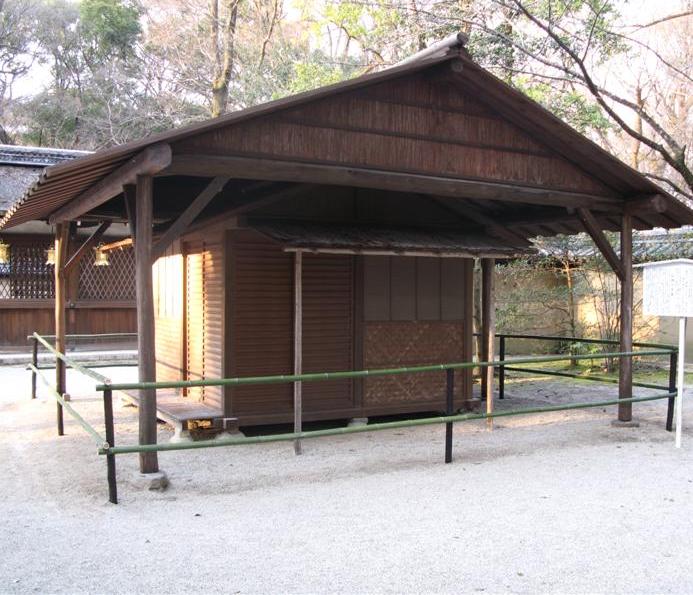
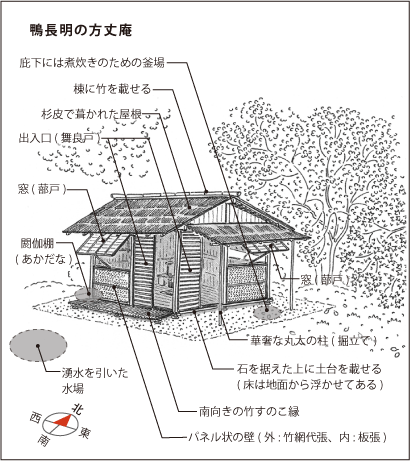
Some time ago I wrote a post about suitable shelters for forest practice. Now I find that some scholarship into that subject has already been done, thanks to interest in Kamo no Chômei. Buddhist hermit of indeterminate lineage, Chômei is most famous for his essay Hôjôki (方丈記), or The Ten Foot Square Hut. And you'll never guess what that essay is about.

To this day there's a certain amount of fascination with his accommodations among fans. Very few of whom, interestingly, are in the English-speaking world. That the most complete and succinct source I could find was Japanese is perhaps not so surprising, but even the runners-up were German and Hungarian. (One wonders if their appreciation of Chômei might be insight into their cultures.)

Anyway, having perused these blueprints in three languages, I'm prepared to certify them. Chômei's hut looks entirely serviceable, without being excessive, and a fitting counterpart to the similar cribs of Ryokan, Issa, and Thoreau.

Perhaps the man himself put it best:
But in this little impermanent hut of mine all is calm and there is nothing to fear. It may be small, but there is room to sleep at night, and to sit down in the day-time, so that for one person there is no inconvenience. […] If one knows himself and knows what the world is he will merely wish for quiet and be pleased when he has nothing to grieve about, wanting nothing and caring for nobody.


UPDATE, 21 June 2014: A reader directed me to this excellent video tour of Kamo no Chômei's hut. Check it out!


(Photo of Kamo no Chômei's preserved hut by David Dorsey; diagrams by アトリエかわしろ一級建築士事務所 and Carpe Diem Teaház.)

Thursday, 5 September 2013

Hermitcraft: Shelters For Forest Practice

The interior of Thoreaus original cabin replica, Walden Pond

Thoreau's cabin at Walden
My decision to live in a tiny tent during my 100 Days on the Mountain, rather than more comfortable quarters, was largely influenced by my determination to live in the forest, rather than just near it. (It was also my only option when I thought I'd have to sit on public land.) But in the doing I discovered that a cabin is necessary to do this right; it spares you practice-robbing work and health risks. Let's be clear: by "cabin", I mean four walls and a roof. A shepherd's trailer; a wall tent; a tool shed; a plywood hut; eight by twelve of simple headroom. More, and you're no longer in the woods.

• Your shelter should have as many windows as possible, for morale and to keep you "in-frame". A broad, wrap-around opening in the walls, screened and shuttered, is perfect. A roofed porch or awning is also useful.

• As I learned, a woodstove can be invaluable in northern climes, even in summer. Otherwise it can be impossible to stay clean; you can't dry your clothes and it's difficult to bathe through cold and rainy weeks. The small portable models they make for hunters are fine.

Shepherd's trailers
• Since cooking on a woodstove is an arcane skill, uncomfortable in warm weather and time-consuming, you'll need a camp stove as well. A single propane or butane burner is entirely adequate and can be used indoors with adequate ventilation.

• Take pains to secure a comfortable cot and a good pillow; unbroken sleep is vital to effective practice.

• You will also need a table and chair. Lack of comfortable seating is a technique governments use to torture prisoners. They do not become enlightened. (Mandarin or convict.)

• Install shelves or cabinets, and a variety of hooks, for storage.

Simple garden shed
A corrugated metal roof and/or sides makes for a fast and solid building, fine for one-season use. A corrugated plastic roof, light to carry and cheap to buy, also acts as a skylight. A wood floor, while not necessary, makes staying clean a lot easier. (If using a tent, consider a plywood platform, a sewn-in floor, or at least a heavy canvas ground cloth.)

Finally, it's a good idea to make whatever structure you choose as neat as possible. People are already suspicious of us. You don't want to give those Ted Kaczynski references any free hand.

Basically, you want something that's dirt-basic but a whole lot cleaner. Then raise the Bandana Ensign in the dooryard and bust some suffering!

UPDATE, 19 June 2014: see my post on Kamo no Chômei's classic hermit hut.

UPDATE, 30 July 2015: Swedish architect draws designer hermit digs! Read about it here.

(Adapted from 100 Days on the Mountain, copyright RK Henderson. Photos: Thoreau's cabin (Tom Stohlman) and shepherd's trailers (John Shortland) courtesy of Wikimedia Commons; simple garden shed from Sheddiy.com.)

Thursday, 11 July 2013

Good Book: Walden (2004 Yale Edition)

I tried to read this book when I was in high school, at the instigation of teachers who swore I was the living tulku of Henry David Thoreau. The brilliant American Transcendalist kicked my butt; his peripatetic sentences, cluttered with puns on European history, Greek and Latin classics, and Hindu scripture, run for days. Just the 26,000-word introductory digression is an admission ordeal worthy of Zen monasteries. It's also the reason that for years I only read excerpts.

Nor was I alone; even in Thoreau's (better educated, less fatuous) day, modest sales forced him to live off prosaic jobs and the support of wealthy friends. But when I came off the mountain, I was finally motivated to read this seminal work of hermit literature. Turns out it's a work of genius. Who knew?

Walden; or, Life in the Woods is the record of one man's classic eremitical experiment: from 1845 to 1847, Thoreau lived in a primitive hut on eleven acres beside the pond of that name, situated outside Concord, Massachusetts. There he applied the timeless formula, living as close to the ground as possible, in order to minimise distractions from the Truth. (The book, which appeared in 1854, distils his experiences to a single year.)

Ango and advanced age haven't thinned Thoreau's dense paragraphs, but this time the rewards kept me hacking. Thoreau is the Elijah of our time, calling down the profligacy of commercial morality. His meditations on the hypocrisy of industrial culture, its lazy ethics and poverty-mill economics, are either exhilarating or depressing, depending on your perspective: a century and a half have made no dent in their relevance. Take his debunking of the myth that the rich repay in "job creation" what they cost society:

"Some show their kindness to the poor by employing them in their kitchens. Would they not be kinder if they employed themselves there? You boast of spending a tenth part of your income in charity; maybe you should spend the nine tenths so, and done with it."

More masterful is a dissection of capitalist theoretics, in which Thoreau calculates the true cost of train fare to nearby Fitchburg. With accountant-like precision he audits the passenger's entire expenditure, and demonstrates at last that it's not only cheaper, but actually faster, to walk. "We do not ride the railroad," he concludes. "It rides upon us."

Walden positively hums with such wry reflections. Some have become famous:

"If I knew for certain that a man was coming to my house to do me good, I would run for my life."

"In the long run, men hit only what they aim at."

"Most men lead lives of quiet desperation [and go to the grave with the song still in them]."

It also carries a surprising tonnage of jokes:

"Not long since I was present at the auction of a deacon's effects, for his life had not been ineffectual."

"…called a 'man of colour', as if he were discoloured…"

"Is [Sir John] Franklin the only man who is lost, that his wife should be so eager to find him?" (A bit of CanCon there.)

We don't normally think of Thoreau as a stand-up comic (Walden also contains one of the few toilet jokes in 19th-century literature), but it would not be farfetched to call him the George Carlin of antebellum America.

And that's just one facet of an enormously rich vein of insight. You also get Thoreau's detailed observation of flora, wildlife, and natural phenomena; his expertise on simple, joyful cuisine; his research in local history; his (occasionally racist; sorry, Ireland) encounters with other cultures; and his engaging reports on the daily-daily of livin' low.

I strongly advise, nay implore, readers to get the 2004 Yale edition of Walden, annotated study-Bible fashion by Jeffrey Cramer. (See photos.) His comprehensive notes, amounting to a second, parallel book, elucidate Thoreau's antiquated terminology, regionalisms, and scholarly allusions that were already obscure the day he wrote them. With Cramer's help, these lines not only cease to be stumbling blocks, they become some of the most enjoyable passages in the work.

Thoreau was neither the first hermit nor the last, but he remains one of the best. His literary power and sheer American modern-ness are gifts for our time. His masterpiece can be hard going for the first few pages, but once you pick up its rhythm, it's hard to put down. Don't forget to use a full sheet of paper for a bookmark, and have a pen handy to write down your favourite quotations.

Thursday, 13 October 2011

My Hermit Hut

I've been feeling a bit nostalgic about the old meditation shed I had down at the beach, and it struck me that I've never actually posted on it, though others' huts have appeared here several times. (I did upload a named exterior shot ten years ago on Wordless Wednesday, but the others that have appeared from time to time were illustrating other topics, and so not identified.)

So in the interest of completism, here it is.

This tiny shack, the very picture of a true purist's definition of "hut", started life as my grandmother's potting shed. My grandfather carved it out of the slope below their house, where I lived for ten years during the formative period of my Zen practice. When I arrived, the house and grounds were both in dire condition; eventually I hacked my way down to this cinderblock shanty, re-opening a steep, eroded goat trail through impenetrable brush. The door, which had been kicked in by a winter storm years before, lay on floor inside; only the twisted wreckage of the lower hinge was still nominally attached.

In the intervening years blackberry and honeysuckle had invaded and filled the interior, along with bracken, lady fern, and infant trees, and the roof and wooden parts had rotted in places. Its concrete floor was completely saturated, covered with standing water and mud from infiltrated silt.

I really didn't need a place to sit, as the house – high on a bluff above the grey Pacific, with few neighbours – was already the best hermit hut in history. But rehabilitating one of my grandmother's work stations was an attractive premise, and the place would provide ground-level, fundamentally outdoor meditation, which I always prefer when available.

So I set-to, and after a lot of concentrated effort and scrounging of materials, ended up with this serviceable little squat. I even once sat an all-night sesshin there, hoping to glimpse the bear that left scat in front of it. (I didn't, but I did relearn, not for the last time, that spring nights on the North Pacific are bitterly winter-cold.)

So here it is, my own hermit hut. Or to be perfectly accurate, my monastic playhouse. It might not have been strictly necessary, but I learned a lot of Zen there.