Showing posts with label France. Show all posts

Thursday, 19 April 2018

Hermitcraft: Pickleweed

Unlikely as it seems, this common plant of the high tide line (Salicornia spp.) is a member of the spinach family, and a righteous edible in its own right. Common names include sea bean, samphire, sea asparagus, and glasswort, but when I was growing up on the North Pacific coast we called it pickleweed.

Salicornia is delicious raw, and adds salty crispness to salads and sandwiches. (Egg salad and hamburgers being two of my favourites.)

The name "pickleweed" may come from the fact that Old Settlers jarred and pickled it; the French, among others, still do.

Or maybe it just looks like pickles. (Likewise, "sea beans" is a reference to its visual and culinary resemblance to string beans.)

The larger, mature stems, which develop a stronger, "greener" flavour, can be steamed, then the entire branch placed in the mouth and the twiggy, woody heart pulled out by the base. This novel dish is a great accompaniment to fish and seafood, and can be enjoyed with or without lemon butter. Salicornia is also one of several marine vegetables layered into New England clambakes for flavour.

In Bretagne, where it blankets whole acres, farmers run flocks of sheep on pickleweed to produce a rare and expensive delicacy called agneau pré salée (salt-pasture lamb).

Finally, the term "glasswort" recalls glassmakers of times past who burned it in large quantities to make soda ash for their craft. And Salicornia may be on the industrial rebound these days, as it's currently being investigated as a biodiesel crop.

Pickleweed is one of those plants many have seen but few have noticed; most only know it as the weed they pass on the way to the tidelands. But because it sets in quantity, is easily identified, and good eating, it's a valuable edible to know.

So keep an eye out for Salicornia in your beach rambles. This uniquely delicious wild food may significantly enrich the experience.

Thursday, 4 February 2016

Good Song: Toujours debout


Renaud was one of the heroes of my youth. Equal parts Springsteen and Dylan (to whom his voice bears an unmistakable family resemblance), his lyrics have a Villonesque flourish that only a French proletarian poet could wield. Throughout the 70s and 80s he was the public conscience of his country – often much to its dismay. Calling down national hypocrisies and – unforgivably – making merry with the French language, Renaud kept the whole nation turning on a spit.

Then he married and became a father. Some whined about the conjugal turn some of his songs took, but the halogen candour he once brought to politics he now turned on domestic life. His love songs were devastating: an adulterer begs his wife not to leave, without quite being able to articulate why not; a parent forbids the child he's just beaten to run away from home.

And then Renaud just… disappeared. Much later we'd learn that he'd poured so much alcohol on his family that his wife took the kid and left. Then he lost his recording contracts. Then his friends.

One morning eight years later he woke, showered and shaved, and called his old studio to book time.

"Not possible," he was told.

Why not?

"Renaud is dead."

Renaud assured him he was not, but with that implacability only those who know the French can fully conceive, the voice on the phone would not relent.

In the end he had to call a collaborator from his previous life, and, after a similar conversation, ask him to call the studio and book time.

The result of those sessions was 2002's Boucane d'enfer (a play on "unholy racket" and "whiff of Hell"), Renaud's all-time bestselling album.

I wish the story ended there, but sadly the intervening years have brought relapses: lost weekends, lost weeks, lost months; a second wife departed with a second child. Renaud battles addiction like a rat with a boa constrictor: he survives, but he doesn't win.

And the press haven't been kind, to say no more.

Which is why this song, appearing after yet another long silence, belted out in Renaud's trademark working-Paris growl, grown breathless and broken, hit me so hard.

Because it sounds just like him, and so different. Because his voice reminds me of my past, and also of my own serial resurrections. And because I've always loved curses spat in the face of a bully.

Here-follow the lyrics. As usual the translation is mine, and it's been the usual heartbreaking grind. How do you land the one-two punch of « Qui me dépriment, et qui m'impriment » with the English "Who depress me and print me?" (You'll see what I went with below.)

There's also profound poignance in a hooligan like Renaud suddenly opting for the inoffensive; « nom de nom », a softer form of the French "God dammit!", has a pathos that "dang it" doesn't really convey.

More globally, the song just comes off as more petulant and defensive in English. The original French is more along the lines of "nice try, dickweeds", with a warm sense of renewal and reunion.

But not to translate would leave non-francophone readers in the dark, and that's not something I'm prepared to do.

So, with apologies for the treason, the gist:

TOUJOURS DEBOUT
par Renaud

Toujours vivant, rassurez-vous
Toujours la banane, toujours debout
J'suis retapé, remis sur pieds
Droit sur mes guibolles, ressuscité
Tous ceux qui tombent autour de moi
C'est l'hécatombe, c'est Guernica
Tous ceux qui tombent, tombent à tour de bras
Et moi je suis toujours là

Toujours vivant, rassurez-vous
Toujours la banane, toujours debout
Il est pas né ou mal barré
Le crétin qui voudra m'enterrer
J'fais plus les télés, j'ai même pas internet
Arrêté de parler aux radios, aux gazettes
Ils m'ont cru disparu, on me croit oublié
Dites à ces trous du cul, j'continue d'chanter

Et puis tous ces chasseurs de primes
Paparazzis en embuscade
Qui me dépriment, et qui m'impriment
Que des ragots, que des salades
Toutes ces rumeurs sur ma santé
On va pas en faire une affaire
Et que celui qui n'a jamais titubé
Me jette la première bière

Toujours vivant, rassurez vous
Toujours la banane, toujours debout
Il est pas né ou mal barré
L'idiot qui voudrait m'remplacer
Je dois tout l'temps faire gaffe
Derrière chaque buisson
A tous ces photographes
Qui vous prennent pour des cons
Ceux là m'ont enterré
Un peu prématuré
Dites à ces enfoirés j'continue d'chanter

Mais je n'vous ai jamais oublié
Et pour ceux à qui j'ai manqué
Vous les fidèles, je reviens vous dire merci
Vous m'avez manqué vous aussi
Trop content de vous retrouver
Je veux continuer nom de nom
Continuer à écrire et à chanter
Chanter pour tous les sauvageons

Toujours vivant, rassurez-vous
Toujours la banane, toujours debout
Il est pas né ou mal barré
Le couillon qui voudra m'enterrer
Depuis quelques années, je me suis éloigné
Je vis près des lavandes sous les oliviers
Ils m'ont cru disparu, on me croit oublié
Ces trous du cul peuvent continuer d'baver
Moi sur mon p'tit chemin j'continue d'chanter

Still alive, rest assured
Still smiling, still standing
I'm reconditioned, back on my feet
Steady on my pins, resuscitated
People falling all around
This place is a slaughterhouse, it's like Guernica
All these people falling, discarded en masse
And me still here


Still alive, rest assured
Still smiling, still standing
Ain't been born, or else just out of luck
The jerk who's gonna bury me
Don't do no more TV, don't even have Internet
Don't talk to radio or newspaper types
They thought I was dead, think I'm forgotten
Tell those assholes I'm still singing

And then all those bounty hunters
Ambush paparazzi
Who depress and im-press me
All the scams and scandals
All these rumours about my health
We won't pay them any mind
And let him who has never stumbled
Buy the first round

Still alive, rest assured
Still smiling, still standing
Ain't been born, or else just out of luck
The jerk who's gonna displace me
I gotta always look
Behind every bush
For those photographers
Who think you're all dumbshits
Those guys buried me
A bit too soon
Tell those jackasses I'm still singing

But I never forgot you
And to those who missed me
You the faithful, I'm back to say thank you
I missed you, too
Delighted to see you're still here
I want to carry on, dang it
Carry on writing and singing
Singing for all the untamed

Still alive, rest assured
Still smiling, still standing
Ain't been born, or else just out of luck
The wanker who's gonna bury me
I've been away for a few years
Living close the ground, beneath the olive trees
They thought I was dead, they think I've been forgotten
Let the assholes blather on
Here on my little journey, I'm still singing


Renaud Printemps de Bourges 1978 (crop)


(1978 photo of Renaud Séchan courtesy of Paul Kiuj and Wikimedia Commons.)

Thursday, 27 August 2015

Good Podcast: San Francisco Zen Centre Dharma Talks

San Francisco is the capital of Western Zen. The sangha there – the Western one; Asian residents were already practicing for over a century – is one of the oldest in the world, founded by Shunryu Suzuki in 1961. Today, most Zen teachers in this hemisphere have some connection with it, whether formal or incidental. (That's Soto teachers; Western Rinzai is less centralised, Korean Zen is bipolar – it has two power centres – and Thich Nhat Hanh's Vietnamese lineage is anchored in France.)

Today's SFZC is a freakin' 900-pound gorilla among spider monkeys, with three houses, an expansive endowment, and a giant sangha consisting largely of priests and priests-in-training. We hermits like to sneer about "enlightenment factories", but this-here really is.

On the other hand, it's nice to have a secure, established hub you know will be there tomorrow: reassuringly conservative, largely unchanging, eschewing relevance and doctrinal debate, and grinding out priests like a latter-day Ireland, who in turn produce reams of teachings for world consumption. In sum, SFZC – its history, its current role, the nature and limits of its authority – is a big topic among Zenners. Few of us exercise don't-know-mind in its regard.

But I'm not going to weigh in. Instead I'm going to direct you to their Dharma Talks podcast; for my money, one of Rome on the Bay's most valuable products. (To begin with, I don't have any money, and all of the teishos in SZFC's bottomless digital databank are free.)

The talks cover every Zen topic under the sun, in every style, as SFZC's diverse clerical corps take turns at the mic. A few of these lectures have about saved my life, when it needed saving. Others leave me more or less unchanged, but they're all useful and productive.

Anyway, dig it, brothers and sisters: there are a lot of them.

SFZC's podcast homepage includes links to such automatic delivery options as iTunes and RSS, as well an archive of the podcasts themselves – one per week right back to 2007 – for individual download.

So if you're up for 300-odd ordained-types throwing down some serious Zen, swing on by San Francisco's perpetual Teisho Slam. Whatever you need, you'll find it there.

Thursday, 18 June 2015

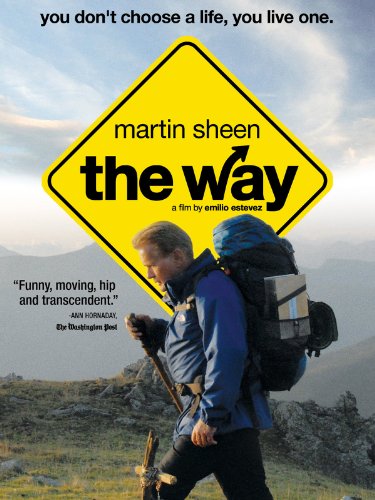
Good Movie: The Way

The Way is a movie you've seen a dozen times: angry/critical/selfish/
disapproving/distant father comes to regret his bullheaded incompetence at the whole human thing. It's also a movie you've never seen before, and I recommend that anyone who has a dad, or is a dad – or is a man, or knows a man – remedy that.

The plot, as I said, is well-travelled, but what saves the film from that (and sometimes itself) is its lead actor's astounding fluency in silence. If nothing else, The Way proves that if you want to make a movie about a man struck speechless by suffering, you're gonna need Martin Sheen. Guy's like the Robin Williams of stillness.

For reasons I can't reveal without spoiling, Tom Avery decides, without a lick of reflection or experience, to hike the Camino de Santiago. This ancient Christian pilgrimage route, winding through the daunting Pyrenees from one side of the Iberian Peninsula to the other, has lately become très chic among aging Boomers. But very few of them actually do it; as a range cop at the trailhead advises our hero, that takes two to three months. If you're in shape. And you have the fire.

Which Avery may; I'll leave that for viewers to discover. But in his desperate search for solitude, our man ends up, Jeremiah Johnson-style, a reluctant surrogate father to a gaggle of young, equally wounded fellow pilgrims. The fact that he has the same prickly dynamic with them that he has with his actual son, is a bit heartbreaking. Yet, pointedly, it works. The filmmaker seems to be telling us, in hauntingly familiar tones, that eighty per cent of fatherhood is just showing up.

Which is particularly bittersweet, given that filmmaker Emilio Estevez, who also wrote and directed the screenplay and played Avery's son, is in fact Martin Sheen's real-life son. All told, the project involved three generations of Estevez men – father, son, and grandson – before and behind the camera.

I was bemused, while researching this review, to find most commentary about The Way on Christian sites. Thus do we chop complex realities into simplistic tropes. Yeah, hiking the Camino is a Roman Catholic thing. And yeah, Tom Avery is Catholic (as are the Estevez family). His faith is apparently one of the tools he takes into the mountains. I say "apparently" because he never utters a Christian word. Neither, come to that, does anyone else; even a priest they meet is refreshingly circumspect. Nobody totes a Bible; nobody prays, at least not formally; nobody mentions Jesus. If it weren't for Avery's briefly crossing himself during a specific repeated ritual, you'd have no idea he was a believer. In anything.

Yet mainstream outlets seem terrified of the sectarian implications of a pilgrimage, while the Christian market glommed hard onto a film with a big-name star. (The fact that many sources were Evangelical underscores the general confusion over "whose" movie this is. Estevez has verified that this was a conscious strategy on his part.) Basically, The Way is several films; sooner or later, it ends up being about everybody.

But one way or the other (get it?), this is a very Buddhist film. C'mon, brothers and sisters: this whole "way-path-journey" thing is our metaphor, eh? And the Estevez spin it particularly well. I defy any Zenner, having seen The Way, to tell me it's a "Christian" movie. (And I defy any Christian to tell me it's not.)

Of course, the viewer-pilgrim is bound to get a few pebbles in his or her sandal along the road. There's a digression involving the Rom that reads like an episode from an old American TV series. The actors' raw commitment carries that off, but harder to dismiss is a subplot that plays smoking as poetic, inconsequential, even cute. It is none of those things. Hollywood is largely responsible for the perpetuation of this devastating – and goddam rude – addiction, and I earnestly wish it would grow the hell up and get over its teeny-bopper fascination with tobacco.

But the film survives this lapse, even if the character will not. Its
decidedly fly- (or walk-) by-night production model delivers scene after magnetically attractive, entirely authentic scene, drenched in immediacy. Estevez has a rare gift for spotting eloquent shots, and here he's inadvertently made one of the best tourist board adverts ever. Watching it, I'm thinking, "What this trail needs is a Zen hermit monk."

Best of all is the ending, which – and here I don't think I'm giving anything away – is realistically open-ended. This reviewer gets a little weary of cinematic "happily ever after" (and its evil twin, "broken forever") outcomes. Life goes on. It's easier to relate to, and to care about, lives that continue after the credits roll.

Why we keep making this movie over and over would be an excellent topic for a doctoral thesis. Why we keep watching it is grist for meditation. I highly doubt The Way will be the last damaged-dad picture ever made. I am equally sure that while some of its successors may be as good, none will be better.


Thursday, 1 January 2015

New Year's Song: Et dans 150 ans


To commemorate this New Year's Day 2015 I offer a meditation on the passage of time. My brother's poetry here is so powerful I first took him for a Canadian. But on second listening I thought, no.

No. The prosody, the peculiar flow of his French; his unflinching insight, his cool under fire. This-here is a Frenchman.

Except better. Raphaël Haroche's father is a Moroccan Jew of Russian descent; his mother is Argentine. In other words, dude's a perfect storm. Prepare for bone-crystallising kensho.

Having said that, I should warn non-francophones that, as Canadian literary critic Mavis Gallant pointed out, "When poetry is translated, the result is either not faithful, not poetry, or not English." Here the author spins kaleidoscopic metaphors and convoluted word play (e.g., "bad choices" can also be "wrong guesses"; "let's drink to the street trash" becomes "let's leave them our empty coffins" when you turn it a certain way); as translator, I could only pick a shade and run with it. With luck the music and intonations will salvage some lost depth (and soften the stilted, un-English sequence of images) for non-French-speaking readers.

Finally, since the visuals in Raphaël's videos are famous for being a whole second song, I strongly recommend that you first just listen, without viewing, while reading the lyrics (below). That way your own impressions won't get wangled. Then, play the video again and just watch it, without reading. Mind blown a second time.

ET DANS 150 ANS
par Raphaël

Et dans 150 ans, on s'en souviendra pas
De ta première ride, de nos mauvais choix,
De la vie qui nous baise, de tous ces marchands d'armes,
Des types qui votent les lois là-bas au gouvernement,
De ce monde qui pousse, de ce monde qui crie,
Du temps qui avance, de la mélancolie,
La chaleur des baisers et cette pluie qui coule,
Et de l'amour blessé et de tout ce qu'on nous roule,
Alors souris.

Dans 150 ans, on s'en souviendra pas
De la vieillesse qui prend, de leurs signes de croix,
De l'enfant qui se meurt, des vallées du Tiers monde,
Du salaud de chasseur qui descend la colombe,
De ce que t'étais belle, et des rives arrachées,
Des années sans sommeil, 100 millions d'affamés
Des portes qui se referment de t'avoir vue pleurer,
De la course solennelle qui condamne sans ciller,
Alors souris.

Et dans 150 ans, on n'y pensera même plus
À ce qu'on a aimé, à ce qu'on a perdu,
Allez vidons nos bières pour les voleurs des rues!
Finir tous dans la terre, mon dieu! Quelle déconvenue.
Et regarde ces squelettes qui nous regardent de travers,
Et ne fais pas la tête, ne leur fais pas la guerre,
Il leur restera rien de nous, pas plus que d'eux,
J'en mettrais bien ma main à couper ou au feu,
Alors souris.

Et dans 150 ans, mon amour, toi et moi,
On sera doucement, dansant, 2 oiseaux sur la croix,
Dans ce bal des classés, encore je vois large,
P't'être qu'on sera repassés dans un très proche, un naufrage,
Mais y a rien d'autre à dire, je veux rien te faire croire,
Mon amour, mon amour, j'aurai le mal de toi,
Mais y a rien d'autre à dire, je veux rien te faire croire,
Mon amour, mon amour, j'aurai le mal de toi,
Mais que veux-tu?

And in 150 years we won't
remember
Your first wrinkle, our bad
choices
How life screwed us over, and all those weapons dealers
Who work for the men who pass laws for the government
This pushy world, this screaming world
The march of time, the
melancholy
The warmth of the kisses, and how the rain trickled
And the love lost, and the ways they get you
And so we must smile.

In 150 years we won't
remember
How age subtracts, and hypocrisy crosses itself
The dying children, the depths of the Third World
The asshole hunters who blow away doves
How beautiful you were, and the things ripped away
The years without sleep, and 100 million hungry
How doors swing shut if people see you cry
The universal impulse to condemn without qualm
And so we must smile.

And in 150 years, we won't even recall
The things we loved, and those we lost
Come on, let's drink to the street trash!
My God, we'll all end up in the ground! Such a disappointment!
Just look how those skeletons sneer at us
But don't glare back; don't make war on them
They'll keep nothing of us -- or themselves -- in the end
As well cut off my hands, or burn them
And so we must smile.

And in 150 years, my love, you and I
Will be – softly, dancing – two birds carved on a tombstone
In this high school prom for dropouts, I'm looking beyond
Maybe we'll come back some day; shipwrecked, perhaps
But there's nothing for it, and I don't want to lie
My love, my love, I'll miss
you so
But there's nothing for it, and I don't want to lie
My love, my love, I'll miss
you so
But what can we do?


He's right, brothers and sisters. In 150 years, no-one will remember a thing we've done or said, or that we ever lived; for the vast majority of us, our very names will never be pronounced again.

You can take it for cruelty or compassion, but you can't change it. Our human being survives time like a beetle survives a millstone. And in the same form.

May we all cultivate, in the coming year, that which endures.