Last month I posted a story about Jia Ruhan, the Chinese opera and erstwhile pop star whose life has taken a turn for the eremitical.
Seems she's not alone. Apparently, fundamental monasticism is kind of a trend (not to say fad) in China today, particularly among the young. Turns out industrialisation and a market economy have fared no better there than elsewhere at supplying humanity's essential desires. And the mix of greater access to education and a system that ignores all but material needs has prompted a rush to the mountain.
Well, good on the Chinese. Others' responses to the same burn-out have been notably less rational.
Aeon Video made the brief but very rich mini-documentary above – just short of 11 minutes – about an appealing little skete in the Zhongnans that receives several of these latter-day pilgrims. Deep gratitude to Aeon for making it available to all, free of charge, on YouTube.
Sure looks cool. Wish we had stuff like this in the West. Cultural differences might preclude it, but I'd still like to give it the best and most resolute possible try.
I recently happened upon an interesting moment in Season 6, Episode 4, of Gimlet Media's Startup podcast. (Transcript here; download podcast from iTunes or wherever you get your podcasts.)
At issue is Jia Ruhan, a Chinese opera singer groomed to become her country's Céline Dion, with hopes she would put it on the international pop music map. Things didn't work out – such outcomes are hard to plan – and now she lives in self-imposed seclusion, having heeded a spiritual call.
At one point the interviewer asks:
"So as a kid, at first you wanted to be a dancer and then a musical star. Then the government has this goal to make you like a global star. What do you want to be now?"
To which Jia replies:
"I want to be a hermit. Truly, exactly, I really want to be a hermit."
A statement of which the young American reporter appears entirely to miss the import. Her voice takes a quizzical tone, as if Jia were joking. The interviewer then exposits:
"After Ruhan left the [pop music] project, she went through some big life changes. She made another album on her own, but after that, she realized she was burnt out and needed a break. She got really into Buddhism and silent meditation. Our two-hour phone call was the longest conversation she’d had in six months. So the state-backed pop star who was supposed to help China become cool… for now, she wants to be a hermit."
That last line is delivered with an ironic inflection, as if Jia had silently added "... or whatever."
I like this podcast. And nobody can know everything. But in this case, the production team dropped the ball. Jia Ruhan comes from a nation with a millennia-old continuing tradition of literal hermits: individuals who retreat to the Zhongnan Mountains to practice eremitical monasticism.
So she wasn't being cute when she referred to herself as a hermit. In point of fact, she aspires, or at least wishes, to be a hermit nun: a monastic practicing alone, under her own rule, almost certainly in the Zhongnans.
I had to smile at the reporter's reaction. It's a true cross-cultural miscue, turning on the fact that Anglophones currently use the word "hermit" pejoratively. ("Don't be such a hermit! Come out and talk to our guests!") In fact, we've used the term sardonically for so long that many of us can no longer define it; for most, it's become a synonym for recluse.
Which doesn't actually bother me. But I do get a little frosted when the Western Zen establishment calls hermits fraudulent and heretical – when not flat-out calling us extinct. Zenners should know better. Or hey, maybe just practice their religion.
It does seem that if a Communist dictatorship can accept, and even boast, the ur-monks in its midst, it's not too much to ask the rakusu set to back down a peg.
Anyway, I nodded while listening to Jia Ruhan talk about her ambitions. To say I totally get it would be an understatement.
Peaceful path, sister.
(Panel from Fan Kuan's Travellers Among Mountains and Streams courtesy of the National Palace Museum, Taibei, and Wikimedia Commons.)
I recently came upon this photo on Wikimedia Commons. According to the uploader, one Pranav Kumar:
"If you leave the well worn path and wander off into the Himalayas, you will find monks practicing here and there, in very inaccessible places. Not that off-beaten after all. Wonder how they get their food though."
Sounds like another vast outdoor hermit monastery, like the Zhongnan Mountains. I would like to hike that ground and meet some of these brothers and sisters.
One gets the impression that eremitical practice isn't as unheard-of in modern Asia as some Western descendants would have us believe.
"Throughout Chinese history, there have always been people who preferred to spend their lives in the mountains, getting by on less, sleeping under thatch, wearing old clothes, working the higher slopes, not talking much, writing even less - maybe a few poems, a recipe or two. Out of touch with the times but not with the seasons, they cultivated roots of the spirit, trading flatland dust for mountain mist."
He ends with a declaration: "Distant and insignificant, they were the most respected men and women in the world's oldest society."
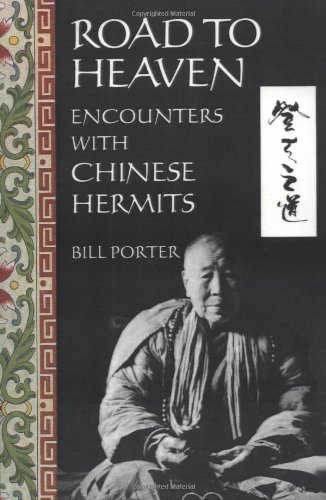
Road to Heaven is the memoir of Porter's 1989 hunt for Buddhism in the People's Republic of China. Theorising that in order to survive Mao's earth-scorching Cultural Revolution, any true practice would have had to return to its ancestral source, he spurned monasteries and struck out for the badlands. Which is already intriguing: an ordained cœnobite and authority on Buddhist scripture, with sixteen published translations to his name (and his ordination name, Red Pine), who respects hermit monks.
His journey starts at the toe of the Zhongnan Mountains, China's vast, rugged outdoor monastery, where Porter and a photographer friend drop by every ancient religious site he can find in the texts. It's depressing: landmark after landmark razed to the ground, or turned to profane ends by the Red Guards; books burned, practice banned, monks killed. There are still clerics around, but they live more like bureaucrats than monks. And they assure Porter that "nowadays, all monks live in temples." (I guess some wars are truly global.)
But Porter persists. Armed with fluent language skills, he follows a trail of hearsay off the pavement, and then off the road, and finally, in one instance, up a long chain bolted to a cliff. (Incredibly, he's given run of the Red Chinese outback, though The Man does contribute a few scary moments.) And up there, on the howling peaks where they've been for seven thousand years, he finds a whole flagrant hermit nation, pounding their ancient path as if the 20th century had never happened. And I'm not being glib; one subject interrupts him to ask, "Who is this 'Mao' you keep talking about?"
As the chronicle unfolds, Porter pieces together a practice that anticipates the Buddha by four and half millennia. It's œcumenical and anticlerical, and often not Buddhist at all: about three quarters of the hermits Porter meets are Taoists. And it turns out that they are the ones obsessed with nontheism and koanic thought and oneness. Thus the oxymoron of Zen Buddhism: the "Zen" part, isn't Buddhist.
Porter puts his profession to work for the reader, bringing in Taoist texts little known in the West, and fleshing out a religion that is a great deal more than Lao Tzu. Nor does he despise eremitic discipline. One informant tells him you must mix Pure Land and Zen equally, or the imbalance will throw you off the Dharma. (Taoism strikes again.) Another says he neither meditates nor chants: "I just pass the time." "Trying to stay alive keeps me pretty busy," agrees a female hermit, then tosses in a statement that should be carved on every hermit's lintel: "Practice depends on the individual. This is my practice."
Not all of the hermits Porter finds live in deep seclusion. Some have built sparse "neighbourhoods" in the mountains, cabins scattered within shouting distance of one another, and some have formed sketes, small numbers of hermits living under one roof. They also recognise urban eremitical vocations. But most striking for me was their universal self-respect. "These are the [Zhongnan] Mountains," states one. "This is where monks and nuns come who are serious about their practice."
Published in 1993, the text has a slightly dated feel, owing to the use of old-style transliterations (i.e., Chungnan rather than Zhongnan). Its resemblance to Amongst White Clouds, Edward A. Burger's documentary on the same topic, is due to the fact that Burger took his inspiration from the Porter book. But where the film is necessarily summary, Porter takes full advantage of his literary medium to go deeper, investigate nuance, and pursue explanations. Where Burger implies, perhaps by oversight, that all Chinese hermits pledge to a teacher, Porter finds Buddhist Associations (parishes) that require no permission at all to sit in their jurisdiction. And as I speculated in my review of the Burger movie, Porter does indeed encounter Zhongnan hermits who reject the notion of separate religions entirely.
The book finishes on a note both hopeful and challenging, not just to China but to Buddhism the world over. Just before leaving the country, Porter happens upon what had for centuries been a thriving urban monastery. Long empty, the place has recently been occupied, in the Wall Street sense, by a knot of Zen hermits. They brook no hierarchy; they have no abbot. And though their new home is falling apart, they are in no rush to restore it; the decay keeps the tourists away.
UPDATE (27 September 2012): My review of Road to Heaven: Encounters with Chinese Hermits, the book that inspired this film, can be found here. Among other things, it points out that hermits have actually sat in the Zhongnans for seven thousand years; it's just the Buddhists who arrived two thousand years later.
This week I saw Amongst White Clouds, a terrific documentary on Chinese hermits. You can buy a copy at Amazon, or see it on YouTube with upgraded subtitles, until/unless they take it down.
Made by American hermit Edward (Ted) A. Burger, this film is a rare jewel of multiple facets. To begin with, very few American scholars learn other languages, even those that are central to their specialities. Burger, for his part, has devoted his academic life to mastering Putongua (Mandarin Chinese), and is likely conversant in one or more regional dialects as well. (But I was unable to confirm this; Burger's Internet presence is remarkably spare, for having made such an important film.)
Burger is also the disciple of a Chinese hermit master, and though the linguistic path may seem obvious for such a person, it is actually very rare for an American to "bother" with language under those circumstances. Burger's personal investment in his tradition's cultural context invests his work with unique authority. (Unfortunately, his convictions didn't extend to the film's subtitles. Though their tone suggests an unusual grasp of the original Chinese, many flash by so fast they'd qualify as subliminal. I found this frustrating, and I read fast.)
Burger and his master.
The work itself is deceptively basic: Burger simply takes his viewers along, by virtue of video equipment, on a hike through China's daunting, breathtaking Zhongnan Mountains, seeking out whatever hermits word of mouth says are up there. It turns out to be a lot. In spite of a ban on their vocation after the Communist Revolution, a recent easing of policy has revealed that the region's 5,000-year-old eremitic tradition has not in fact died out; estimates place the number of hermits in those mountains today between three and five thousand.
The fact that Burger makes no effort to define his terms leaves some ambiguity in the work. He appears to consider a hermit someone living in a master-disciple relationship, as he himself did, though he doesn't verify that all of his interviewees walk that path. (In an excellent interview with the Kyoto Journal, Burger uses the verb "ordain" to mean "become a hermit," i.e., "She ordained at a young age." Again, he doesn't define this term.) He also considers "Buddhist" implicit in the term "hermit," though I can virtually guarantee that if there really are 5,000 of us in those hills, at least some reject such labels.
But that's my hang-up; Burger's point is simply that old-timey hermits still exist in China. On the way he films about a dozen, of both genders and all ages, half of whom he interviews in depth. Each reveals a unique personality, with a custom-designed practice. There are some wonderful moments of human warmth: a man my age laughs to think anybody would be interested in his unremarkable life; another is mystified that the hairy young barbarian introduced to him as "Edward" is called "Ted" by English-speaking friends; and my all-time favourite, the teenage monk who respectfully ignores the repeated orders of his deaf, 87-year-old master to "Speak up, boy! The man's making a movie!"
In the end, Amongst White Clouds avoids the pitfalls of pious tribute on one hand and insensitive judgement on the other, to become an authentic if maddeningly limited glimpse of an ancient Zen path. It's also an amazing feat of anthropology, and an impressive cinematic accomplishment in which the land itself, the remote, densely-forested, canyon-steep slopes of this massive open-air monastery, is a character in its own right.