Showing posts with label starfish. Show all posts

Thursday, 7 August 2025

Sea Star Wasting Disease Cracked

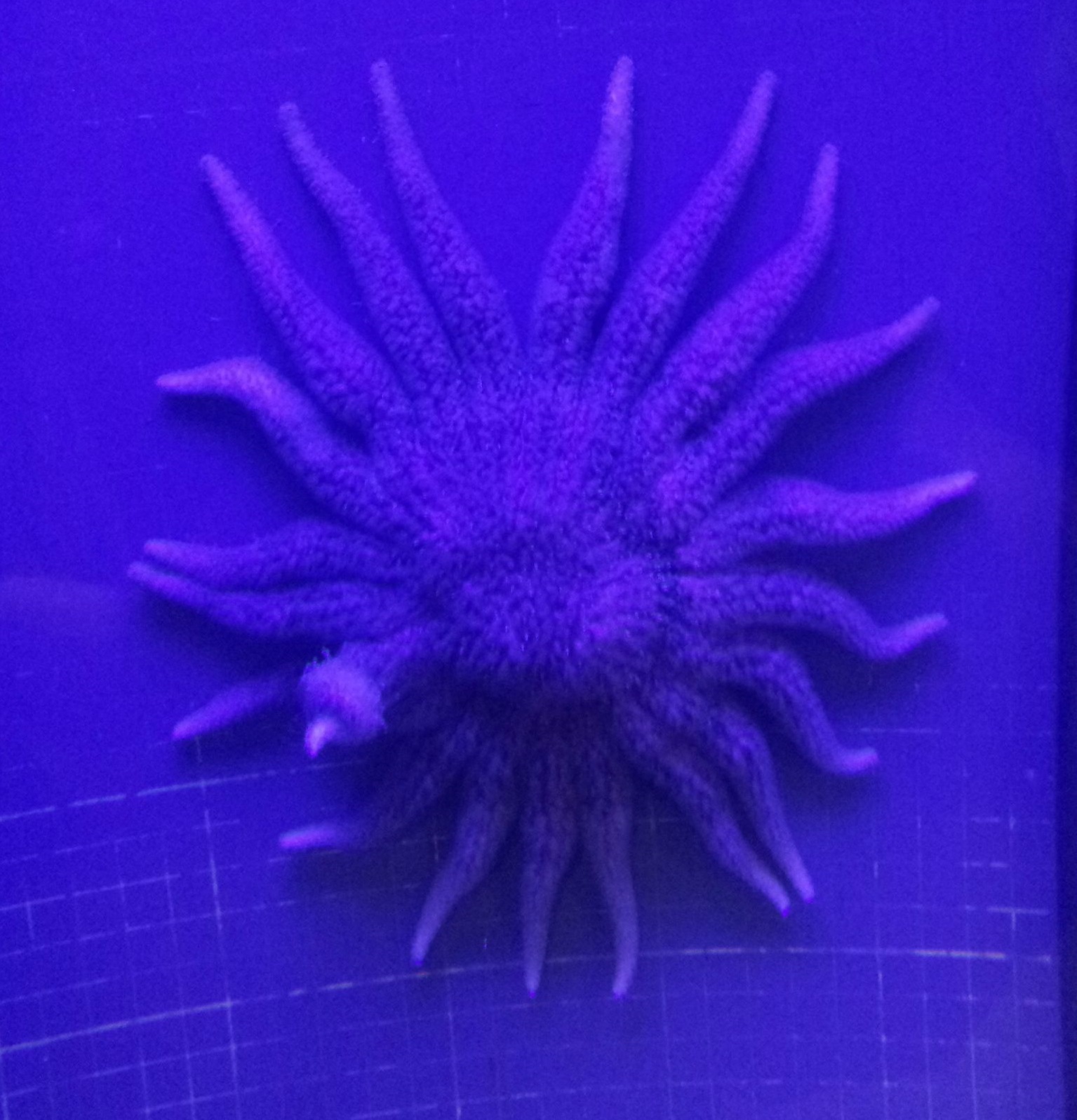
Sunflower sea stars in an Alaskan intertidal area. (2d7f9806-a3b5-abd1-9b95-2da866aa90e2) Over the past eight years I've posted regular reports on the welfare of local starfish as they endured (and some populations became extinct due to) a mysterious contagion that makes them rot alive. Now American television network CBS has announced that the cause of Sea Star Wasting Disease has been firmly established, and it's not a virus as suspected, but a bacteria.

As noted before, several species have developed a measure of immunity to this pathogen since it first appeared in 2013, but a few have been wiped out, at least in shallower, warmer water. One of my favourites, the sunflower star (Pynopodia helianthoides), once omnipresent on the North Coast, is now basically exterminated; according to the article, less than 10% of the original count still exist, all in cold, deep water. But efforts to breed them in captivity have been successful, so there's hope they might be reintroduced to their old habitat one day.

A little Googling verified that another old friend, the giant pink Pacific starfish (Pisaster brevispinus) also lives on in colder water.

As suspected, the underlying cause of this pandemic is climate disruption, which has allowed the bacteria to flow north along the eastern Pacific Coast, to warming waters where sea stars have no defence against it.

But we've got an important scientific advance in the identification of the pathogen. Together with significant rebounding on my local beaches and location of surviving populations of much-mourned MIAs, I'm taking delivery.


(Photo of pre-plague tidepool crammed with young Pycnopodia courtesy of the US National Park Service and Wikimedia.com)

Thursday, 31 July 2025

The Grandfather Paradox


This graphic illustrates the grandfather paradox, a secular koan demonstrating the inability of the human mind to grasp reality.

Alright, it's actually La avo-paradokso, which means "the grandfather paradox" in Esperanto, because it's still July and I'm still licensed to go a bit off the rails. And as we'll see, those rails can be hard to discern, anyway.

For starters, let's acknowledge from the outset that the above premise cannot be tested, because we don't have a tempomaŝino (time machine). But that doesn't stop us using it to challenge our mental faculties.

So, starting at 12 o'clock and proceeding horloĝdirekte (clockwise):

I invent a time machine.
I travel into the past.
I kill my grandfather.
My father isn't born.
I'm not born.
I don't invent a time machine.
I don't travel into the past.
My grandfather is born.
My father is born.
I'm born.
I invent a time machine.
I travel into the past...

You can see that though the proposition is (science-)fictional, the conceptual challenge is real. It's an example of a reality that the human mind can't perceive:

– It's impossible to kill your grandfather, because if you did, you wouldn't exist.
– But you do exist, so if you could go back in time you could totally kill your grandfather.
– Except you couldn't, because if you did, you'd never exist in the first place, so you couldn't kill anybody.
– But you do exist, therefore…

The solution? There isn't one.

Not if you're human.

Because your primitive reason runs on logic, which is why all the Vidyārājas are sniggering at you.

(However, consider that we might come to realise even this concept if we could live it. The human brain has the capacity to pencil out and penetrate circumstances that utterly lack logical sense, if it stands in front of them. I only hope our grandfathers arm themselves well if ever that comes to pass.)

Buddhism has long taught that time is neither linear nor universal; timelines are numberless, each running at its own speed and in its own direction. The variance between the classical reincarnation of Hindu and some Buddhist worldviews, and Zen's messy ad hoc concept of transmigration, originates in this contention.

That's why we developed koans, which are meant to jazz that part of the brain that can't grok the great stretch of reality that lies beyond dualistic perception. ("What was your face before your grandmother was born?" seems an appropriate example.) This also goes a long way toward explaining those wild tales of monastery practice: the decades of mu-pondering, the dharma combat, insight expressed by farting and slapping and barking like a dog. Because extracranial notions exceed language.

You can find an in-depth philosophical exploration of the grandfather paradox, as well as similar thought experiments, at BYJU'S page about it. And while you're there, take a moment to marvel that this page was uploaded by a company that educates children. I've got a feeling India's going to be running this popsicle stand in another generation.

In the meantime, why not just be nice to your grandfather? Ok, so maybe you can build your time machine without him, but who decided we needed that more than we need him?

See if you can wrap your choanocytes around that, Spongebob.

Thursday, 12 October 2023

Starfish Report 2023

Healthy adult P. ochreceus.
I conducted my informal annual survey of a local beach a few weeks ago and found the wasting-syndrome situation holding, relative to past years. The species recorded in the past are present in similar number, with a possible bump in the number of Pisaster ochraceus, the purple starfish. In that case I noted a heartening continued presence of adults with no noticeable infection or mutilation, supported by what I believe is a modest rise in the number of youngsters.

As this iconic North Coast star all but vanished at the height of the pandemic, I was touched to note this.
White E. troschelii.
With any good luck, this old friend is back to stay.

Evasterias troschelii, the mottled star, held the lead as the largest population on the tidelands since reclaiming first place from Dermasterias a few years back, though they still run small compared to pre-SSWS norms. Together with what may be signs of plague in two of the largest specimens, this may be a bit of a blue note. (See photographs; one individual appears unusually white about the disc, and a ray of another seems whiter and weaker than normal where it's been thrown over a cobble. Compare with the photos on this page. Again, I'm relying solely on 60 years of familiarity with the starfish of my homeland; this wasn't a scientific survey, and I may have misread the cues.)

So Evasterias may still be dying
Possible infected ray.
before it reaches full size. If so, the breeding population is keeping apace, so there are grounds to hope for an evolved solution.

For the rest, leather stars (Dermasterias imbricata) seem about as present as before, and sadly, Pycnopodia helianthoides, the sunflower star, and Pisaster brevispinus, the giant pink star, just as extinct. I wasn't able to observe the blood stars (Henricia leviuscula), which barely reach the intertidal zone, because the tide was a few feet higher than those I've caught in the past.

Final analysis: though the beach apparently still isn't clean, all in all, an encouraging show by the new normal.

Adolescent P. ochreceus.

Wednesday, 9 November 2022

WW: Climate disruption on the North Pacific


Salal (Gaultheria shallon)


Western red cedar (Thuja plicata)

(A particularly disturbing consequence of global climate disruption is the rapid perishing of species unique to the North Coast.

Because we have until recently had a specifically regional climate, a great many types of plants and animals have evolved to live only here. [Or here and and similar places they've invaded, such as the UK and the South Island of New Zealand.] These species have become emblematic of this place and the human cultures that developed here.

Like the disappearance of our starfish and the dying crowns of our bigleaf maples, watching these symbols of my homeland suffer and die in the arid blast-furnace heat of the new "normal" is heartrending. Other key examples are the salal and Western red cedar pictured here.

I saw several abnormally hot, dry summers in my youth, but the salal and cedars never died.)


Appearing also on My Corner of the World.

Wednesday, 6 July 2022

WW: Resilient mottled star


(Evasterias troschelli. Note that the tip of one ray has apparently been gnawed off by the starfish plague, but the organism's immune system has fought off the attack. This bodes well for the species.)

Appearing also on My Corner of the World.

Thursday, 23 June 2022

Starfish Report 2022

Maimed P. ochraceus with a
replacement ray coming.
So here we are again, back at the usual beach, counting starfish. (On a -5 tide! The Woodstock of marine biology nerds.)

News on the viral front remains guardedly optimistic. In a nutshell, several species present that are susceptible to starfish wasting disease continue to indicate resilience to one extent or another, though the depredation of the virus is still evident.

The bad news is that there is still no Pycnopodia and no Pisaster brevispinus. Researchers suggest the first may now be extinct here, though I hold out hope for deep-water populations of both that may eventually repopulate the shallows.

Meanwhile, that other Pisaster – the iconic North Pacific ochraceus – continues to display real backbone. In addition to a few full-grown specimens that are looking very intact if a bit pale, I also found some badly maimed ones that nevertheless showed no signs of current infection, and were even regrowing eaten limbs. This acquired immunity – if that's what I'm seeing – bodes well for a return to former numbers.

Evasterias troschelli also maintains a pronounced presence, which is more good news, given that this was another species
Young Evasterias troschelli.

virtually wiped out on North Coast beaches the instant the virus appeared. Many juveniles dot the beach now – more, I believe, than last year – though so far no fully grown ones. That last point remains a bit troubling; these animals may still be falling to infection before reaching adulthood. But a few mid-sized ones, scattered among the bright, colourful youngsters, give hope that this species too will eventually surmount the plague entirely.

In any case, there was little evidence of active infections anywhere on the beach, which all by itself is huge.

For the rest, leather stars (Dermasterias imbricata) still mostly own the low intertidal zone. Formerly sparse in southern Puget Sound owing to heavy predation by Pycnopodia, the disappearance of that rapacious marauder, combined with Dermasterias' near-immunity to the wasting disease, has handed it a golden ticket. (Bad news for the anemones though, since this star goes positively Pyncopodia on their figurative backsides.)

Also of note were the continued presence of a few neon Henricia leviuscula, another genus that's largely, though not entirely, impervious to the virus.

So there you go. No miracles, but a heartening show of evolutionary vigour from those species that survived the first wave.

Two juvenile Dermasterias.

Wednesday, 15 June 2022

WW: Six-rayed leather star

(Same beach, different starfish. Individual from another five-rayed species [Dermasterias imbricata], randomly turning up with six. That early-days DNA showing its evolutionary bent again.)

Appearing also on My Corner of the World.

Thursday, 9 June 2022

Does A Starfish Have Buddha-Nature?

I had the good fortune to be raised on the coast, and have spent a good deal of my life beside, on, and in the sea. The incredible diversity of the marine environment has always fascinated me; I never tire of turning over stones and gazing into tide pools, every one full of intriguing creatures.

But what has captivated me most from toddlerhood are the lowest phyla. And of these, my decided favourite are the echinoderms. I love sea cucumbers, sea urchins, and sand dollars, but most especially starfish, in all their myriad extraterrestrial forms.

At the risk of bathos, I believe they were my first Zen teachers.

Because starfish, like other faceless marine invertebrates, have no brain. Yet they get on just fine.

They move about, eat, reproduce, and apparently enjoy a typical animal lifestyle, all without hearing, seeing, or thinking.

Still, they have to experience their habitat on some level. They're highly active, constantly touching everything with thousands of tiny restless feet. They know light from dark, warm from cold, wet from dry. When I pried one from a piling and lifted it out of the water, it clearly knew something was up, demonstrating behaviours my species associates with animation and alarm.

But they were obviously incapable of grasping my nature. Those little translucent fingers must've telegraphed something, but the creature clearly had no idea what I looked like; the whole notion of visual appearance is foreign to organisms without sight. Or sound, so there goes that dimension, too.

Raised into the air and sun, every marine thing suddenly out of tactile contact, it had to be completely bewildered; a simple displacement of a few feet having brought this limited being into a world so strange it literally had no idea how to proceed.

I used to think about this as a kid: that starfish, wholly competent and to all appearances supremely confident in their intended environment, were probably certain that everything in existence could be known by their tube feet and rudimentary photosensors. Growing older, meeting many more sea stars, it also occurred to me that "what can be known" to starfish must in places exceed "what can be known" by humans; their radically different neural network can't just fail to catalogue information that ours can; in some domains, it must also catalogue information ours can't.

Jump ahead several decades, and I've now tried and failed to read marine biology at university (chemistry is one of the types of information that my neural net does not catalogue), to splash at length into the sea of Zen.

Where I'm reminded of starfish.

Because Zenners talk about perception a lot. And the lack of it. And the lack of perceiving our lack of perception. And the perception that we're perceiving perceptions that we can't perceive we can't perceive.

And then perceiving that.

Without perceiving it.

All of which I suspect starfish are too insightful to piddle with.

But my species is dead certain that we can perceive everything that can be perceived. With our so-so eyes, our so-so ears, and especially, our magnificent climax-community brain.

It isn't belief. It's knowledge.

I run into it all the time. Near-death experience people. Atheists. Certainty addicts of one cant or the other. And those annoying "scientific mindset" people who can't even perceive science, let alone everything.

We are chronically, incurably ignorant of giant swathes of existence. Whole dimensions. Entire phenomena that we don't simply not see or feel, but indeed that our brains, constructed for seeing and feeling, can't even picture. The very existence of these characteristics of reality, we will never grasp.

Because we're starfish.

And I think if a human can grasp that, there's hope for that human.

Besides, now Pisaster ochraceus, the purple sea star of my own North Pacific, apparently hunts in packs.

You read that right. These echinoderms band together like wolves and pitch epic raids against terrified prey.

This fact was only recently discovered by the planet's most advanced species, by an amateur diver no less, who noticed something quizzical in footage he'd taken of a P. ochraceus colony off the coast of Oregon. Curious, he sped up the film, then watched in horror as a brainless swarm of purple and orange sci-fi monsters zoomed at great speed over the rocks and sand, implacably herding and finally engulfing their presumably screaming quarry under a heap of flailing rays and gnashing centre discs.

Starfish are not intellectually equipped to do that.

But these did.

Thursday, 16 September 2021

Starfish Correction


Will the real Pisaster brevispinus please stand up?

Looking again at the photo I published at the top of last week's post, purporting to be of an adult giant pink starfish (Pisaster brevispinus), I've come to the conclusion that it's actually just an unusually large leather star (Dermasterias imbricata). Among other things, it doesn't seem to have any brevispini (short spines).

Sigh.

Oh, well. I hold out hope that this favourite of mine, which was always more numerous in deep water than intertidally, is still down there, outbreeding the plague.

(Photo courtesy of D. Gordon E. Robertson and Wikimedia Commons.)

Thursday, 9 September 2021

Good News on the Starfish Front


Not Pisaster brevispinus, unfortunately.

(Update, 15 September 2021: my report of a mature Pisaster brevispinus in this survey was sadly premature. See correction.)

So after a down year due to COVID lockdown, I got in not one but three Annual Puget Sound Asteroid surveys this year. And the news is brilliant!

The first took place at a bay on the Canada-US Border, where two old friends and I have searched for hardy echinoderms since the arrival of the climate disruption-related sea star wasting disease (SSWD) about ten years ago. There we'd previously noted a small but tenacious community of Pisaster ochraceus, the once-ubiquitous ochre star that had seemingly disappeared from all points south, both pelagic and thalassic.

But now they've gone bananas. As we probed crevices and rocky groins in the lower tidal zone, we found seam after seam stuffed with adult P. ochraceus, in numbers reminiscent of the pre-plague days.

Nor was that all. A subsequent hike along Bellingham Bay, a few miles south, fetched up many more, lying around in jaded profusion as if they owned the place.

With unrestrained delight we documented this turn of events in a wealth of celebratory photos.


Pisaster ochraceus.

And this is not, I soon learned, an isolated case. Another visit to the other beach I've been monitoring, near the southern extreme of the Sound 150 miles distant, produced not only several healthy adult Evasterias troscheli, where before I'd only found juveniles, but also an able-bodied adult P. ochraceus, luxuriating the warm plague-friendly austral shallows. And best of all, the first appearance of a robust Pisaster brevispinus!

That last was truly exciting, owing to the long relationship I've had with the North Pacific giant pink sea star. When I was three years old, my uncle and a neighbour girl – young adults both, and divers – disappeared below the inlet in front of my grandmother's house and resurfaced with a great glistening pale monstrosity. They propped it up, tall as I was, on the beach in front of me, and I watched its rows of tube feet wave in phlegmatic bewilderment at the sudden change of world.

This lasted all of five minutes, after which they returned the perplexed fellow to the saltchuck, but the moment remains sharp in memory, now six decades gone.

A few years later I rowed the same bay, hip pressed against the port gunwale, head craned over the rail to peruse the creatures on the bottom. The further out I rowed, the fewer I could discern, until at last only great green bands of sea lettuce were visible in the depths, alternating with bare grey sand.

And then nothing.

Except… here and there, the ghostly undulating skeletal hands of yard-wide P. brevispinus, glowing up through 100 feet of green water.

So the disappearance of my old friend truly hurt, and I fairly cried when I found this one.


Evasterias troschelii.

As it happens, I'm not the only observer of this uptick. As early as 2018, a grad student at UC Merced noted genetic variances in local P. ochraceus populations that allowed a durable nucleus to survive after the great majority had perished. At the time her department wondered aloud whether a similar evolutionary reserve might bail out other species as well.

And so it seems. The single blue note here is the continued absence of great sunflower of death Pycnopodia helianthoides, the final Puget Sound regular still absent. (Though I didn't survey for Leptasterias hexactis, the tiny six-rayed star that lives under rocks, so can't comment on its status.) Marine biologists have suggested that Pycnopodia – soft, squishy, easily penetrated and dissolved by SSWD – may be extinct in our waters.

But I hold out hope that a breeding population, sheltered in colder, deeper fathoms, will one day repopulate its ancestors' old range.


SSWD-resistant Dermasterias imbricata, still very present in the South Sound,
as it's been since the beginning.

Wednesday, 28 August 2019

WW: Starfish report, 2019

(Well, here we are again, on the same beach as last year. This summer I had difficulty finding many Evasterias; total count was only two. However, I did find an adolescent Pisaster ochraceus (photo above), which is heartening. Meanwhile, Dermasterias, which is resistant to the starfish plague, continues much in evidence. I didn't find many Henricia either, but they're not technically intertidal, and the tide wasn't as low as last year. And as in the past, not a single Pycnopodia, profuse in these quiet North Coast waters when I was a kid.

The lack of Evasterias compared to recent post-plague years, and the small size of those found, continue to sound a knell for this species. However, there remain two slim hopes.

First, the very low census still adds up to more than
Pycnopodia , now apparently extinct here.

And second, though it appears that all our young
Evasterias still succumb within a year or two to the plague, so far a handful are still turning up on the tidelands each summer.

So a healthy breeding population must survive in deeper, colder water. With any luck they'll outlive the virus, and eventually repopulate the bay.)

Wednesday, 17 October 2018

WW: Six-legged seastar


(This is good old Henricia leviuscula, the blood star, but with an experimental enhancement. Happens sometimes. Reminds you how elementary the genetic situation is in this ancient phylum.)

Thursday, 16 August 2018

Starfish Update, August 2018

Last week I trolled a few beaches in Whatcom County with two droogies from college. We were taking advantage of passably low tides and the bright August weather to reconnect with some of our favourite haunts.

The first was predictably depressing: where the rocks had been encrusted with brightly-coloured sea stars last I saw it – 33 years ago – they now boasted not a one.

So when we arrived at the second, early next morning, expectations were low. But what was our delight to find, first one… then several… and finally hordes of Pisaster ochraceus, the purple shore star.

Signature starfish of the North Pacific, these are the first Pisaster I've seen in years. We all cheered loudly.

And they're adults, which suggests they're either bearing up against the plague or (more likely) haven't yet been exposed to it.

The disease was present, though. We didn't conduct a formal survey, of course, but we did find a single infected individual who was well on the way to dissolving into mush. Interestingly, that was also one of the few immature specimens we found on the beach that day. This is contrary to the usual pattern, but that's probably just a fluke.

Will Pisaster survive on this beach? Seems dubious. But we can hope.

In the meantime, it did my heart good just to see them again, after all these years.

Thursday, 19 July 2018

Starfish Report 2018

Evasterias troscheli
We had a minus-4 tide the other day and I got in an epic mile-long wade along the tidelands. The biological diversity was outstanding; next best thing to diving.

Among the prolific sea life present were three starfish, all of which presented reasons for hope, if not celebration, that the starfish plague may be slowing down, now that it's wiped out most of our sea stars.

I was first delighted to find several blood stars (Henricia leviuscula). These striking neon echinoderms have been a favourite since childhood. Seldom found intertidally – testimony to the rare opportunity of this very low tide – they were before the die-off omnipresent on mud-bottomed diving grounds.

One adult specimen I found had small scrapes on its disc. These might have been signs of incipient viral infection, or abrasions caused by being dashing about in the "surf" created by passing boats. I also found a few tiny individuals; normal for this time of year. With the exception of that first adult, none showed visible signs of disease (yet?).

Sadly, not a single sunflower star (Pycnopodia helianthoides), of any size, in any condition, was present. It does seem this beautiful if rapacious species, a fixture in quiet northern water until very recently, has been driven to extinction.

Further proof are the leather stars (Dermasterias imbricata) that now stud the beach and shallows. Formerly thinly represented on lower Sound
Adult Henricia leviuscula
beaches, because a favourite Pycnopodia food, Dermasterias is now virtually the only star left.

That population, at any rate, enjoys a natural immunity to the horrific seastar wasting disease, and appears healthy.

Finally, good news and bad on the mottled starfish (Evasterias troscheli) front. Good, because I encountered several specimens of this similarly once characteristic species. Bad, because every one was tiny; a year old, at most.

The wasting virus tends to take a few years to locate and destroy its victims, thus the average size of this species indicates it hasn't yet been able to out-manœuver the plague.

But its presence at all on this ravaged beach suggests that a healthy breeding population exists in the deeper, colder water offshore. With luck and a bit of Darwinian cunning, it may yet return.

Thus the state of the starfish.

It's hard to express how painful all of this is. They may be "just starfish", but this attractive class has been such an integral part of my life, albeit unrecognised till they were gone. Along with most other people, it never occurred to me I might one day wake up to a North Pacific functionally bereft of seastars.

And the creeping suspicion we'll lose many more beloved habitats and life forms before we've seen the end of the Anthropocene.

Immature Henricia

Wednesday, 23 May 2018

WW: Before the plague


(I took this photo on the beach in front of my house in 2009. Pretty much every subtidal rock on the North Coast looked like this then; it's a scene deeply rooted in my childhood.

Pisaster ochraceus, the purple sea star (variation notwithstanding), is among the species most vulnerable to sea star wasting disease. Over the last five years that horrific plague, which literally causes infected individuals to melt into a tapioca-like substance and flush away with the tide, has wiped out virtually all intertidal starfish in the northeast Pacific.

The epidemic is associated with an invasive virus, which is itself believed to be symptomatic of rising ocean temperatures and related conditions.

Regional outbreaks of SSWD were recorded in 1972 and 1978. Continued monitoring of the latter suggests that permanent extinction, at least on this coast, is not off the table.)

Wednesday, 26 July 2017

WW: Mottled starfish


(Evasterias troscheli. These were among the worst-hit in the recent virus strike that decimated starfish here on the North Coast. Thus I was pleasantly surprised to find this beach littered with them on a recent minus tide. All were small – hand-size, like this one – and many were deformed or missing rays. Whether any survive remains to be seen. The virus, which is believed to have been triggered and intensified by the rising water temperatures, has wiped out the once-ubiquitous sunflower star [Pycnopodia helianthoides], which preyed on this and the leather star. Some researchers are now using the word "extinct" to describe formerly robust Pycnopodia populations here.)

Monday, 1 October 2012

Reality Check Kyôsaku


"I do not say there is no Chàn.
Just no teachers."
                            Huangbo


(Photo of Evasterias troschelii [mottled seastar] fry, on the underside of a rock. The orange guy is about 2 inches long.)