Wednesday, 19 October 2011

WW: Candid capture of my practice


(Glasses put down on the way back in from the beach, before a bundle of Chinese coins for making cemetery fudos; reflection of me in the left lens and my Buddha bowl in the right.)

Thursday, 13 October 2011

My Hermit Hut

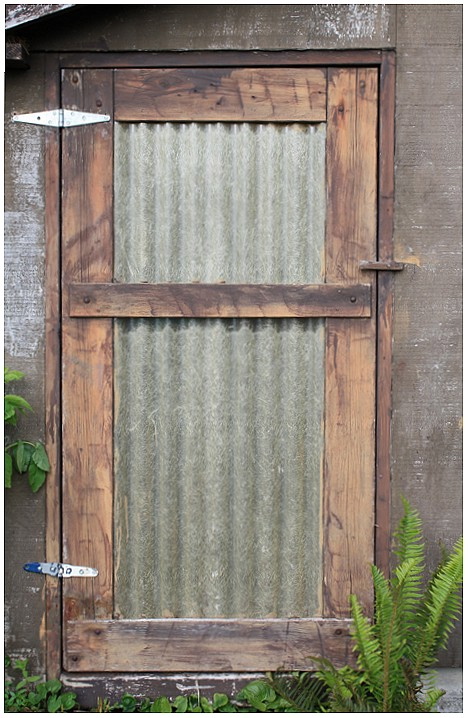
I've been feeling a bit nostalgic about the old meditation shed I had down at the beach, and it struck me that I've never actually posted on it, though others' huts have appeared here several times. (I did upload a named exterior shot ten years ago on Wordless Wednesday, but the others that have appeared from time to time were illustrating other topics, and so not identified.)

So in the interest of completism, here it is.

This tiny shack, the very picture of a true purist's definition of "hut", started life as my grandmother's potting shed. My grandfather carved it out of the slope below their house, where I lived for ten years during the formative period of my Zen practice. When I arrived, the house and grounds were both in dire condition; eventually I hacked my way down to this cinderblock shanty, re-opening a steep, eroded goat trail through impenetrable brush. The door, which had been kicked in by a winter storm years before, lay on floor inside; only the twisted wreckage of the lower hinge was still nominally attached.

In the intervening years blackberry and honeysuckle had invaded and filled the interior, along with bracken, lady fern, and infant trees, and the roof and wooden parts had rotted in places. Its concrete floor was completely saturated, covered with standing water and mud from infiltrated silt.

I really didn't need a place to sit, as the house – high on a bluff above the grey Pacific, with few neighbours – was already the best hermit hut in history. But rehabilitating one of my grandmother's work stations was an attractive premise, and the place would provide ground-level, fundamentally outdoor meditation, which I always prefer when available.

So I set-to, and after a lot of concentrated effort and scrounging of materials, ended up with this serviceable little squat. I even once sat an all-night sesshin there, hoping to glimpse the bear that left scat in front of it. (I didn't, but I did relearn, not for the last time, that spring nights on the North Pacific are bitterly winter-cold.)

So here it is, my own hermit hut. Or to be perfectly accurate, my monastic playhouse. It might not have been strictly necessary, but I learned a lot of Zen there.

Monday, 19 September 2011

Intelligent Life: The Proof

I found this in the surf last week. It's a porpoise skull.

And yes, it's all there. They really look like that, under the grin. I can't think of any other animals, apart fellow cetaceans, whose eye sockets are actually below their teeth. It's like a life form designed by Picasso.

As if that weren't alien enough, there's also that bulbous cranium bulging up aft, like the superstructure on a bowpicker.

The reason for both is the same: this porpoise negotiated its environment not by sight or smell, but by sound. Hence any high-riding eyes would just have been show, and a waste of critical bone; this skull is built to amplify the echoes of tiny, high-pitched squeaks made by its owner, and secondarily those of podmates.

Thus, much of that beetling brow roll is a resonator, meant to detect vibrations and gauge their intensity and direction.

Dolphins and porpoises are also highly sophisticated animals whose behaviour is largely unfathomable to humans. They have consistently demonstrated extremely advanced cognition, extending possibly even to altruism, morality, sexuality, language, and existential autonomy.

So here it is, at long last: reason to hope that there may be intelligent life on this planet.

Saturday, 10 September 2011

100 Days on the Mountain

Day 37.
So I'm back. It's taking some time to recalibrate to the (by turns insistent, by turns indifferent) rhythm of Humania, but I thought I'd climb back up on the blog horse by offering an overview of the project.

The deal: A week ago I completed 100 days of hermit ango in the Willapa Hills, being the rugged, densely forested, sparsely populated southern frontier of my coastal nation. I spent each of those days attending to the needs of survival and practising meditation, both sitting and other. I also brought out 445 pages (and counting) of journal. These will be rockered into a book, but for the time being, I can summarise the experience as "deep and broad and one of the most worthwhile things I've ever done."

In the meantime, here are some photos. I had no camera, since possessions were limited to survival requirements, so "some" photos is pretty much all of them. But I offer them all the same, in deep gratitude for the opportunity to practice, and for the friends and fellow monastics who made it possible. Supplying these photos was the least of their contributions.

Facts in Brief:

I established camp on 83 acres of undeveloped hillsides, surrounded by much the same for miles in every direction. I was dropped on 26 May 2011, and remained in-country for 100 days.

View of my mountain from another one.
The land was extremely diverse, consisting of bands of deep coastal jungle alternating with dense stands of Douglas fir; high, cleared ground going to brush; low, marginally maintained pastureland; and several riparian habitats. It was bounded to the north by one tidal creek, and to the south by another. Decadent luxuries included a 100-year old orchard that furnished my fill of heritage apples in the final weeks, and a barn I was permitted to use. With a freakin' wood stove! (Big deal? Read on.)

The weather was... how do you say? Ah, yes. CRAP. To put things in perspective, let me explain to those not from the North Coast that our famous perma-rain is supposed, by custom and contract, to diminish through June, ending definitively on 1 July. After that date, glorious summer is to ensue and persist until mid-September, at which time the rain may begin again.

Thus, I sat, as I expected, in the bitter wet sopping dark through the full 30 days of June. Then I did likewise through July, day by day, night by night, week by week. Finally, on 1 August, the rain stopped. The grey kept on, but I'm cool with that. You can have the grey, July, just stop goddam raining on me.

So my host's gracious offer of the barn, including the wood stove and even his firewood, as laundromat and spa, proved vital in a summer that included a sit in full winter kit (tuque, gloves, and every stitch of clothing I owned on under my robe) on 4 July. And that wasn't the last.

At long last, mid-August produced a near-facsimile of summer, following clouded mornings with sunny afternoons, and only 1 full day of rain. I was even able to take the fly off my tent for several days, so only somewhat arctic had the nights become.

Despite my sitting
Three things will not be silenced
Mind. Body. Tyvek.
The gear consisted of a small tent, a Tyvek tarp, a sleeping bag, a backpacking stove, and a backpack. I also had the minimum tools and clothing, and a cache of food (an all-purpose cereal I invented for the purpose, called zenola, and rice and beans for afternoon and evening meals) and other supplies, located in the rafters of the barn. My robe, which I designed and my mother, the Stradivarius of the sewing machine, drafted and made, was critical equipment, as was my stick. Both served 24 hours a day throughout the entire ango.

Sangha included, by partial account: Steller's jays; more configurations of garter snake than I've ever seen; kingfishers; salmon smolt; four species of owl; Douglas squirrels; bears; deer; alligator lizards; a young goshawk; otters; numerous colonies of paper wasp; beavers; bobcats; a special-ops unit of raccoons; a herd of elk; and an entire tribal confederation of coyotes. All of us closely monitored by a proprietary flock of ravens. (Full list to be included in the upcoming book.)

Finally, close friends made three scheduled proof-of-life visits during the ango. One dropped me off in May and made an emergency trip on Day 62 to verify my well-being, and another picked me up in September and bought me a cheeseburger and fries on the way back to the realm of people. And of course the couple who allowed me, with incredible generosity, to sit on their land all summer, and supported my practice in smaller but vital ways over the full 100 days.

And now the work begins. I'm hoping to have the book done soon. In the meantime, you'll be seeing excerpts and related material here.

And I'm glad the rest of you didn't blow yourselves up in my absence. Keep up the good work, eh?

The Bodhi Tree, a giant bigleaf
maple, under which I sat.

Monday, 23 May 2011

Just Sitting


I'll be offline for the next 100 days, as I'm going into the woods to meditate.

I'll resume posting here when I come back out in September.

This is a world of compassion.

– Robin


Today's top headline:
"Free-Range Buddhist Eaten By
Health-Conscious Cougar."

Thursday, 19 May 2011

Product Review: The Mobile Meditator Zafu

The Mobile Meditator
provides monastic-
quality support.
One of the drawbacks of writing a hermit blog is you don't get to write many product reviews. As a rule, hermits don't "do" products; products mean materialism, which means consumerism, which means buying things, which means having money, which means valuing money. Which we also don't do. (Forget ice to Eskimos; the real test of salesmanship is selling anything to a hermit.)

But just as it's nice to eat out every so often, it's also fun to to review something you didn't make, find, or receive as a gift. And this is a good one, as it's something hermits need, and we can't really make.

The Mobile Meditator Inflatable Meditation Cushion is exactly what it says it is. But does it work? The only other product out there that seems to fill this description is widely held to be a piece of, well, karma. Although I've never used one, sangha brothers and sisters tell me it's underwhelming. And many Internet reviewers agree. So I was cautious about gambling my grubstake on an inflatable. Can you really buy a truly portable zafu, small and lightweight enough to carry into the woods, but serious enough to support your back and backside during prolonged sitting? And can you be sure it won't fall apart at a rate that would offend Pema Chödrön?

Yeah. It's called the Mobile Meditator.

Folded up and stuffed in its pouch.
I won't go into specs here, since the manufacturer's website is precise, but this zafu is small when deflated, full-sized when inflated, and almost frighteningly light in both states. Three-chamber design makes it fully adjustable. You know how one thigh is always higher than the other in half lotus, queering your balance? Well, on this zafu, you can tune half to feel almost like full.

Three chambers also mean it takes longer to blow up, especially since the valves have to be pinched just right while blowing into them; that's to prevent the air from coming back out. It also makes the zafu harder to deflate, which you have to do pretty thoroughly to get it back in the included protective pouch. But those hardcore valves also guarantee surprise-free sitting, and better yet, they make it possible to adjust posture on the fly: just reach down and pinch the one on the offending chamber, and your body descends, elevator-style, into proper position.

Mine looks like a giant burnt crescent roll.
Feels like one, too.
The Mobile Meditator is crescent-shaped, which lends itself to Western-style, on-cushion positions. Those who prefer the "Japanese wedge" might get it by inflating the Mobile Meditator hard and using it backward; I don't sit that way, so I can't say. I was initially afraid it would soap-bar out from under me, being vinyl and all, but the flocked surface clings to me militantly. In fact, it clings to everything militantly, making it a magnet for all manner of filth. But it's a small price to pay for a tight seal with the planet. (A light touch with an old-fashioned, bristled clothing brush does adequate clean-up.)

I have heard Brand X users complain of feeling like they were sitting inside a Moon Walk, unable to settle firmly on their inflatable base, but thanks to its shape and design, the Mobile Meditator provides positive purchase. It's not as solid as my beloved buckwheat, but I quickly became accustomed to the slight difference.

The zafu on its back.
To date, I've only come up with two criticisms of this otherwise excellent product. First, it's sweaty; after a long sit, my Enlightenment Base is wet and greasy. This is uncomfortable, but in all honesty, I can't imagine a way to make an inflatable zafu that doesn't do this. So I just place a folded towel on it before I sit, and that solves most of the problem. On the other hand, the company could easily do something about its limited colour choice. Right now the Mobile Meditator comes in two flashy Las Vegas versions (Very Red! and Very Orange!), as well as black. I'm happy; I like black. But they really ought to add a conservative blue, and maybe an earthy green and brown. Just sayin'.

I sure can't complain about the price. At $24.95, a person could be forgiven for assuming it's cheap junk. But it's not; it's cheap quality.

I don't really know exactly how tough this thing is yet, as I've only just got it. However, in a few days I'm going into the woods to meditate for a hundred days, which is why I bought the Mobile Meditator in the first place. Of course I won't do anything stupid, like jump on it or use it directly on the ground or shove it into a bear's mouth to save my life. But I think we can safely assume that this summer will be the Mobile Meditator equivalent of a Timex commercial.

I'll let you know how it goes.

UPDATE, September 2011:

Not well, as it happens. The zafu popped on the third day out, and I ended up rolling up my closed-cell sleeping pad each day to serve as a cushion. I wouldn't read too much into this, though; the conditions were extremely challenging for anything inflatable. By way of comparison, my Thermarest pad, which I used as a zabuton, also developed a leak, and the Mobile Meditator is nowhere near as sturdy as that is.

So the Mobile Meditator is not great for exterior hermitry, at least not as-is. I suspect you could make a cover for it of leather or some artificial material (the stuff they make industrial hoses out of comes to mind), and that would probably keep it alive in abrasive conditions.

Before I leave this topic, let me also say that I cut the side chambers out (only the big middle one popped) and used one for my pillow at night and the other as knee support with the rolled-mat zafu. Both served throughout the ango with no further complications, and are still perfectly airtight. The knee support was particularly welcome, since the little cushion could be adjusted with a pinch, and sitting on that hard foam roll increased joint stress rather a lot.