I'm not a big incense guy. Some Buddhists are. They like to set up an exotic Asian vibe, and incense is one of the foreign accoutrements they amass on their borders to accomplish that. As Thich Nhat Hanh says, these practitioners "make a lot of smoke".
Meanwhile, I'm a hermit, and rama-lama-ding-dong irks me. But I have to admit, in many ways it can support valid practice.
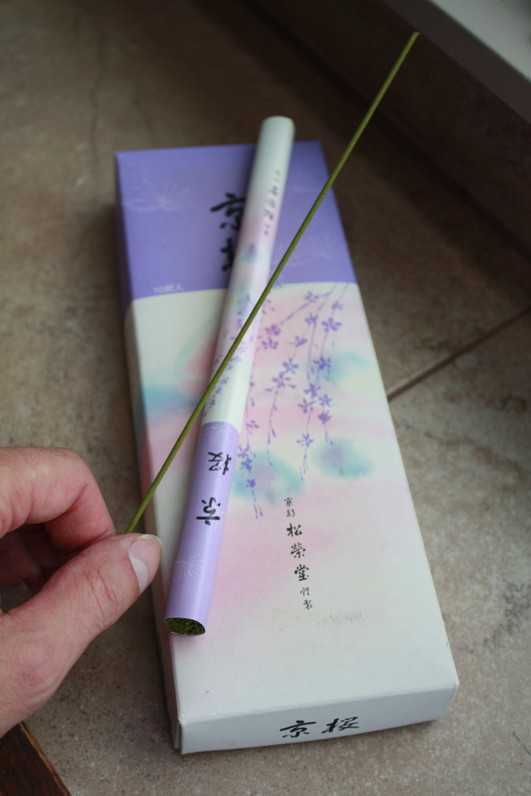
At the start of my vocation I lived upstairs from two incessant smokers. Their ceiling/my floor proved dismayingly porous, and I couldn't escape the stench even in my own home. Since I had recently embarked on a Zen path, my counter-schemes naturally turned to fine Japanese temple incense. It's expensive, but it doesn't stink up the place like the cheap stuff, and, as I happily learned, its pleasant unobtrusiveness doesn't stop it getting all bushido on smokers' arses.
As a side benefit, the fact that I was saturating my living quarters with temple incense during the founding months of my practice imprinted it, Pavlov-style, on my neural net. So now the smell of good incense calms me and puts me in practice mind. Which is exactly how cœnobites justify their incense fetish.
Goddam cœnobites.
Anyway, I needed an incense burner. Did I mention I don't like the thing Chögyam Trungpa called "spiritual materialism"? And on a Scottish note, commercial burners tend to be wasteful, because the end of the stick that's stuck in their hole or sand doesn't burn. Hey, if I'm gonna blow seventy dollars on smell, I'm wringing every last penny back out of it.
And so I invented this. It works. It burns the stick down to one or two millimetres. And it's bindle technology, which is the electrical opposite of pretence.
You will need:
1. Two clothespins, the kind whose wooden legs are held together by a steel spring.
2. Glue.
3. An empty sardine tin. (I like the long skinny tins that kippers come in, because they catch all the ash when

4. A fine-toothed saw, such as a coping saw or hacksaw
Optional: paint or stain; sandpaper; a small triangular file.
1. Saw the "lips" off one of the clothespins, angling the cuts about 45 degrees toward the tail, making a pointed business end. (See illustrations; you can also accomplish this by rubbing the clothespin on coarse sandpaper or holding it against a disc sander.) Without this, the incense stick will snuff out prematurely.
2. Next, take the second clothespin and saw about half an inch from the end of one of its legs. Then turn that bit narrow end forward, and glue it to the inside of the end of one leg on the clip. (See illustrations.) This forms a cleat that will hook over the rim of the tin and hold the clip in place. Clamp the glued bit down with the donor clothespin until it dries.
3. Inscribe a shallow groove in the middle of the biting surface of the jaws, to keep the round incense sticks straight in the jaws and prevent them from rolling out. A small triangular file is handy for this. In any case don't cut the notch too deep or the clip won't hold the stick. A good scratch is all that's needed.
Optional: clean up the sawn surfaces with fine sandpaper, and paint or stain the clip so it doesn't look so much like a clothespin. If that's a problem. (The clip in the photos was stained with outdoor trinity tar.)
To use, clamp an incense stick between the clip's jaws. Fix the clip to the tin by hooking its cleated leg over the rim of the tin and stepping the uncleated leg in the angle formed where the tin's side meets the bottom. (Photos again.) Ideally the installed stick should lean about 45 degrees over the tin. If the fit is good and secure, you may have to flex the clip's spring a bit to get it mounted. If it's too loose, consider modifying the cleat, or try a different size clothespin.
This incense burner is easily made, lightweight, and cheap. You could conceivably parlay your artistic skills into a pretty fancy model, if you painted up the tin. But it would be hard to make it very expensive, even at that. Either way, I'll confess to becoming very attached to mine. When somebody tossed out the first one I made back in the day, I was truly raked off.
So now I hide this one.