Thursday, 26 June 2014

Kenshô Koan


How many light bulbs does it take to change a Zenner?

Wu Ya's commentary: "How many you got?"


(Red light bulb courtesy of Marcel Klinger and Wikimedia Commons.)
Wednesday, 25 June 2014

Thursday, 19 June 2014

Hut Lust

You know when you're researching a blog article and then you run across something entirely unrelated thanks to Google's arcane search algorithms, but it's so awesome you stop writing about that other thing and write about this one instead?
I love that.

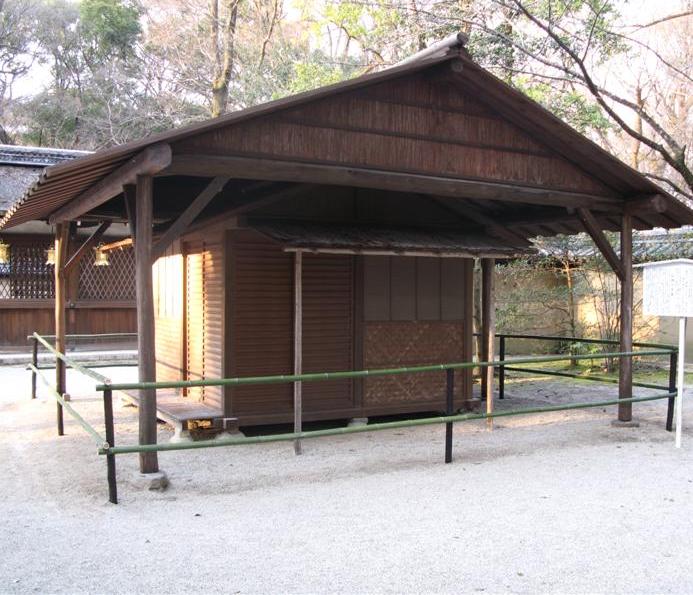
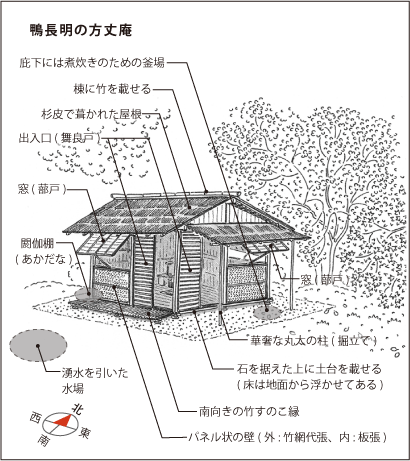
Some time ago I wrote a post about suitable shelters for forest practice. Now I find that some scholarship into that subject has already been done, thanks to interest in Kamo no Chômei. Buddhist hermit of indeterminate lineage, Chômei is most famous for his essay Hôjôki (方丈記), or The Ten Foot Square Hut. And you'll never guess what that essay is about.

To this day there's a certain amount of fascination with his accommodations among fans. Very few of whom, interestingly, are in the English-speaking world. That the most complete and succinct source I could find was Japanese is perhaps not so surprising, but even the runners-up were German and Hungarian. (One wonders if their appreciation of Chômei might be insight into their cultures.)

Anyway, having perused these blueprints in three languages, I'm prepared to certify them. Chômei's hut looks entirely serviceable, without being excessive, and a fitting counterpart to the similar cribs of Ryokan, Issa, and Thoreau.

Perhaps the man himself put it best:
But in this little impermanent hut of mine all is calm and there is nothing to fear. It may be small, but there is room to sleep at night, and to sit down in the day-time, so that for one person there is no inconvenience. […] If one knows himself and knows what the world is he will merely wish for quiet and be pleased when he has nothing to grieve about, wanting nothing and caring for nobody.


UPDATE, 21 June 2014: A reader directed me to this excellent video tour of Kamo no Chômei's hut. Check it out!


(Photo of Kamo no Chômei's preserved hut by David Dorsey; diagrams by アトリエかわしろ一級建築士事務所 and Carpe Diem Teaház.)

Thursday, 29 May 2014

Getting To The Point


Like most Western Zenners, I come to this practice from a life of emotional trauma. More than once, I've stood at that point where you realise, after a long, desperate march, that the cause is lost; there's no going back, or even holding on. You can only let go, and let karma happen.

What comes next, if you practice attentively, is insight and growth, but that instant of acceptance, when you see it's all been delusion, is sacred. (If only in hindsight.)

ELO's Getting To The Point expresses that state perfectly. Founder Jeff Lynne's goal for his appropriately-named Electric Light Orchestra was to bring classical music sensibilities to pop – which is why the execution here is so reminiscent of Beethoven. His song texts, tolerated largely to carry the melody, were correspondingly fatuous for the most part. But this one reads like Japanese poetry, riding a dramatic score to devastating effect. Throw in a masterful flourish of wailing sax, so emblematic of the power balladeers (Bruce Springsteen, Billy Joel, Mark Knopfler, Gerry Rafferty, Don Henley) of the late 70s and 80s, and you've got ELO's most moving song.

Which is either ironic or prescient, given that, in eerie echo of another revolutionary British band, it was also the last single they ever released. Sadly, an untimely distribution glitch prevented most people from hearing it, leaving one of pop music's most seminal groups to slip unmemorialised over the horizon.

Until today. Give it a spin.


GETTING TO THE POINT
by Jeff Lynne

It's out of control
Out of control
And there's nothing I can do now
Out of control
Out of control
Spinning softly through the blue now
And look beyond these walls
As the meaning starts to dawn
It's getting to the point
Getting to the point

It's out of control
Nothing I can do
Like a fire that keeps on burning
And nobody knows
What I'm going through
And the thoughts just keep returning
And all you had to say
Was that you were gonna stay
It's getting to the point
Getting to the point
It's getting to the point

It's getting to the point
Where nobody can stop it now
It's getting to the point
Of no return
And all that I can do
Is stand and watch it now
Watch it burn, burn, burn

It's getting to the point
Where reasons are forgotten
It's getting to the point
Where no one knows
And all that I can do
Is say I'm sorry
But that's the way it goes
Getting to the point

Forever is a long way
Forever takes your breath away
I'd like to talk about it
Try to understand
It's getting to the point
Getting to the point

It's getting to the point
Where nobody can stop it now
It's getting to the point
Of no return
And all that I can do
Is stand and watch it now
Watch it burn, burn, burn

It's getting to the point
Where reasons are forgotten
It's getting to the point
Where no one knows
And all that I can do
Is say I'm sorry
That's the way it goes

It's getting to the point
Getting to the point