Thursday, 13 August 2015

Shipwrecked

I recently re-read a journal I kept in January 2003, during the period of my divorce. I was struck by the events and emotions it recorded, and particularly the role of meditation and Zen in helping me weather them. Although the period was one of the hardest I've traversed (and there are lots of candidates), in some ways I remember it as the best. The log, which I kept to gain insight into my mood swings (and, I confess, to have someone to talk to) ends up documenting a proven strategy for surviving adversity. So for the benefit of others in similar straits, I'd like to share a few reflections.

The first pages, written when my wife was still living with me but flaunting an affair – and getting in a lot of gratuitous cruelty on the side – are especially gruelling. I was living in the great Canadian G.A.N. ("God-Awful Nowhere"), 3000 miles from my family and friends, in a culture (Québec) that wasn't mine, with no car or income. In short, I was in an abusive relationship and there was no escape. No wonder those paragraphs are so full of angst and fear.

A litany of suffering is listed there: ghastly nightmares; medical issues; niggling terror; my wife's sneering, baiting jibes; and conversely, the odd oasis of peace and reflection. Most of the latter are associated with meditation; I had been sitting twice daily for nearly a year, and snowshoeing in the forest, during which I often meditated as well. Then, suddenly, after my wife announced the date of her departure, a marked drop in stress. Pointed insight, if only in retrospect.

The role of my growing monastic practice in enduring all of this is clear in entries such as:
Good AM meditation, followed by Zen study and tea. Sunny in my cell [a tiny room in which I barricaded myself, often for whole days]. Attitude rises. Productive day. Some sadness at night, before PM meditation. The sit was OK. Cut branches outside this afternoon. Felt very good during and after. Work helps.
Yet I took her actual leaving surprisingly hard. Surprising, I say, because I'd quite had enough of her by then; I was eager to live in a whole house, in peace, without a demon from some Buddhist parable whose personality had dwindled to just two channels: cold and screaming.

I've long since forgiven, in light of what I've learned, and no longer take the abuse personally. But I vividly recall what life was like with her. So it's interesting now to read the lines of grief and despair I wrote the day she left.

Still, the bedtime entry, last one in the log, sums it all up:
Things remained sad and shaky until I meditated at 10PM, for almost 50 minutes. Now I'm still sad, but less so.
Because the journal ends there, it doesn't detail the accruing strength and calm of the following months, due in part to the full-on monastic discipline I adopted. Nor does it record the inevitable relapses, when depression and desperation paralysed me for an hour, or a day – or in one instance, four straight days – before I took up the practice again and forged on to healing. But the seeds of that story germinate in the telegraphic chronicle of the last month of my marriage.
Things don't happen to me,
I wrote toward the end,
they just happen.
And then, in response to my wife's constant insistence that I was the source of all her unhappiness:
They don't happen to her, either.
Zen saved my butt, and not for the last time. I'm a monk today for the same reason my grandfather remained an FDR man till the day he died: not for theory or pretence or cachet, but from sheer fire-hardened memory. So if you're suffering, be assured that you're not alone. Others have been there – others still are – and there's an end to it.

In my case, the Four Noble Truths, and the practice they inspired – not just reading and reflecting, but the actual doing – were that solution. It may be for you as well. Any road, you might as well try; sitting is free.

The path is always there, regardless of trailhead. May we walk it with the Buddha's own diligence and humility.

  • Readers interested zazen [Zen meditation] will find good instructions here.
  • Zen students suffering through depression or despair will find support and companionship here.


(Detail from Winslow Homer's Gulf Stream courtesy of the Metropolitan Museum of Art [Catharine Lorillard Wolfe Collection, Wolfe Fund, 1906] and Wikimedia Commons.)

Wednesday, 12 August 2015

WW: Forest fire sunset


(The fire is a few miles west of this ridge; prevailing winds brought the smoke this way, creating this bloody [and I mean that literally] sunset.)

Thursday, 6 August 2015

Enlightenment Kyôsaku

Toyokuni II - 8 Famous Views (Meisho Hakkei), Night Rain at Oyama (Maya Mountain)

Why chatter about enlightenment?
Listening to the night rain on my roof,
I sit comfortably, with both legs stretched out.

Ryokan


(Photo of woodblock print Night Rain at Oyama, by 二代目 歌川豊国 [Utagawa Toyokuni II], courtesy of William Pearl and Wikimedia Commons.)

Wednesday, 5 August 2015

WW: County fair triumph


(This sweet potato sprouted in a cupboard last Christmas. Instead of throwing it out, I stood it up in a flower pot. Spool forward seven months, and not only does it take the blue ribbon in its class at the county fair, but also the Growers' Choice award.)
#Zen

Thursday, 30 July 2015

Hermits Arrive


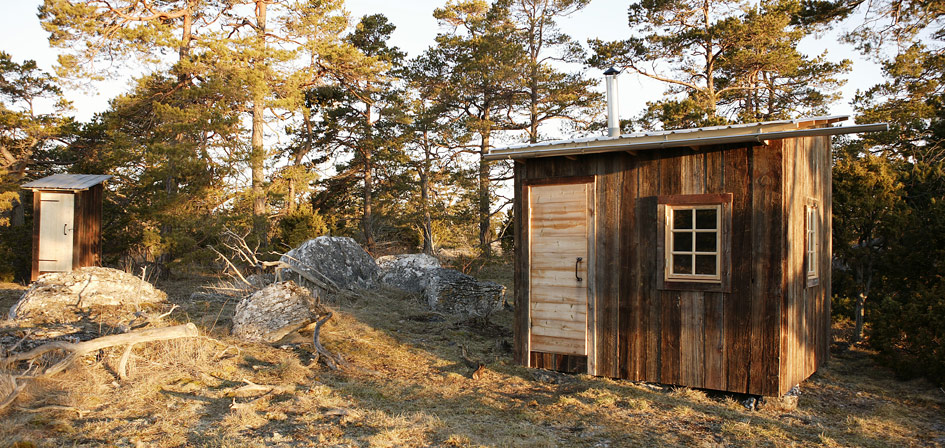
So I'm doodling around on the Enlightenment Superpath, and I surf into Arvesund, a Swedish company that makes prefab outbuildings. I browse through attractive garden sheds, summer cabins, sauna houses, and the odd lusthus, when suddenly I discover their Eremitens koja: a purpose-designed, so-designated hermit hut, from the drawing table of architect Mats Theselius!

My price inquiry to the company has gone unanswered, but another firm sells a kit to these lines, made entirely of recycled wood, for 96 500 Swedish kronor (about $11,300 Yank, at current rates). Models with new-wood exteriors sell for 79 500 SEK ($9,300 US); new wood overall for 67 500 SEK ($7,900US).

This is not the kind of money a hermit carries around; I could build at least eight such cabins for the cost of that lowest-price model. (Four, with woodstoves.) But I gotta hand it to the designer: he gets it. If it's true that some of the serving suggestions in Arvesund's literature are a bit, shall we say, spiritually encumbered, the dimensions and basic accommodations are entirely on-spec. This is indeed "just enough". Good on ya, Mats!

But the mere existence of this product raises a burning question: are we hermits becoming that thing that all populations must be to have legitimacy in the Red Dust World: a market? Will those glossy up-market magazines that pass for the Buddhist press soon be carrying adverts for elegant artisanal Japanese rice kettles and fair-trade rushlights made by Indonesian villagers?

Estimated Category of Risk: NBL.


(Photographs courtesy of Arvesund; front view located on Materialicious.com; interior and side view courtesy of Poppytalk.com; specs courtesy of SW Byggritningar AB.)

Thursday, 23 July 2015

Poem: As You Like It (The Hermit)

The habitation of a hermit

Through the magic of Twitter, I recently met Prabhu Iyer, a poet in Chennai (India). Among his many compelling works is a Hermit cycle that succinctly encapsulates the eremitical impulse and mindset. He has graciously given me permission to post a movement I particularly like here, and so I'm sharing it with you.

The envoi alone could serve as the motto on the Great Seal of the Nation of Seekers, if we had such regalia.


AS YOU LIKE IT (THE HERMIT)
by Prabhu Iyer

Let the film end before intermission
characters be underdeveloped
let the plot lie open like cut veins

and let the background score
resonate in the hall at its shrill note

It's a broken piece of the heart
cracked into two:
two faces reside here now
on either sides of the chasm.

Make whatever you wish out of it
Sweet or bitter end,
tragedy, comedy or farce
or thriller or horror,
write your own story, make it up.

take any road up the hill
to eternity beyond.


(Скит [Hermit Dwelling], by Аполлинарий Михайлович Васнецов [Apollinary Vasnetsov], courtesy of Wikimedia Commons and a generous photographer.)