Thursday, 17 December 2015

Hermitcraft: Trailer Park Samosas

Just in time for holiday entertaining, here's a killer recipe for an easy, addictive appetiser or side dish. Both the "Quick" and "Better" versions can be filled with either hamburger or lentils, suitable for omnivore and vegetarian alike, and the ingredients are readily available from most any North American supermarket. The "Quick" recipe is indeed quick: about half an hour from groceries to piping hot, fragrant samosas. The "Better" one takes a little longer, but is well worth the extra time if you've got it. (Note: both are also fairly spicy; for milder results, dial back or omit the jalapeños.)

Pastry for both versions:

2 tubes ready-bake crescent roll dough, for 16 rolls in all. Keep tubes chilled until the moment of use.

"Quick" filling:

1 tablespoon ghee or cooking oil
1/2 teaspoon minced garlic
1 tablespoon minced onion
1 1/2 teaspoons jarred jalapeños, minced
a few good grinds of fresh black pepper
2 teaspoons prepared curry powder
pinch each ground cinnamon and cloves (just a pinch; you shouldn't taste either in the finished product)
1/2 teaspoon powdered ginger
1/2 teaspoon chili powder
1/2 cup diced tomatoes
1/4 teaspoon thyme
1 tablespoon minced celery
1 pound very lean ground beef, or cooked lentils (about 1/2 cup raw)


"Better" filling:

1 tablespoon ghee or cooking oil
1 inch grated gingerroot
"Better" spice mix; beef or
lentils will be stirred into this
1 garlic clove (about 1/2 teaspoon), minced
1 tablespoon minced onion
1 1/2 teaspoons jarred jalapeños, minced
a few good grinds of fresh ground black pepper
1 teaspoon ground cumin
1/4 teaspoon turmeric
good pinch garam masala, if available
1/2 teaspoon coriander powder
pinch each ground cinnamon and cloves (just a pinch; you shouldn't taste either in the finished samosas)
1/2 teaspoon chili powder
1/2 cup diced tomatoes
1/4 teaspoon thyme
1 tablespoon minced celery
1 pound very lean ground beef, or cooked lentils (about 1/2 cup raw)

Instructions for both (all four?) filling recipes:

Preheat oven to 375F.

Warm ghee or oil in a heavy skillet over medium-low heat. Add all ingredients up to tomatoes, in order, and simmer gently until onion is translucent and spices are fragrant. Add tomatoes, thyme, and celery, raise heat slightly, and cook until celery is soft and mixture is pasty, scraping it frequently about with a spatula.

Add beef or lentils, mix thoroughly with spice mixture, and simmer until beef is browned or lentils have thickened, about 10 minutes. Scrape frequently with the edge of a spatula; if the mixture gets too dry, add a little water .

To make samosas:

Unroll crescent roll dough and separate into triangles.

Put a heaping tablespoon of filling in the centre of the wide end of each triangle. Pull up the short corners and seal them together on top of the filling; pull the long last corner over the top of the sealed short ones and around the back to form a round, filled pastry; pinch and seal all seams closed so that no filling shows. Place on an ungreased cookie sheet.

Bake at 375°F for 10 minutes or until golden brown. (Take care they don't burn; these bake very quickly.) Serve warm, wrapped in a tea towel, as finger food.


Wednesday, 16 December 2015

WW: Gift of my own blackberry wine


(I used to make blackberry wine every year, an activity I dearly loved. Sadly, life conspired to make the 2008 vintage my last. Last week I was rooting deep in a forgotten storage corner and came up with this: my last-ever bottle, which somehow escaped consumption.

But not for long. Brilliant Christmas gift.)

Thursday, 10 December 2015

Sound of the Season

1880 Christmas Osgood
Twelfth Month singers
seven feet away
a little one sings

Issa


(1880 American Christmas card courtesy of Wikimedia Commons and a generous photographer.)

Thursday, 3 December 2015

The Three Infinitudes

Galaxies in Hiding (Unannotated)

The length of time.
The depth of space.
The ignorance of people.


(Photo of one tiny chunk of space, containing over 200 galaxies [that's galaxies, brothers and sisters: each an aggregation of billions of stars, most of those presumably anchoring entire solar systems] courtesy of Wikimedia Commons, NASA, and the Hubble Telescope.)

Thursday, 26 November 2015

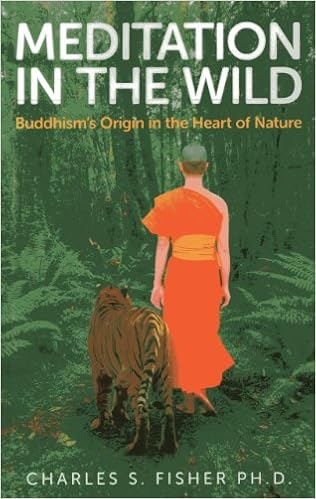
Good Book: Meditation in the Wild

In Meditation in the Wild: Buddhism's Origin in the Heart of Nature, Charles S. Fisher writes:
"Buddhism was born in the forests of India. [...] The Buddha found his original revelation while practicing as a forest monk. [...] He developed an understanding of nature which would become part of the remedy he proposed for the problem of human discontent. [...] He chose wild nature - the evolutionary context in which humans arose - as the place to do this. [...] He went to the place in the human mind where there is understanding without words."
The next 315 pages go on to prove his thesis.

Not that it's easy; as a quotation from Theravada scholar Richard Gombrich points out:
"So much of the material attributed to [the Buddha]… is so obviously inauthentic that we can suspect almost everything. In fact, it seems impossible to establish what the Buddha really taught. We can only know what early Buddhists believed he taught."
And this, as it happens, is very different from what we've been told. For example, some of their records maintain that Gautama encountered his famous Four Sights on the way to the forest, where he sat and pondered what he saw. Others suggest that the pivotal debate between Mara and Gautama on the eve of his Enlightenment was actually about the Devil's contention that the young man had no right to strive to end suffering. All those statues of him touching the earth, they contend, depict him saying, "Check it out, dipstick: I'm home. Go find someone who cares."

But outdoor practice was hard – even harder than it is now – with dangerous wildlife and tribal warriors still ruling the outback, and the impulse to organise was strong. Yet The Kindred Sayings of Kassapa show the Buddha "bemoan[ing] the passing of the forest way of life and criticis[ing] those who depart from it"; he may have gone so far as to advocate a straight-up return to hunter-gathering, according to texts that describe his sangha living off the land, hunting game, and never returning to the Red Dust World. The fact that Buddhism spread to new lands precisely as Indian forests were clearcut leads one to wonder what exactly the motivations of those first "missionaries" were. (It also throws intriguing light on the Bodhidharma story. Canon holds that when asked why he came all the way to China to sit under a tree, he replied: "Because this is the best tree in the world." Perhaps his actual words were something like, "Because you still have trees.")

Conjecture aside, the founding generation of Buddhists exhorted aspirants to imitate Gautama literally. Mahakasyapa, a member of the Buddha's inner circle, died a loud and proud hermit, as did no less than Sariputra, of Heart Sutra fame. Finally, reports of early Western observers – Greek travellers – confirm that the first Buddhists were itinerants, without clergy or temples.

But as the movement grew respectable and sedentary, hermits were increasingly viewed as "unsocial, possibly antisocial, and potentially dangerous to established Buddhism." This last repeated pious tales of the Buddha's forest practice, but openly discouraged others from emulating it. Old-school monks, known as "mahallas", were accused of backsliding and dissolution and reviled by the ordained. (Some verses quoted in Wild are stunningly similar to the rant St. Benedict unleashed on Sarabaites and Gyrovagues at an identical stage in Christian history.)

To be sure, over the past 2500 years Buddhist back-to-the-landers have continued to crop up; modern Zen and Theravada are remnants of two such rebellions. Possibly Wild's greatest gift is the two and half millennia of these forgotten reformers it lifts from obscurity. Along the way its author weighs the relative merit of individual cases. He reviews Issa's suburban eremiticism, which echoes most current hermit practices, with guarded approval, but – interestingly – takes Bashō, Ryokan, and Kamo No Chomei firmly to the woodshed.

And that's where I get off the train. In these passages, Fisher reminds me of Thoreau's critics, calling down suspects for claims they never made. His indictment of Bashō does ring, but he repeatedly spins individual innovation in self-directed practices as weak or duplicitous; in the case of Ikkyu, he indulges in crass bourgeois morality. Somehow, in all of his research on us, he missed our core vow: "I will neither take nor give orders." I may raise an eyebrow at others (OK: I do raise an eyebrow at others) but ultimately I have no right to deplore them. Licence to judge is a delusion of the ordained.

But this mild annoyance in no way diminishes the significance of Fisher's work. His journalism is both intrepid and thorough, penetrating the Thai forest lineage – a modern restoration movement – at length and documenting the gradual deterioration of Zen, from Bodhidharma's boldly-planted hermit flag, to the dismissal of 19th century hermit Ryokan (his own beefs with him aside) as a "lunatic". He finishes with an account of his own brushes with eremitical practice (Fisher is not a practising hermit per se, but is attracted to our forms) and a light survey of four contemporary American hermits. All in all, it's the most comprehensive treatment of the subject I've found anywhere.

And I found it impossible to put down. With any luck, Meditation in the Wild will stand for many years as Eremitical Buddhism 101 for sincere students of the Buddha's way.