Wednesday, 12 April 2017

WW: Retrogrouch

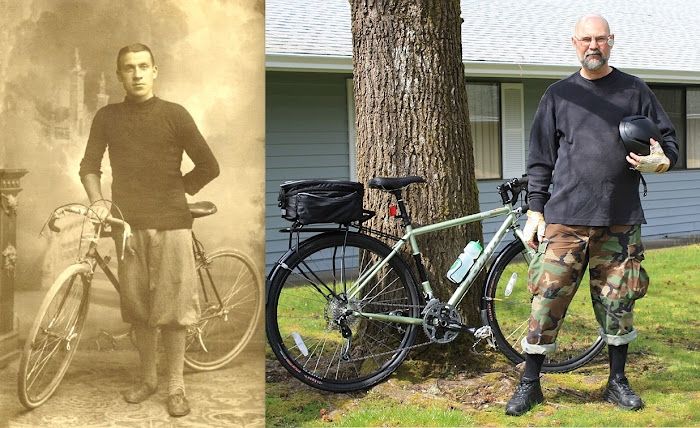
(So I'm getting ready for a ride and I happen to catch my reflection in the mirror.

Ho-lay.

A "retrogrouch" is a biker who bemoans the passing of older fashions and technologies that may not have flashed "I've got more money than I know how to spend", but also didn't look silly or fail to function.

I count myself a proud resident of that battered dustbin. If you're familiar with biking, you can't miss the symptoms: crocheted gloves; military surplus trousers; fad-proof helmet; German-made spectacle-mounted rearview mirror not made for decades; and the unforgivable Piece of Resistance:
toe clips.

Because I'm neither a racer nor Italian. Nor, for that matter, a fool.

Oh yeah, the attitude? Also regulation.

But I had no idea how deep it ran until I caught that glimpse. A few minutes on the Google, and it's diagnosis confirmed.

Either that, or transmigration is a thing after all.)


(Photo of my brother Vincenzo Milano – who was Italian, and a racer, and is probably swanning the bleeding edge – courtesy of GallerieFotografiche.)

Thursday, 6 April 2017

An Education

Asleep on my lap in bed.
Three days ago I had the sad duty of accompanying my mother's cat out of this life. A cherished family member, he's figured many times in these pages, most recently only weeks ago.

Since I was a child I've seen many pets die. It's been educational, in some ways more than human deaths. There's so little drama when an animal goes, so little desperation. Our pets seem to die as they live: with acceptance, if a little apprehension. When they become too sick to sleep well, you see this come into their eyes.

He was just ten years old, but probably had liver cancer for some time before it became debilitating, and therefore noticeable to us. Suddenly he became lethargic, lost his appetite, and started holing up in dark places. Most alarming, he refused to purr, no matter how much affection was lavished upon him. By the time we could get to the vet, I was fairly sure what I was going to hear.

That same day, before our appointment, he began crying, loudly and urgently. Mostly from fear of abandonment, it seemed. Therefore I stayed close to him, except when he was in the lab. At last the attendant brought him into the examination room, laid him on an old pink towel, and left us alone for a few minutes. He lay on his side, his breathing shallow, a dull, half-open expression in his eyes, as if in meditation. I stroked his soft, thick fur and struggled to tell him what a good kitty he was, how much I loved him, and to thank him for taking care of Mom these last years.

At last the doctor came. I fondled the kitty's ears as she searched for a vein. Her calm competence at the end of a long workday helped keep me from crying, as long as I breathed mindfully and remained silent. I did my best to remain present, and not confuse the observer (me) with the events.

It came fast when it came, with so little disturbance the vet had to tell me he was gone. I stopped petting and stepped back from the table, and she swept him up in the towel. The last I saw of him was his head and ears, disappearing through the swinging door.

You and I will be lucky to go so softly.

One of the great strengths of Buddhism is its recognition of the universality of life. I've known too many animals to believe there is some qualitative difference between sentient beings. Cats are born; they live, to the best of their ability; and they die. Scientists warn us not to be anthropomorphic about this, but I warn them back not to ignore the evidence. If it's true we can't know what's going on in an animal's head, it's also true we can't know what's going on in each other's heads, either. Yet decent people don't assume that we can't fathom the feelings of a crying stranger, just because when we do it, we're sad, scared, or in pain.

That would be stupid. And as I've often said, nothing stupid is Buddhist.

Animals may love differently from humans, but they love. And anything that loves is worthy of love.

Also: life – all life – is brief and unrenewable. So love now.

Because sooner than later, we all pass through that swinging door.

We called him Sherlock, by the way. We'll never know what his real name was.

Thursday, 30 March 2017

Shut Up and Drink Your Potential

Conformal Cats (8074241727) I was born on the crest of a tsunami of late-century self-help that's had a geological effect on our ability to think clearly.

The good news is that the worst is past. That was the period from the 70s to the Millennium, when such messianic gimmicks as Positive Mental Attitude (authentic 70s tip: the capital letters signal dippy fad ahead) laid waste to Western civilisation. But thirty years stoned on trademarked morality have taken their toll, and we're still dealing with the fallout from our protracted no-substance abuse.

I'm often given to reflect on this in Zen company. Western Zen draws heavily on what the 80s called "bobos" (bourgeois bohemians), a fetish of whom is rejection of consumerism, jingoism, xenophobia, homogeneity, and other questionable Western values.

All of which is fine by me. However, they may also indulge in baby-trashing, as when they spurn logic, empiricism, individualism, and circumspection. As a Wikipedia editor writes on the Positive Mental Attitude talk page:
More pernicious is the prescribed PMA [Positive Mental Attitude] in business and public governance, with consequences from a philosophy of over-confidence bordering on self-delusion along with lack of due diligence and just plain common sense.
Given that Zen circles are wont to tolerate such traps, and that they're negatively correlated with sanity (and therefore Zen), I rate it good sangha to lay down a few definitions. So-armed, the sincere meditator can navigate his or her way out of the maze.

Essentially, three terms are in play:

Strength is a synonym for resilience. Meeting a setback, strong people redouble effort; find a way around it; transform it into something useful; or decide, after sober reflection, to abandon that goal in favour of another.

Optimism is a character trait typified by strength. Faced with failure, an optimist says, "We can fix this, or do without it, or succeed at something else instead. One way or another, we'll press on." To correct a trite aphorism, an optimist sees the glass as half potential.

(By contrast, the pessimist sees the glass as all useless. "We can't fix this, and if we could it would only break again, so let's just wait for death.")

Denial is a negative character trait often confused with optimism. Denialists reject truth that annoys or frightens them, or simply doesn't serve their interests. A hallmark of denial is misdirection, i.e., defining things according to one's wishes rather than empirical data.

Presented inconvenient facts, deniers resort to censorship, intimidation, name-calling, and appeals to dogma to enforce or restore silence. These actions may be marketed as "strength", but they are logically its opposite.

Most of the PMA Moonies I worked with in the school system back in the 80s and 90s were more properly chronic denialists, unwilling or unable to address the daunting work at hand. Tellingly, they also couldn't sort a pessimist ("Don't attempt to solve this; we'll only make things worse") from an optimist ("Let's flush our problems into the sunlight and slay the crap out of them!").

In Zen we endeavour to look deeply. Any prejudice that obstructs our vision we engage to clear away. So let's first recognise that attitude isn't an objective phenomenon. The elephant tramples positive and negative monk alike, and any insistence that a cheery outlook can change that is magical thinking. (Which is a therapy term for delusion.)

What attitude does influence is our choices. An optimist might devise a response to the charging elephant ("I know! I'll use my feet to get out of its way! Because I'm awesome like that!"), whereas a pessimist might declare the trampling inevitable, thereby guaranteeing it. But in both cases, reality is influenced by a course of action (practice), not an attitude (perception).

In Zen practice, the two perspectives manifest like this:

P: "Do not criticise the teacher, the sangha, or the Zen community. It causes people to lose faith in the practice."

O: "The Buddha and the Ancestors have provided the tools we need to correct the errors of the teacher, the sangha, and the Zen community."

P: "I'll never practice properly because there is no teacher or Zen centre nearby, and the experts all say you have to have those." (Or: "… because my teacher or Zen centre isn't doing it right." Or: "… because institutional Zen doesn't do it for me, and everybody says you can't practice alone.")

O: "I can order my practice to conform to circumstances, among which are my situation and my nature. Or I can take a page from the Ancestors and continue as-is, seeking enlightenment in things as they are."

P: "Zen is grown lazy, sensual, namby-pamby, narcissistic, Confucian, political, hippy, poser, intellectual, bourgeois, institutional, Western, something. You can't truly do it in this time and/or place. The only genuine Zen is in the past and/or Asia."

O: "Zen is the best shot I've got. Ima do it."


That last one has saved my butt more times than I can count.


(Photo of cat realising her potential courtesy of Steve Jurvetson and Wikimedia Commons.)

Wednesday, 29 March 2017

WW: The ocean giveth


(Latest fudo ring, collected from the beach after a storm.)

Thursday, 23 March 2017

Meditation Meditation


"You start out feeling, 'Oh Lord, I hate this' and then later on you feel 'Oh boy this is wonderful', and you're wrong both times."

Robert Pirsig


(Photo of Zen monk striking call to zazen courtesy of Wikimedia Commons and a generous photographer.)