Thursday, 8 February 2024

Religion Kyôsaku


"Don't try to use what you learn from Buddhism to be a Buddhist; use it to be a better whatever-you-already-are."

His Holiness the 14th Dalai Lama


(Photo courtesy of Jordan McQueen and Unsplash.com.)

Wednesday, 7 February 2024

Thursday, 1 February 2024

The Trilobite Koan

Let's clear up a pernicious gaffe.

The fundamental tenet of Darwinian theory is not that the strongest survive.

That's been arrogant-prick propaganda from day one.

Rather, the fundamental tenet of Darwin's hypothesis is that the fittest survive.

Among humans, fitness boils down to one thing: living in a group that prioritises coöperation. Members of that group not possessing this instinct weaken the unit's ability to meet survival challenges; something our species only does collectively.

If obsolete members gain too much influence, whether through numbers or other means, and so draw below parity the group's ability to overcome environmental obstacles, your band collapses, leaving you to fend for yourself. In our species, that usually means dying without (further) offspring.

If, on the other hand, you're lucky and/or sufficiently evolved, you might earn membership in a new group. Thus the trend among human cultures has been to privilege coöperating individuals over those who compete. (In-house, at any rate.)

Spooling forward, we find humanity overall becoming less churlish by comparison with ancestor species; more drawn to novel others whose very difference suggests obtainable value, and less given to reflexive fear and attack.

(Note that these generalisations, like all evolutionary principles, apply only to the species as a whole. They don't apply to individuals – or, in the case of humans, individual cultures – and take no account of the infinite temporary tidal patterns within the gene pool.)

When the bulk of our community becomes unable to apply the essential human survival tool of sociability in amounts sufficient to clear the next hurdle, our species will lie down with the trilobite and never been seen again.

In view of this scientific fact, I propose a question:

In what ways must our Zen practice – each one – change to meet this existential imperative?


(Photo courtesy of the Houston Museum of Natural Science, Wikimedia Commons, and a generous photographer.)

Thursday, 25 January 2024

Street Level Zen: Nihilism


"He's a nihilist."

"That must be exhausting."

– The Big Lebowski


(Photo courtesy of Pexels.com and a generous photographer.)

Wednesday, 24 January 2024

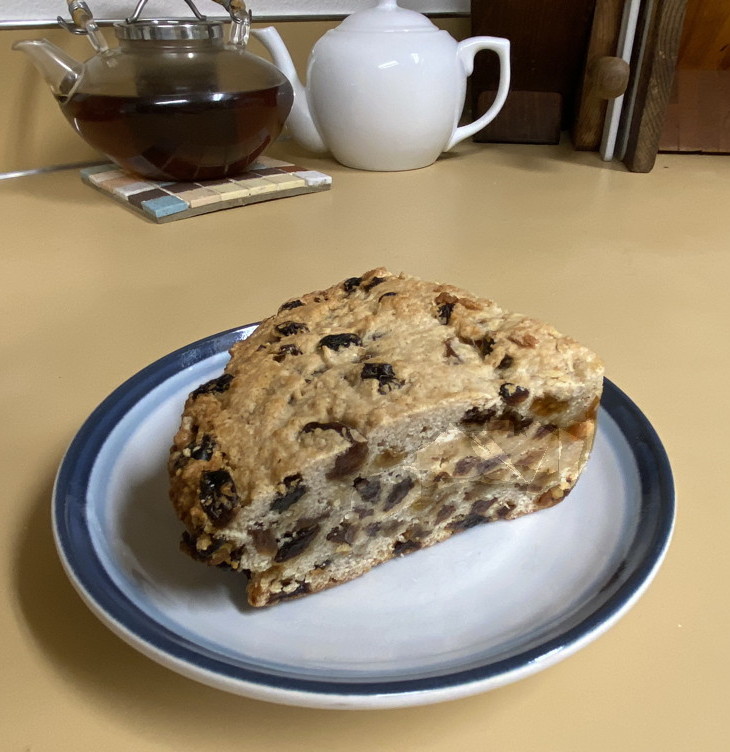
WW: Bachelor cake


(Last of a traditional Scottish bachelor cake that I baked for Christmas. First time in 30 years. Still just as good.)

Appearing also on My Corner of the World.

Thursday, 18 January 2024

Secret of My Success

Rosa 'George Burns' JBM 1
"The secret of writing about Zen practice is sincerity, and if you can fake that, you've got it made."

My riff on a quotation from George Burns. Or Jean Giraudoux, or Groucho Marx, or any of several other posited sources. It's likely an old saw from Yiddish theatre or similar Jewish art form. Not only are many proposed authors [none of whom claimed to invent it] Jewish, but the quip itself has the distinct salt of Hebrew insight.


(Photo of a 'George Burns' variety rose courtesy of Nadia Talent and Wikimedia Commons.)

Thursday, 11 January 2024

One-Legged Meditation

Nagasaki One Legged Torii C1946
Though this seems at first glance avant-garde sculpture, in real life it's the famous one-legged torii of Nagasaki.

You can fill in its backstory yourself.

This Shinto devotional object was just another spirit gate, like thousands of others in Japan, until retrofitted for the Atomic Age by the US Air Force. The survivors took its still standing, despite the instant destruction of their entire city and the amputation of over half the monument, as an icon of hope. While rebuilding their home, they carefully preserved this gate, unmoved and unrestored, in front of the shrine that no longer existed behind it. (Though it soon would again.)

Today both are close-pressed by modern urban development, quite unlike the quiet neighbourhood in which they started, though neither has travelled so much as a yard since the day they were built.

And though all of this is as Shinto as it comes, I can't help but find commanding Zen significance in it, too.

To me, that war-veteran torii's silhouette – gates being a foundational metaphor for us, too – speaks to the nature of enlightenment practice. You practice where you are, how you are. If you lose a leg, you practice on the other.

And if an atomic bomb annihilates everything you know, you practice in the remains.

Nothing to do with machismo; it's just that you have no alternative.
Sanno torii and camphor trees

I'm particularly touched by the Little Apocalypse – the tidal wave of concrete that drowned shrine and spirit gate in a matter of decades. Because while I struggle to imagine their Great Apocalypse – it's just more horror than my mind can honestly grasp – I've lived, and continue to live, the little one over and over.

Thus the sight of that silent, single-minded symbol of trust and true nature, standing up to its chin in a mindless race to oblivion, has special relevance for me. In that sense, notwithstanding religious distinctions or the brutality it's survived, we're comrade monks.

It's simply the most succinct expression of Things As They Are that I have found.

Today humanity is flirting with holocaust at least as hot as WWII. Given the geo-engineering challenges we choose to ignore; our growing embrace of political ideologies long proven suicidal; and the diplomatic tools we beta'd at Nagasaki, this could reasonably be the end.

It's difficult for me as a historian, a Zenner, and a decent guy, to remain in harness in the midst of our extinction.

So, what to do?

Well…

Sit down.

I'll also be keeping a photo of the one-legged torii of Nagasaki somewhere in the house, where I can see it.

Sanno-jinja-afterbomb


(All photos courtesy of Wikimedia Commons. Contemporary view also courtesy of Frank Gualtieri. View of torii after blast from bottom of stairs also courtesy of U.S. Strategic Bombing Survey, 1945; Committee for Research of Photographs and Materials of the Atomic Bombing; Nagasaki Foundation for Promotion of Peace; and the Nagasaki Atomic Bomb Museum. Torii's eye view of the devastated city also courtesy of 林重男 [Hayashi Shigeo].)