Showing posts with label mountain. Show all posts
Thursday, 2 April 2026
What Men Want
A Substack meditation on the emotional lives of men has been making the rounds. Fruit of Drunk Wisconsin, whose timeline is one of those digital live traps that will keep you scrolling and surfing all day if you're not careful, Men Only Want One Thing (And It's Disgusting) is that rarest of things: a brief, well-written rumination on the never-asked question of what men want.
Given cultural assumptions on this matter, if you're not a man, you likely haven't the slightest accurate idea.
If, on the other hand, you're one of "those" men, you'll probably be disgusted by the whole thing. Look, brother, the writer warned you.
And if you're here among us left–overs, you may feel that welter of repressed, conflicting emotions that signals a direct hit.
For further proof, check out the comments below the Substack post. Important: read the text first, and only afterward the comments. If you reverse that order, you'll lose the ability to read the post at all.
Because bombarding a challenge with self-mocking parody is the jiu jitsu of the reflective male. (If you thought it was middle school insults embedded in dripping sarcasm… see "those" men, above.)
Let the author of this pithy, penetrating, precise manifesto be Exhibit A.
I'd say "I feel seen", but the truth is I feel x-rayed.
(Photo courtesy of Pixabay.com and a generous photographer.)
Wednesday, 1 April 2026
WW: Desert snapshot
(Photo taken during my outbacking trek through the Columbia Basin last summer. Mt. Rainier in the distance.
Open in a new tab to see it to better effect.)
Thursday, 19 September 2024
The Mountain Kyôsaku
Wednesday, 17 July 2024
WW: July mountain
Thursday, 5 October 2023
Ango

True nature;
It is on this mountain.
Because of the heavy mist, the exact location is unknown.
– An Ancestor's commentary on the Mumonkan.
(Photo of a North Coast mountain that looks remarkably similar to the one were I sat ango, courtesy of John Fowler and Wikimedia Commons.)
Topics:
100 Days on the Mountain,
ango,
Gateless Gate,
hermit practice,
mountain
Wednesday, 17 May 2023
WW: Mt. Rainier
(Open in a new tab for a better view.)
Appearing also on My Corner of the World.
Thursday, 23 December 2021
Wednesday, 20 October 2021
WW: Sitka mountain ash
(Sorbus sitchensis. AKA rowan.)
Appearing also on My Corner of the World.
Topics:
hermitcraft,
mountain,
rowan,
wild edibles,
Wordless Wednesday
Thursday, 4 April 2019
The Easter Effect

spring breeze...
packed with people
the mountain temple
Issa
(Photo courtesy of Maria Yamaguchi and Wikimedia Commons.)
Thursday, 18 October 2018
The Mountain Wins Again
I recently happened upon an interesting moment in Season 6, Episode 4, of Gimlet Media's Startup podcast. (Transcript here; download podcast from iTunes or wherever you get your podcasts.)At issue is Jia Ruhan, a Chinese opera singer groomed to become her country's Céline Dion, with hopes she would put it on the international pop music map. Things didn't work out – such outcomes are hard to plan – and now she lives in self-imposed seclusion, having heeded a spiritual call.
At one point the interviewer asks:
"So as a kid, at first you wanted to be a dancer and then a musical star. Then the government has this goal to make you like a global star. What do you want to be now?"
To which Jia replies:
"I want to be a hermit. Truly, exactly, I really want to be a hermit."
A statement of which the young American reporter appears entirely to miss the import. Her voice takes a quizzical tone, as if Jia were joking. The interviewer then exposits:
"After Ruhan left the [pop music] project, she went through some big life changes. She made another album on her own, but after that, she realized she was burnt out and needed a break. She got really into Buddhism and silent meditation. Our two-hour phone call was the longest conversation she’d had in six months. So the state-backed pop star who was supposed to help China become cool… for now, she wants to be a hermit."
That last line is delivered with an ironic inflection, as if Jia had silently added "... or whatever."
I like this podcast. And nobody can know everything. But in this case, the production team dropped the ball. Jia Ruhan comes from a nation with a millennia-old continuing tradition of literal hermits: individuals who retreat to the Zhongnan Mountains to practice eremitical monasticism.
So she wasn't being cute when she referred to herself as a hermit. In point of fact, she aspires, or at least wishes, to be a hermit nun: a monastic practicing alone, under her own rule, almost certainly in the Zhongnans.
I had to smile at the reporter's reaction. It's a true cross-cultural miscue, turning on the fact that Anglophones currently use the word "hermit" pejoratively. ("Don't be such a hermit! Come out and talk to our guests!") In fact, we've used the term sardonically for so long that many of us can no longer define it; for most, it's become a synonym for recluse.
Which doesn't actually bother me. But I do get a little frosted when the Western Zen establishment calls hermits fraudulent and heretical – when not flat-out calling us extinct. Zenners should know better. Or hey, maybe just practice their religion.
Interested parties may wish to consult Assignment Asia: A modern-day hermit in China. It may be a bit precious, but that's to be expected from a government production.
It does seem that if a Communist dictatorship can accept, and even boast, the ur-monks in its midst, it's not too much to ask the rakusu set to back down a peg.
Anyway, I nodded while listening to Jia Ruhan talk about her ambitions. To say I totally get it would be an understatement.
Peaceful path, sister.
(Panel from Fan Kuan's Travellers Among Mountains and Streams courtesy of the National Palace Museum, Taibei, and Wikimedia Commons.)
Topics:
China,
hermit practice,
Jia Ruhan,
mountain,
music,
podcast,
video,
Zhongnan Mountains
Thursday, 7 July 2016
Rock Groups 2016
The rules remain the same as they are every year:
1. Anybody can use any of these band names; I claim no form of copyright or trademark on any of them.
2. That said, be aware that some of these bands may already exist. (And some names may be taken by non-music projects, such as the Internet browser that stole "Iceweasel" from me, probably before I even thought of it.)
3. If your group decides to take one of these names, all I ask is that when people ask you where you got it, you say, "A Zen hermit gave us this name." Because that's, like, an awesome origin story.
Where a genre suggests itself, I've included that meditation. Such proposals are for your consideration only; if your Cookie Monster metal band wants to take a name that sounded like a jazz ensemble to me, I stand corrected.
And now:
Rock Groups 2016
Baby Goes Boom
Opie's Maw (all female alt-country band)
Box o' Rocks
Kalakala (North Coast First Nations rock band)
Dormouse (psychedelic)
Metal Rain
Titanic Mushroom
Hitler GIF
The Tailfins (50s rock)
One Horse Town
The Trust
KOCMOHABT
Dr. Strangepork
The Zouaves
Dred Scott
Terd O'Hurtles
Blood Moon
Scred
Tinfoil Fedora
The Chocolate Teapot
Mudd's Women (all-male group)
Gastropod
Possible Soup
Henge
03 (pronounced Ought Three)
Tone Def (rap parody)
Blowtorch
Sloboda
Death Zipper (Canadian metal)
The Screaming Carrots
Hammer & Tongs (British folk rock)
Mysterious Meat
Sonar
Magnet School
Axolotl
The Love Dogs
Steel Penny
The Flashbulbs (warning: apparently there's already a musician called The Flashbulb)
Gizzard
SpicePeach
The Walking Stereotypes
Klo Zen Plā (old-school rapper)
Voynich
Origami Ethos
Quảng Đức's Heart (political rock)
Doctor Dregg and the Maniacal Plan
Haakon
Monkey Wrench
Kutter
Bucket of Dumb
(Photo of the original rock group courtesy of Sam Boulton Sr. and Wikimedia Commons.)
Thursday, 22 October 2015
Stupid Wisdom
It helped. I don't know why.
Not long after that I fell in love again, and not long after that, got bounced again. Days later found me high on a sheer rock face, alone, with little experience or equipment.
I almost didn't survive that one.
That September morning remains vivid, these many years later. A scent of sun-baked basalt and cool alpine breeze, the memory of grey stone driving into my gut like a lithic fist, and once again I'm crimped over the ledge, cheek pressed against the Olympics. Below, the toes of my hiking boots are wedged against a shallow nub on an otherwise featureless wall, while above I'm literally clinging by my fingerprint ridges to the shelf. Suspended between worlds, I am simultaneously of one piece with the mountain, and apart.
Backing down is not an option; toeholds are few, and I can't see to find them. I can't climb up for the same reason. So I cling, and ponder. Indian summer makes my palms sweat, and that makes them slip, in tiny jerks that send electric jolts through my body. Yet I'm strangely detached, as if it's happening to someone else.
I suck a lungful of air, and my expanding chest deducts another quarter-inch from my account.
The fall, fifty feet to jagged rocks, will surely kill me. I could channel my strength into a desperate upward surge, but my boots might slip and their weight drag me to my death. On the other hand, if I deliberate much longer, the problem will solve itself.
Calmly, I choose to panic.
Knotting the muscles in my legs, I shove off hard, back arched, arms thrust forward like an Olympic swimmer. My face slams into the outcrop, but my fingertips find a crevice. I jam my knuckles into it, lips numb and swelling, head throbbing, and dangle. My boots kick briefly in the void, then find a ripple of their own. Chin clenched against the ledge, I cling and gasp, and wait for the nausea to pass. A rivulet of blood trickles down the rock and into my tee shirt collar. But I'm well-belayed now, hanging by my own skeleton. A heavy heel flung over the rim, and I throw my arse into the job to flop myself onto the deck like a halibut.
For a long time I just laid in the hot grit, trembling, one arm tossed over my eyes. At length, choking on blood now flowing backward, I rose to half lotus, clamped a bandana over my nose, and panted through my mouth. Golden morning whispered the dry grass in the cracks. A Steller's jay screamed in the treetops below, neon blue amongst the needles. Far below that a forested valley stretched pristine to the edge of the world.
The bleeding stopped eventually, and some time later, the singing in my spine. I swallowed cold water and laid back again.
That day I decided I'd got what I came for. Since then, my heartache remedies trend to solitary journeys through remote places.
Still dangerous. But not stupid.
(Adapted from Rough Around the Edges: A Journey Around Washington's Borderlands, copyright RK Henderson. Photo of a guy doing it right courtesy of Jakub Botwicz and Wikimedia Commons.)
Topics:
autumn,
bird,
book,
hermit practice,
mountain,
Rough Around the Edges,
wildlife
Thursday, 27 September 2012
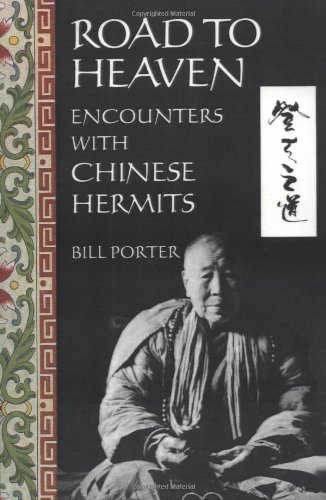
Good Book: Road to Heaven: Encounters with Chinese Hermits
In Road to Heaven: Encounters with Chinese Hermits, Bill Porter writes:
"Throughout Chinese history, there have always been people who preferred to spend their lives in the mountains, getting by on less, sleeping under thatch, wearing old clothes, working the higher slopes, not talking much, writing even less - maybe a few poems, a recipe or two. Out of touch with the times but not with the seasons, they cultivated roots of the spirit, trading flatland dust for mountain mist."
He ends with a declaration: "Distant and insignificant, they were the most respected men and women in the world's oldest society."
Road to Heaven is the memoir of Porter's 1989 hunt for Buddhism in the People's Republic of China. Theorising that in order to survive Mao's earth-scorching Cultural Revolution, any true practice would have had to return to its ancestral source, he spurned monasteries and struck out for the badlands. Which is already intriguing: an ordained cœnobite and authority on Buddhist scripture, with sixteen published translations to his name (and his ordination name, Red Pine), who respects hermit monks.
His journey starts at the toe of the Zhongnan Mountains, China's vast, rugged outdoor monastery, where Porter and a photographer friend drop by every ancient religious site he can find in the texts. It's depressing: landmark after landmark razed to the ground, or turned to profane ends by the Red Guards; books burned, practice banned, monks killed. There are still clerics around, but they live more like bureaucrats than monks. And they assure Porter that "nowadays, all monks live in temples." (I guess some wars are truly global.)
But Porter persists. Armed with fluent language skills, he follows a trail of hearsay off the pavement, and then off the road, and finally, in one instance, up a long chain bolted to a cliff. (Incredibly, he's given run of the Red Chinese outback, though The Man does contribute a few scary moments.) And up there, on the howling peaks where they've been for seven thousand years, he finds a whole flagrant hermit nation, pounding their ancient path as if the 20th century had never happened. And I'm not being glib; one subject interrupts him to ask, "Who is this 'Mao' you keep talking about?"
As the chronicle unfolds, Porter pieces together a practice that anticipates the Buddha by four and half millennia. It's œcumenical and anticlerical, and often not Buddhist at all: about three quarters of the hermits Porter meets are Taoists. And it turns out that they are the ones obsessed with nontheism and koanic thought and oneness. Thus the oxymoron of Zen Buddhism: the "Zen" part, isn't Buddhist.
Porter puts his profession to work for the reader, bringing in Taoist texts little known in the West, and fleshing out a religion that is a great deal more than Lao Tzu. Nor does he despise eremitic discipline. One informant tells him you must mix Pure Land and Zen equally, or the imbalance will throw you off the Dharma. (Taoism strikes again.) Another says he neither meditates nor chants: "I just pass the time." "Trying to stay alive keeps me pretty busy," agrees a female hermit, then tosses in a statement that should be carved on every hermit's lintel: "Practice depends on the individual. This is my practice."
Not all of the hermits Porter finds live in deep seclusion. Some have built sparse "neighbourhoods" in the mountains, cabins scattered within shouting distance of one another, and some have formed sketes, small numbers of hermits living under one roof. They also recognise urban eremitical vocations. But most striking for me was their universal self-respect. "These are the [Zhongnan] Mountains," states one. "This is where monks and nuns come who are serious about their practice."
Published in 1993, the text has a slightly dated feel, owing to the use of old-style transliterations (i.e., Chungnan rather than Zhongnan). Its resemblance to Amongst White Clouds, Edward A. Burger's documentary on the same topic, is due to the fact that Burger took his inspiration from the Porter book. But where the film is necessarily summary, Porter takes full advantage of his literary medium to go deeper, investigate nuance, and pursue explanations. Where Burger implies, perhaps by oversight, that all Chinese hermits pledge to a teacher, Porter finds Buddhist Associations (parishes) that require no permission at all to sit in their jurisdiction. And as I speculated in my review of the Burger movie, Porter does indeed encounter Zhongnan hermits who reject the notion of separate religions entirely.
The book finishes on a note both hopeful and challenging, not just to China but to Buddhism the world over. Just before leaving the country, Porter happens upon what had for centuries been a thriving urban monastery. Long empty, the place has recently been occupied, in the Wall Street sense, by a knot of Zen hermits. They brook no hierarchy; they have no abbot. And though their new home is falling apart, they are in no rush to restore it; the decay keeps the tourists away.
And they've come to practise.
"Throughout Chinese history, there have always been people who preferred to spend their lives in the mountains, getting by on less, sleeping under thatch, wearing old clothes, working the higher slopes, not talking much, writing even less - maybe a few poems, a recipe or two. Out of touch with the times but not with the seasons, they cultivated roots of the spirit, trading flatland dust for mountain mist."
He ends with a declaration: "Distant and insignificant, they were the most respected men and women in the world's oldest society."
Road to Heaven is the memoir of Porter's 1989 hunt for Buddhism in the People's Republic of China. Theorising that in order to survive Mao's earth-scorching Cultural Revolution, any true practice would have had to return to its ancestral source, he spurned monasteries and struck out for the badlands. Which is already intriguing: an ordained cœnobite and authority on Buddhist scripture, with sixteen published translations to his name (and his ordination name, Red Pine), who respects hermit monks.
His journey starts at the toe of the Zhongnan Mountains, China's vast, rugged outdoor monastery, where Porter and a photographer friend drop by every ancient religious site he can find in the texts. It's depressing: landmark after landmark razed to the ground, or turned to profane ends by the Red Guards; books burned, practice banned, monks killed. There are still clerics around, but they live more like bureaucrats than monks. And they assure Porter that "nowadays, all monks live in temples." (I guess some wars are truly global.)
But Porter persists. Armed with fluent language skills, he follows a trail of hearsay off the pavement, and then off the road, and finally, in one instance, up a long chain bolted to a cliff. (Incredibly, he's given run of the Red Chinese outback, though The Man does contribute a few scary moments.) And up there, on the howling peaks where they've been for seven thousand years, he finds a whole flagrant hermit nation, pounding their ancient path as if the 20th century had never happened. And I'm not being glib; one subject interrupts him to ask, "Who is this 'Mao' you keep talking about?"
As the chronicle unfolds, Porter pieces together a practice that anticipates the Buddha by four and half millennia. It's œcumenical and anticlerical, and often not Buddhist at all: about three quarters of the hermits Porter meets are Taoists. And it turns out that they are the ones obsessed with nontheism and koanic thought and oneness. Thus the oxymoron of Zen Buddhism: the "Zen" part, isn't Buddhist.
Porter puts his profession to work for the reader, bringing in Taoist texts little known in the West, and fleshing out a religion that is a great deal more than Lao Tzu. Nor does he despise eremitic discipline. One informant tells him you must mix Pure Land and Zen equally, or the imbalance will throw you off the Dharma. (Taoism strikes again.) Another says he neither meditates nor chants: "I just pass the time." "Trying to stay alive keeps me pretty busy," agrees a female hermit, then tosses in a statement that should be carved on every hermit's lintel: "Practice depends on the individual. This is my practice."
Not all of the hermits Porter finds live in deep seclusion. Some have built sparse "neighbourhoods" in the mountains, cabins scattered within shouting distance of one another, and some have formed sketes, small numbers of hermits living under one roof. They also recognise urban eremitical vocations. But most striking for me was their universal self-respect. "These are the [Zhongnan] Mountains," states one. "This is where monks and nuns come who are serious about their practice."
Published in 1993, the text has a slightly dated feel, owing to the use of old-style transliterations (i.e., Chungnan rather than Zhongnan). Its resemblance to Amongst White Clouds, Edward A. Burger's documentary on the same topic, is due to the fact that Burger took his inspiration from the Porter book. But where the film is necessarily summary, Porter takes full advantage of his literary medium to go deeper, investigate nuance, and pursue explanations. Where Burger implies, perhaps by oversight, that all Chinese hermits pledge to a teacher, Porter finds Buddhist Associations (parishes) that require no permission at all to sit in their jurisdiction. And as I speculated in my review of the Burger movie, Porter does indeed encounter Zhongnan hermits who reject the notion of separate religions entirely.
The book finishes on a note both hopeful and challenging, not just to China but to Buddhism the world over. Just before leaving the country, Porter happens upon what had for centuries been a thriving urban monastery. Long empty, the place has recently been occupied, in the Wall Street sense, by a knot of Zen hermits. They brook no hierarchy; they have no abbot. And though their new home is falling apart, they are in no rush to restore it; the decay keeps the tourists away.
And they've come to practise.
Topics:
Bill Porter,
book,
Buddha,
Buddhism,
China,
cœnobite,
Edward A. Burger,
hermit practice,
koan,
Lao Tzu,
monastery,
monk,
mountain,
movie,
review,
Road to Heaven,
Taoism,
Zhongnan Mountains
Thursday, 23 August 2012
Sweetgrass Butte
As I swung around a blind bend the scene suddenly turned to Dante: an entire mountainside razed black and smouldering, heat waves dancing over its charred crust. I cranked the window against its acrid fumes and proceeded with caution. Yellow cards staked along the verge assured me this was a fire-management burn, under the theoretical control of a man behind a desk in a town twenty miles away. The Forest Service was getting a jump on wildfire season, burning the scrub and slash from this clearcut slope while the still-forested ones were fresh enough to discourage disaster.
As the road caterpillared around the next ridge, Hell vanished behind me and I was cutting diagonally across vertical green pastures, one after another, bands of deer and cattle, and the occasional integrated society of both, browsing amid the wildflowers. The grandeur and freedom so mesmerised me that I forgot my resolve to stay alert and deferred to the hood ornament again. By the time I came to my senses it was too late: I'd sleepwalked onto another summit feeder, trapped on a sharp, thin track jutting cloudward at something like the Ram's maximum grade. To the left, nothing but empty space; the mountain cut away so steeply from my outboard tires that it disappeared beneath them.
But with no hope of turning around, and nothing lying between me and the Swan Dive of Retribution, I had no choice but to push this steep and squirrelly road to its bitter end. I flattened the accelerator and the truck leapt gamely forward while I clung to the steering wheel and struggled to maintain maximum thrust on a sinuous ribbon of dirt. At that moment, momentum was survival; stop for any reason, and I wouldn't have the traction on that pitched surface to continue forward. And the thought of having to back all the way down that winding scaffold froze me in terror.
So heart in mouth, eyes riveted on the empty stratosphere, I Buck-Rogered that screaming Dodge into the cosmos. The g's pressed my spine into the bench while I fervently prayed I didn't cross another Forest Service truck bent on validating Einstein on the way down.
Time dwindles to a drip at such moments; for an instant, truth stands in bold relief. Hanging somewhere between an unremembered beginning and an unknowable end, possessed of a theoretical but functionally inoperative ability to stop, I could only rocket, as if a Saturn V were strapped to my backside, up and out. Welcome to existence.
At last the road crested, with nothing visible beyond but open sky. The Ram shot into it like a truck in a TV commercial, seeming to lift off the earth, and then lit soft as a cat on a freshly-graded plateau. I trod the brake and we sprayed to a stop. As the dust blew past the cab, I discovered the wherefore of this goat path to the stars: two huge, battleship-grey communication towers, their microwave drums implacably fixing the horizon, utterly indifferent to the panting insect at their feet. Red masthead lights winked in the linty clouds, warning jetliners not to ding their paint jobs on the bristling antennae.
I rested my forehead on the steering wheel and drew a long, shaky breath. The trouble you get into with your mind in neutral. According to the atlas, I had arrived at Sweetgrass Butte, official edge of the twentieth century, and at 1860 meters, the highest point in the region.
I lifted my hat, passed a hand through my hair. The truck purred underneath, as unperturbed as if we'd stopped at a traffic light. Apart from sky and cloud, and icy gusts bouncing the truck on its shocks like a basketball, we were alone; if not for those antennae, we might have touched down on some distant planet.
I reseated my hat, shifted mind and motor back into drive, and etched a tight doughnut in the gravel. By standing on the brake, I was able to shinny the truck back down that rope to the mainline. This time I could see the cliff dropping directly from the right front wheel, down and down, to a knife-edged Road Runner gully miles below. Where, the crease being forested, I wouldn't raise so much as a dust ring, should that tire wander a few inches west.
When at last I reached the bottom, I found that the intersection well-signed. I had no excuse for the detour, except possibly lack of sleep.
(Adapted from Rough Around the Edges, copyright RK Henderson. Photo courtesy of WikiMedia and a generous photographer.)
Saturday, 10 September 2011
100 Days on the Mountain
|
| Day 37. |
The deal: A week ago I completed 100 days of hermit ango in the Willapa Hills, being the rugged, densely forested, sparsely populated southern frontier of my coastal nation. I spent each of those days attending to the needs of survival and practising meditation, both sitting and other. I also brought out 445 pages (and counting) of journal. These will be rockered into a book, but for the time being, I can summarise the experience as "deep and broad and one of the most worthwhile things I've ever done."
In the meantime, here are some photos. I had no camera, since possessions were limited to survival requirements, so "some" photos is pretty much all of them. But I offer them all the same, in deep gratitude for the opportunity to practice, and for the friends and fellow monastics who made it possible. Supplying these photos was the least of their contributions.
Facts in Brief:
I established camp on 83 acres of undeveloped hillsides, surrounded by much the same for miles in every direction. I was dropped on 26 May 2011, and remained in-country for 100 days.
![]() |
| View of my mountain from another one. |
The weather was... how do you say? Ah, yes. CRAP. To put things in perspective, let me explain to those not from the North Coast that our famous perma-rain is supposed, by custom and contract, to diminish through June, ending definitively on 1 July. After that date, glorious summer is to ensue and persist until mid-September, at which time the rain may begin again.
Thus, I sat, as I expected, in the bitter wet sopping dark through the full 30 days of June. Then I did likewise through July, day by day, night by night, week by week. Finally, on 1 August, the rain stopped. The grey kept on, but I'm cool with that. You can have the grey, July, just stop goddam raining on me.
So my host's gracious offer of the barn, including the wood stove and even his firewood, as laundromat and spa, proved vital in a summer that included a sit in full winter kit (tuque, gloves, and every stitch of clothing I owned on under my robe) on 4 July. And that wasn't the last.
At long last, mid-August produced a near-facsimile of summer, following clouded mornings with sunny afternoons, and only 1 full day of rain. I was even able to take the fly off my tent for several days, so only somewhat arctic had the nights become.
![]() |
Despite my sitting Three things will not be silenced Mind. Body. Tyvek. |
Sangha included, by partial account: Steller's jays; more configurations of garter snake than I've ever seen; kingfishers; salmon smolt; four species of owl; Douglas squirrels; bears; deer; alligator lizards; a young goshawk; otters; numerous colonies of paper wasp; beavers; bobcats; a special-ops unit of raccoons; a herd of elk; and an entire tribal confederation of coyotes. All of us closely monitored by a proprietary flock of ravens. (Full list to be included in the upcoming book.)
Finally, close friends made three scheduled proof-of-life visits during the ango. One dropped me off in May and made an emergency trip on Day 62 to verify my well-being, and another picked me up in September and bought me a cheeseburger and fries on the way back to the realm of people. And of course the couple who allowed me, with incredible generosity, to sit on their land all summer, and supported my practice in smaller but vital ways over the full 100 days.
And now the work begins. I'm hoping to have the book done soon. In the meantime, you'll be seeing excerpts and related material here.
And I'm glad the rest of you didn't blow yourselves up in my absence. Keep up the good work, eh?
![]() |
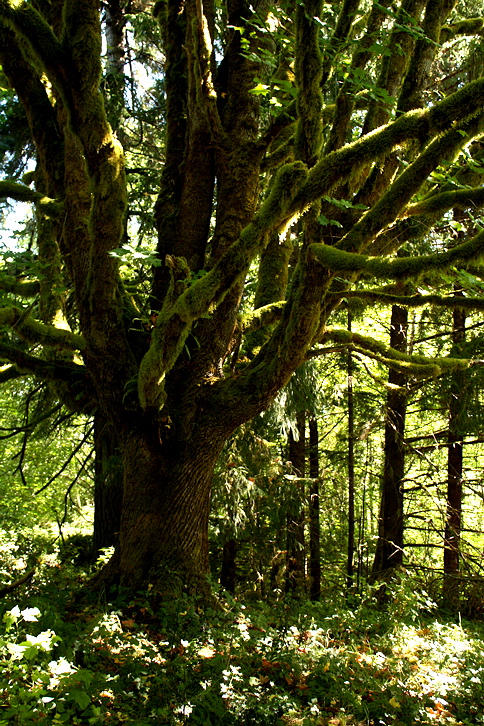
| The Bodhi Tree, a giant bigleaf maple, under which I sat. |
Topics:
100 Days on the Mountain,
ango,
hermit practice,
maple,
meditation,
mountain,
poem,
sangha,
walking stick,
wildlife,
Zen
Thursday, 24 February 2011
Good Movie: Amongst White Clouds
UPDATE (27 September 2012): My review of Road to Heaven: Encounters with Chinese Hermits, the book that inspired this film, can be found here. Among other things, it points out that hermits have actually sat in the Zhongnans for seven thousand years; it's just the Buddhists who arrived two thousand years later.This week I saw Amongst White Clouds, a terrific documentary on Chinese hermits. You can buy a copy at Amazon, or see it on YouTube with upgraded subtitles, until/unless they take it down.
Made by American hermit Edward (Ted) A. Burger, this film is a rare jewel of multiple facets. To begin with, very few American scholars learn other languages, even those that are central to their specialities. Burger, for his part, has devoted his academic life to mastering Putongua (Mandarin Chinese), and is likely conversant in one or more regional dialects as well. (But I was unable to confirm this; Burger's Internet presence is remarkably spare, for having made such an important film.)
Burger is also the disciple of a Chinese hermit master, and though the linguistic path may seem obvious for such a person, it is actually very rare for an American to "bother" with language under those circumstances. Burger's personal investment in his tradition's cultural context invests his work with unique authority. (Unfortunately, his convictions didn't extend to the film's subtitles. Though their tone suggests an unusual grasp of the original Chinese, many flash by so fast they'd qualify as subliminal. I found this frustrating, and I read fast.)
![]() |
| Burger and his master. |
The fact that Burger makes no effort to define his terms leaves some ambiguity in the work. He appears to consider a hermit someone living in a master-disciple relationship, as he himself did, though he doesn't
verify that all of his interviewees walk that path. (In an excellent interview with the Kyoto Journal, Burger uses the verb "ordain" to mean "become a hermit," i.e., "She ordained at a young age." Again, he doesn't define this term.) He also considers "Buddhist" implicit in the term "hermit," though I can virtually guarantee that if there really are 5,000 of us in those hills, at least some reject such labels.
But that's my hang-up; Burger's point is simply that old-timey hermits still exist in China. On the way he films about a dozen, of both genders and all ages, half of whom he interviews in depth. Each reveals a unique personality,
with a custom-designed practice. There are some wonderful moments of human warmth: a man my age laughs to think anybody would be interested in his unremarkable life; another is mystified that the hairy young barbarian introduced to him as "Edward" is called "Ted" by English-speaking friends; and my all-time favourite, the teenage monk who respectfully ignores the repeated orders of his deaf, 87-year-old master to "Speak up, boy! The man's making a movie!" In the end, Amongst White Clouds avoids the pitfalls of pious tribute on one hand and insensitive judgement on the other, to become an authentic if maddeningly limited glimpse of an ancient Zen path. It's also an amazing feat of anthropology, and an impressive cinematic accomplishment in which the land itself, the remote, densely-forested, canyon-steep slopes of this massive open-air monastery, is a character in its own right.
See it. You won't lament the time.
Subscribe to:
Comments (Atom)