Sunday, 17 April 2011

Rough Around the Edges: Vincente

Blue mottled border collie (The following is an excerpt from "Rough Around the Edges: A Journey Through Washington's Borderlands." Copyright RK Henderson.)

Humans are a novelty in the borderlands. At most you see a dormant pickup, careened on the shoulder, awaiting an anonymous driver off on who knows what mission. And even that's uncommon. Which is why I was startled, corkscrewing down a high-centre track in the Umatilla National Forest, pushing for yet another called the Kendall-Skyline Trail, to see a man, statue-still and silent, standing by the side of the road. No truck in sight; he'd just come to stand.

Shooting past I also saw the proverbial ten foot pole, its slim, flexible shaft propped against a fir behind him. This was either one of those dreams, or a story.

Skidding to a halt, I jumped down, camera in hand, my Man Friday watching with the liquid eyes of a deer prepared to dart back into the forest at the first alarm. I grinned and waved, and his round, olive face relaxed into a shy, almost childlike smile.

A small, compact fellow, scarcely five feet tall, with worn jeans bloused into black gum boots, and a thick woollen cap pulled down hard over his straight black hair. His pole, I now saw, was actually a long hook, and that, together with the bleating chorus from the woods and a whiff of wet wool on the wind, explained everything. His flock remained unseen, but three deadpan border collies skulked out of the undergrowth, halted at regulation distance, and scanned me up and down. They continued staring, rigid and mute as cast iron, for a good half-minute, then wheeled as one and disappeared back into the bracken.

"Mind if I take a picture?" I asked, hefting my camera.

The shepherd nodded once, and I squeezed off a shot.

"Thanks." I snapped the lens cap back on. "How long you been up here?"

Again the timid smile, and an apologetic shrug. Once, many years ago, I met a Basque shepherd in these mountains. My French had bailed me out that day. Now I instinctively reached for it again, but the man's dark skin and almond eyes caught the parlez-vous in my throat.

"¿Habla español?" I ventured.

His face split into a wide grin.

His name was Vincente, and he was from Peru. His awkwardness was not entirely dispelled by my lousy Spanish, and I learned that he'd been tending these sheep, with nought for company but three unilingual dogs, for several weeks. His features I now recognised from countless Inkan friezes; if a single Castilian corpuscle fouled those veins, it was damn quiet. I didn't press for specifics, but he'd apparently followed the same trail that led Scottish shepherds to New Zealand, Welsh ones to Patagonia, and Basques to Chile and the far American West.

I felt gifted for the accident, and privileged to have met him. Solitude is a skill, practiced professionally by very few in this age of robot lighthouses and flying fire watchers. If the wheels of commerce have ground most of us solitaries to dross, it was a comfort to know that there was still a place in these mountains for Vincente.


(Border collie photo courtesy of Wikipedia Commons and a generous photographer.)

Thursday, 14 April 2011

Hermitcraft: Ancestor Gong

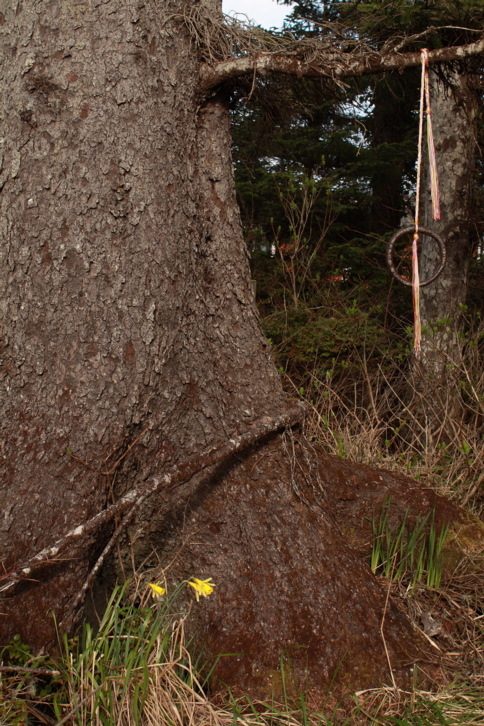
This is an ancestor gong I made from an old saw blade I found in my grandfather's shop. Each time you ring it, it sings gratitude for those who went before and made this life possible. Starting with my grandparents, who built the house I'm living in.

The blade sings nicely (I chose the best ringer in the lot), and gongs of this type have deep meaning for Old Settlers; time was, all the muddy, isolated villages on the Green Side had a big, worn-out head saw blade hanging in the square, along with some random piece of busted ironmongery to beat on it. That's how you got people's attention for announcements, fires, celebrations, and so on. Where there was no church bell, it called folks to that, too.

The symbolism in this particular blade goes even deeper, as my grandfather, his roots gnarled deep in this glacial till, was a congenital, nay compulsive, woodworker and builder. With this very blade he put the roof over me and the walls around. So with each stroke, this gong pays homage to all my people, conceptual and concrete.

The striker is a piece of hawthorn I cut on the property. The photo at right shows what it looks like now. This was originally finished in classic trinity tar (linseed oil, turpentine, and vinegar), but that mildewed in the rain. So I took the beater back down, sanded off the first finish and re-tarred it, this time with linseed oil, paint thinner, and vinegar, with half a part of asphalt to darken it up. I like the result, and after about two dozen coats of that toxic, no-more-mister-nice-guy tar, well-rubbed and hardened over the woodstove for a month or so, it's looking good out there.

The lanyard is six strand kongo kumihimo: four strands of tarred seine twine, two of gold mason line.

I try to ring this gong every day at noon. I give it one han roll-down, striving for perfect symmetry and tone. It's become part of my mindfulness practice.

Update, 5 November, 2011: It turns out that the saw blade eventually loses the ability to ring in this climate, evidently because of the heavy coat of rust it acquires. Today I replaced the original blade with another from my grandfather's pile, but it too will gradually grow duller. It would be fine for an indoor chime, though.

Sunday, 10 April 2011

Gun Control


(Click on photo, then open in a new tab to see it full size)

Razor clamming has been central to the local culture and economy since humans first arrived here. (Best current guess: 15,000 years ago. And counting.) We used to be allowed to dig any tide low enough, and the limit was, uh... so many I never had to know what the limit was.

Then when I was in high school, the combination of overdigging and a shellfish epidemic closed all the beaches, as in no more digging, ever. Together with a catastrophic failure of the logging industry, it blasted the whole coast back to the 1930s. We never fully recovered.

But back in the 1990s, fisheries biologists determined that stocks had bounced back enough to open the beaches for a day here and there, with a 15 clam limit. When the populations survived that, they authorised a few more openings. These days, we typically get a weekend per month between October and April. But it's no guarantee, and my suspicion is that what with development, and the Tribe fully exercising its treaty rights, we'll see fewer digs in the future.

But some openings this winter have put July 4 crowds on the beach. Digging that intense is harder and less profitable, especially for an old-schooler like me, who still digs with the traditional clam gun and his own hands. These days I'm often the only guy on the sand with a shovel, surrounded by tube-tuggers like the Seafair Parade.

So that's my solution: open the beach, ban the tube. Guns-only from now on, just like the day.

And if that doesn't work, by God: ban the gun.

We'll see who the real honkers are.


Cereal box prize:

Links to Buddhist movies galore, with synopses. Many are instructional, if you're into that. Also many feature films, like those periodically reviewed here. You many never need to leave the house again.

Thursday, 7 April 2011

I Get Off With A Warning

So it's midnight, and I'm meditating on the lower deck when my fat lamp suddenly goes out. With only twenty minutes to go, I decide to sit tight. (No pun intended.)


Until something literally almost climbs into my lap. I yell, and it scatters. After collecting a flashlight, I see this.


It's the night shift. (Note my zafu and zabuton in the upper right.)


They scope me out, more from procedure than concern.


"Don't look like much."


"Don't smell like much, neither."


"No worries, guys. It's just a big Buddhist monkey."


And they continue their rounds, as if no one were there.

No one important, anyway.

Wednesday, 6 April 2011

Street Level Zen: The Importance of the Possible


"Almost anything you do will be insignificant, but it is very important that you do it."

Mahatma Gandhi


(Photo courtesy of Vantha Thang and Pexels.com.)

Thursday, 31 March 2011

Good Movie: The Truman Show

I recently watched this again, for the first time since it came out 'way back in 1998 CE. I liked it then; the cultural themes were timely and important, and the plot, performances, and cinematography were excellent.

Then it disappeared from cultural radar, and I seldom thought about it again. In the intervening years I became a monk, and The Truman Show became a completely different film.

The premise is simple enough: a production company builds a giant set, peoples it with actors and advertisers, and drops in a real baby. Hidden cameras then broadcast Truman Burbank's entire life, public and "private", and the resulting 24-hour soap opera becomes the highest-rated show on the planet. The prescience is eerie; reality TV at that time was still limited to MTV space-fillers, watched mainly by high school kids.

Imagine. Just thirteen years ago, the notion of mass media dominated by voyeurism was still dystopian.

When we come in, Truman is a twenty-something insurance agent, raised on a steady diet of fear: fear of the new, fear of risk, fear of the unknown. The news juxtaposes reports of distant tragedies with glowing accounts of the seamless perfection of Seahaven, Truman's island fishbowl. (American friends encouraged not to read too deeply into this.)

But the kid isn't happy. Sure, he smiles a lot. He's cheerful, funny, upbeat. But something's wrong. For one thing, Klieg lights occasionally crash to the sidewalk, almost killing him. And the media's explanation ("airplanes") only works if you want it to.

And that's just the beginning. I won't spoil it for those who haven't seen the film, or haven't seen it recently, but anyone who's tasted alienation will relive Truman's travails: being forced to participate in advertisements for no apparent audience; the odd feeling, laughed down by one's peers, that choices are rigged off-screen; and the readiness of the world to break its own laws when convenient.

And the more insistently our hero questions all of this, the more desperately – even violently – he's smacked back into place.

Director Peter Weir's genius starts in the casting. I'm not an unreserved fan of Jim Carrey's trademark burlesque, but his Truman is so understated, so believable as a good-hearted schlemiel surrounded by users, that he quite won me over. He's just eccentric enough to be real – seekers are eccentric.

Ed Harris similarly nails Truman's "God," the intense, soft-spoken, beret-ed and bespectacled TV producer Christof. Self-important artistes are not Harris' stock in trade, but his grasp of this one is almost creepy. And Natascha McElhone, in a small but pivotal role, does one of the best jobs of playing an actual woman I've seen in a long time.

Like the main character in The Matrix, a film more deeply ingrained in the cultural zeitgeist, Truman is driven to confront a reality that is, if not exactly illusion, at least bowdlerised and rationalised to the point of absurdity. The great strength of Truman is that it delves into the process of coming to that epiphany, and the courage required to step beyond it.

In short, The Truman Show is great companionship for those of us who have been there, one that will keep you mulling and meditating its metaphors for months. (Not bad, eh? I just made that up.) Whether it will mean anything to others, I can't say, but at minimum it's a Feast of Good: good writing, good acting, and good directing.

Wednesday, 30 March 2011

Street Level Zen: Tuesday Night Kyôsaku

Spring comes to the
leeward garden


"The only appropriate attitude for Man to have about the big questions is doubt."
Bill Mahrer