
Wednesday, 14 February 2024


Thursday, 8 February 2024
Religion Kyôsaku

"Don't try to use what you learn from Buddhism to be a Buddhist; use it to be a better whatever-you-already-are."
His Holiness the 14th Dalai Lama
(Photo courtesy of Jordan McQueen and Unsplash.com.)
Wednesday, 7 February 2024

Thursday, 1 February 2024
The Trilobite Koan

The fundamental tenet of Darwinian theory is not that the strongest survive.
That's been arrogant-prick propaganda from day one.
Rather, the fundamental tenet of Darwin's hypothesis is that the fittest survive.
Among humans, fitness boils down to one thing: living in a group that prioritises coöperation. Members of that group not possessing this instinct weaken the unit's ability to meet survival challenges; something our species only does collectively.
If obsolete members gain too much influence, whether through numbers or other means, and so draw below parity the group's ability to overcome environmental obstacles, your band collapses, leaving you to fend for yourself. In our species, that usually means dying without (further) offspring.
If, on the other hand, you're lucky and/or sufficiently evolved, you might earn membership in a new group. Thus the trend among human cultures has been to privilege coöperating individuals over those who compete. (In-house, at any rate.)
Spooling forward, we find humanity overall becoming less churlish by comparison with ancestor species; more drawn to novel others whose very difference suggests obtainable value, and less given to reflexive fear and attack.
(Note that these generalisations, like all evolutionary principles, apply only to the species as a whole. They don't apply to individuals – or, in the case of humans, individual cultures – and take no account of the infinite temporary tidal patterns within the gene pool.)
When the bulk of our community becomes unable to apply the essential human survival tool of sociability in amounts sufficient to clear the next hurdle, our species will lie down with the trilobite and never been seen again.
In view of this scientific fact, I propose a question:
In what ways must our Zen practice – each one – change to meet this existential imperative?
(Photo courtesy of the Houston Museum of Natural Science, Wikimedia Commons, and a generous photographer.)
Thursday, 25 January 2024
Street Level Zen: Nihilism

"He's a nihilist."
"That must be exhausting."
– The Big Lebowski
(Photo courtesy of Pexels.com and a generous photographer.)
Wednesday, 24 January 2024
WW: Bachelor cake
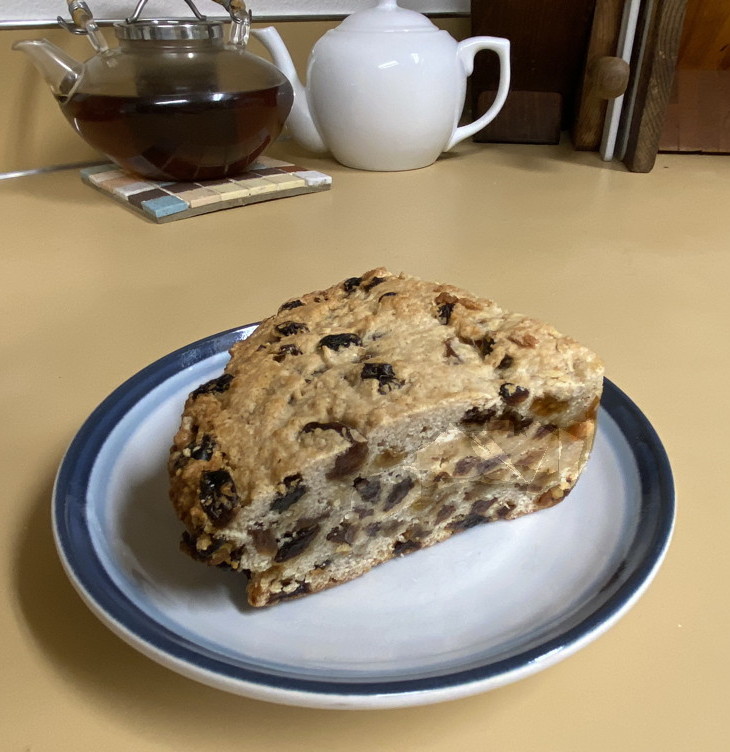
(Last of a traditional Scottish bachelor cake that I baked for Christmas. First time in 30 years. Still just as good.)
Appearing also on My Corner of the World.
Appearing also on My Corner of the World.
Thursday, 18 January 2024
Secret of My Success

My riff on a quotation from George Burns. Or Jean Giraudoux, or Groucho Marx, or any of several other posited sources. It's likely an old saw from Yiddish theatre or similar Jewish art form. Not only are many proposed authors [none of whom claimed to invent it] Jewish, but the quip itself has the distinct salt of Hebrew insight.
(Photo of a 'George Burns' variety rose courtesy of Nadia Talent and Wikimedia Commons.)
Subscribe to:
Comments (Atom)