Showing posts with label zabuton. Show all posts

Thursday, 13 April 2023

Hermitcraft: Towel Zafu

When I first became a hermit monk I had no zafu, so I sat on a sofa cushion. That got me off the ground – no pun intended – but was bulky, interfered with my thighs, and couldn't be transported on road trips. So a few months in, having researched zafu alternatives on the Enlightenment Super-Path, I upgraded to this. Since it took some time to perfect, I thought it might help others to share my experience here.

The suggestion I found online was "use rolled-up towels". This proved underwhelming for a few reasons, worst of which is that bath towels unroll readily beneath a sitter.

So I rolled the three thick terrycloth bath towels again, as tight as I could – painfully so – and bound them with jute twine. That prevented them migrating in the cardinal directions. It did not, however, stop them from telescoping out of integrity and firmness.

So I cut them loose again, fluffed them up, and started over. This time, after layering them on the floor, I cut two lengths of jute about a foot longer than the towels were wide and laid them width-wise across the stack, about four inches from the end. Then I cut four new jute bindings and tore up my knuckles hard-rolling them again.

After retying as before, I knotted each lengthwise string on opposite sides of the roll. (Be sure to weave them over and under the four shorter bindings before tying, to dissuade all from wandering. Also, I suspect four long strings would do even better.)

This was major improvement. But the roll still mushed down quickly, no matter how hard I rolled and tied it, and contact with the floor and my backside caused the bindings to wander and fray, and even untied the knots.

So… again with the unrolling, fluffing, knuckle-grinding, and tying. But this time I also made a drawstring cover to protect the bindings. (The velours I used has velvety knap that grips mat and meditation trousers and reduces travel while sitting.) For maximum structural support, I cut it so tight I could barely get it on. And because the fabric was under constant stress, both from me and the resentful towels inside, I double-sewed all seams and took other sailmaker measures to toughen them up.

After a lot of jerking, shoving, and swearing, I managed to force this cover on. (Pro tips: push the terrycloth down with two fingers and pull the cover up over them a half-inch with the other hand. Then turn the roll three inches and repeat, continuing patiently till you've got the cover on. A quicker trick is to tape collars cut from round plastic bottles around the roll and remove them as you progress.)

The result served me daily for a year, until I received the buckwheat zafu I now use, a birthday gift from my mom. (And during my 100 days I sat on a roll of closed-cell foam, which worked out somewhat better than the towel roll.) But I still keep the old bolster around, just in case; for example when passing my zafu and/or seiza bench to people who've asked me to teach them how to meditate. It's also a memento of the determination I brought to this pursuit, and the wonderful sense of growth and success in that early practice.

To be sure, even a well-built towel zafu isn't the equivalent of a real one; it's heavy and hard, and needs regular rebuilding – say, every two months or so – to restore loft and elasticity and repair bindings that come adrift. Also at those times, launder or rotate out the towels, which tend to compress and become stiff and thin with service. If at all possible, machine-dry before rebinding, because hang-dried towels don't recover their nap until they dry somebody.

The bursitis I've since developed would axe my old friend for twice-daily, hour-long sits – a problem I also had, though not as severely, with my closed-cell foam on the mountain.

But at the time this old bindle technology was just the ticket. I sat on it daily, travelled with it, and built a solid monastic practice on it. Given that store-bought options are expensive, this can get you into Zen right away, even if you don't have much money.

Deep bow to all who enter the Path, by whatever trailhead.

Thursday, 7 December 2017

Product Review: Dharmacraft Classic Buckwheat Hull Zafu


One of the hallmarks of eremitical monasticism is its visceral anti-materialism. It's not that hermits never buy things, we're just deeply suspicious of the impulse.

Thus, our practice-related purchases must pass rigorous muster:

  • They have to be truly necessary.

  • They have to be unencumbering: no dragging things across the surface of the planet just to establish credibility with others.

  • They have to be non-habit-forming: no adding things you will soon find yourself unable to practice without. 

  • Buying has to be demonstrably more economical than making.

That's why in almost 7 years I've posted exactly one product review. And it's no coïncidence that it's for a different sort of the same item I'm reviewing today.

I received my Dharmacraft Classic Buckwheat Hull Zafu almost 15 years ago, as a birthday gift from my mom. (Yes, hermits have moms.) And it's still going strong.

Prior to that I sat on a zafu of rolled-up bath towels, bound together with twine and forced into a tight-fitting cover sewed from scrap material. It got the job done, and I still use it as a spare today.

However, the rolled towels pack down and get hard with use, making long sits, or multiple short ones, painful to my hip joints and back. So after a year of consistent meditation I decided to add a classic Japanese meditation cushion, or zafu, to my practice.

Research determined that I didn't have the sewing skills to make a reliable one, and that, combined with the cost of materials, justified buying a well-made commercial alternative.

Hence, my Dharmacraft Classic Buckwheat Hull Zafu.

This cushion – Dharmacraft's basic model – enables me to sit for long periods with minimal discomfort. (Its buckwheat-hull stuffing is kinder to long sits and my aging frame than the slightly less-expensive kapok model.) I've used it intensely for a decade and a half without drama. (Just dharma. Zen dad joke, there.) My single criticism has since been resolved: the old model I've got has to be unstitched to add more buckwheat and then sewn back up. But a zipper on the current design eliminates even that annoyance.

In fact, the basic item is now a natural cotton insert zipped in a washable cover. (Mine is sewed into its cover, meaning that you have to cover the cover to protect it from dirt and wear. I eventually tied it up in a cloth bag, which works perfectly, but all of the other monks laugh and call me names.)

The current iteration comes in a large array of colours – and even combinations of colours – and goes for $69.00 US from their website at this writing. Cheap at the price for serious practitioners of Zen, at least for those of us who sit lotus.

You might say, it's the basis of practice.

Thursday, 2 February 2017

Hermitcraft: Solitary Sesshin, Pt. 2: Planning

(For an overview of solitary sesshin, see Part I. For meal planning tips, see Part III.)

Planning is the difference between a sustaining sesshin and wasted time. Plan well, and you'll "touch the mind". Don't plan, and you'll touch frustration.

It's a good idea to start a week in advance. Though slapping a sesshin together the night before becomes doable after you've got a few under your belt, in all cases a longer runway makes for better practice.

Take that lead week to:

• Plan your menu (specific tips here).
• Procure supplies.
• Prepare time-consuming dishes in advance.
• Print out Net-sourced study materials; multiple copies of your sesshin schedule; and your meal plan. This allows you to avoid computers and other soma-screens on show day, which is a major prop to concentration and mindfulness.

On Sesshin Eve:

• Prep your tea pot so all you have to do next morning is heat and pour water.
• Ready zafu and zabuton, and any other paraphernalia such as timer, bell, tuque, etc, in the zendo (meditation room or spot).
• Post your schedule around the house. (Zendo, bathroom, kitchen, garden, hall, work room…)
• Set up incense or scented candles*, if used.
• Straighten up and vacuum.
• Turn off your phone. (Completely. No vibrating. Lock it in a drawer.)

*Incense is useful to set up mindful, contemplative space, even if you rarely use it other times. Scented candles are a Roman Catholic approach some may prefer. As ever, spend money on the good stuff.

Preliminary thoughts:

• Prioritise sitting. There's a tendency to fudge on the meditation; to cut it down with too many work or study periods. But meditation is what sesshin is all about, and if you stiff yourself, you may not realise the benefits you seek. A half-hearted sesshin can even exacerbate unhappy states. When in doubt, err on the side of sitting.

• Morning meditation always sucks. You're sleepy, grumpy, lonely; the place is dark and cold; you have no clue why you thought this was a good idea. (This is just as true in the monastery. Aloneness is not the dependence of this co-arising.) But those morning blocks lay the foundation for the whole day. Sit them faithfully, regardless of mood.

• Work and study are also important. Have a minimum of one hour-long period for each. (Hygiene breaks and after-meal clean-ups don't count.)

• Recordkeeping is an ancient part of Zen practice, and it's important to log your own sesshins: what worked, what didn't work, any noteworthy divergences from the printed schedule, stuff to do or not to do next time. Don't forget to note significant moments, even if they're not relevant to future efforts. "Brilliant sunrise." "Fabulous sit after dinner." "Eggs have hatched in the nest by the garage."

• During sesshin, write notes on paper. If your sesshin log is on computer, transfer the comments to it next day.

• Keep old schedules and menus on file, whether hard or digital. (Ideally both.) This makes planning future sesshins a lot easier and serves as additional historical documentation.

• I find a formal nap productive. Always schedule the nap immediately after a sit. Sometime before lunch generally works best for me. You'll need a 10-minute passing period afterward to get dressed and wake up. Don't schedule a sit immediately after a nap; do something else between, even for 20 minutes.

• Work is generally best when it's simple and physical. (Cleaning up your actual desk: good. Cleaning up the desktop on your computer: bad.) Avoid work that requires communication, such as correspondence.

• Though it may appear physically undemanding, sesshin is hard on the body; by bedtime you'll be racked. You'll have better luck (and better meditation) if you schedule shorter sits than normal. My daily sits are forty to sixty minutes, but I limit them to thirty during sesshin.

• Back-to-back sits should be separated by ten minutes of mindful, low-effort movement, such as kinhin (walking meditation), yoga, tai chi, or stretching exercises. The point is to loosen up those joints without scattering your mind or stirring up your endocrine system.

• Be comfortable. Have a good cushion or chair, regulate light and temperature, deal effectively with hunger, fatigue, and thirst, so they don't disrupt the task at hand. Machismo and indiscipline are manifestations of the same delusion.

• The best study texts for sesshin are formal and classical. Commentary on the sutras or koans is perfect. Avoid stuff about Zen politics ("The Zen response to teacher misconduct") or worldly application ("Practice with pets"), unless they address challenges that prompted the sesshin. "Meditations" – lists of unanswered questions on a given theme, such as forgiveness or acceptance – are also good.

• A major difference between solitary and group sesshin is the need for sound. When you sit with others, there's a conversation going on, whether you hear it or not. Alone, the silence can become oppressive. To remedy this I listen to a podcasted teisho during work period (same rules as written study), and supportive music – chanting, singing bowls, shakuhachi, whatever works – while preparing a meal. Figure out what works best for you.

• End the sesshin on a sit, after evening hygiene and bedtime tasks. Go straight to bed afterward; if you futz around between, you may experience bad sleep or depression next day.

• Finally, don't give up. A difficult day often leads to a good evening. And a hard sesshin may lead to a good next day. You've lit a trash fire inside your skull; whatever happens next is not going to be uncomplicated.


But I've consistently found that a good sesshin, well-planned and carried off, is a rebirth. Even if you're a few days in labour.

Thursday, 5 January 2017

Hard-Condition Meditation


(Readers who are new to meditation might find How to Meditate useful. More experienced meditators might also appreciate Meditation Tips.)


Our Ancestors, from the Buddha forward, gave specific instructions for setting up a meditative environment. The particulars are as universal as they are basic:

Sit lotus or facsimile on a cushion in a darkened, but not dark, room.* Maintain temperatures on the cool but not cold side. Exclude distracting sights, sounds, and smells. And (in some versions) close all doors and windows to prevent stray breezes from breaking your concentration.

(*Cœnobites generally insist on sitting indoors. Since they also do most of the teaching, the "conventional" instructions reflect their values. Hermits, for our part, typically accept, and may even prefer, sitting outdoors. For a brief discussion of this difference, see the end of this post.)

I can testify that these instructions work. In fact they're thunderously effective, and once you've created such a setting and positioned yourself in the midst of it, it's harder to avoid zazen than to embrace it.

'Course if I had ready access to such an environment, I wouldn't need enlightenment. I'd just move in and call it a life.

So for my neighbours here south of the long-lived god realm, I'd like to kick off this new year of practice by sharing some hard-earned pointers for hacking meditative space out of an unmeditative existence.

Unhelpful sounds are one of the most common and troublesome challenges. If you can't get away from them or wall them out, you'll find modern headphone technology a godsend. Queue up something contemplative on your iPod, computer, or other device and turn it up just far enough to allow you to meditate. Ideally the masking material will not include human voices (though unintelligible chanting may work for some) and will not otherwise draw your attention in any persistent way.

The result isn't pure zazen, but it beats no sitting at all.

Nature sound recordings (surf, forest, rain) work best for me. Wordless ASMR videos are good too, though they can turn into a relaxation session if you're sensitive to ASMR. This isn't the end of the world either, as long it doesn't replace zazen practice entirely.

Though New Age or religious music often markets itself as a meditation aid, I find it stimulates discursive brain function and prevents zazen.

Finally, by all means don't overlook good old earplugs. For some reason this simple, cheap solution is largely unknown to a large segment of the population, but those disposable foam plugs working people use to avoid going deaf on the job clear all kinds of sound-borne obstructions. They're most effective on low-pitched noises, such as machinery, but greatly attenuate music, television, and voices as well.

Foam earplugs can be had at any hardware store. Having a pair ready on the nightstand can mean the difference between a sleep interrupted and a sleep ruined.

Physical inconvenience is yet another pernicious trial, particularly if you're infirm, or far from your zafu. Meditating in a modern office chair can solve this. Scientifically-designed to distribute your weight as widely as possible, these ubiquitous devices are fully equivalent to a buckwheat zafu and good zabuton. They're a great fall-back for us cushion-sitters, and if you can't sit lotus at all, they flat-out give you your practice back.

Use is straightforward: lower the seat until your feet are flat on the floor. Place your hands in mudra, if comfortable; if not, rest them on your thighs. Meditate.

There may not be any statues of the Buddha sitting in a polyester swivel chair, but you're doing exactly what he did all the same, and that's all that matters.

Note: most how-to-meditate guides say that if you sit in a chair, you must not touch the back. I've sat both ways in an office chair and enjoyed equal success. I still usually sit bolt-upright, because I'm a macho puritanical Japanese-trained Zen Buddhist and there's an angel in heaven who keeps track of these things and will reward me after death. But if you'd rather sit comfortably, research suggests there ain't one difference.

Bad smells are something beginners seldom anticipate, but for my money they're the hardest thing to sit with; all the more since zazen strops your sense of smell to a razor's edge. Trouble is, barring hard-helmet diving gear, you can't insulate yourself from the atmosphere and live.

I've already covered the value of incense for mitigating stench, even deeply nauseating ones like sewage and cigarettes. The trick is to pony up for the good stuff; cheap incense is one of the stinks we're trying to escape.

Different religions (Christian, Buddhist) and traditions (Tibetan, Japanese) cultivate different vibes, so you might have to shop around to find an incense that works for you. But high-grade Vajrayana, Zen, and Roman Catholic incense have all worked for me. Hippy Crap®, on the other hand, makes me gag.

Sometimes you can't sit. (Like, at all.) Maybe your rooming situation won't permit it. Maybe your schedule makes seated zazen impossible. In such situations it's legal to meditate in other positions and places. My two favourites are in the bath and in bed.

For the bath, fill the tub with hot water, sit down in it, fold your legs lotus-style, and lie down on your back. This has the further benefit of enveloping you in a warm, soundproof, weightless cocoon. I've had some fabulous "sits" like this.

For the bed, same drill: tuck self in comfortably, assume position, and meditate.

You're likely to fall asleep in both cases – I actually do it on purpose at night – but you'll get in some good meditation in the meantime. (You might also drown, in the bath tub. So far I've always woken up, coughing and spitting, before that happened, but if you have some kind of condition that might preclude this, you should probably avoid bath-sitting.)

And of course there's always real meditation. Instructions be damned, the Ancestors advised us to meditate with our surroundings, not apart from them. Try befriending your irritations, looking deeply, understanding your annoyance, and accepting them and it. Doesn't always grow corn, but I've had some ringing successes. At any rate, sitting with my own frustration is one of the most useful practices I do.

Which brings me at last to the indoor-outdoor question. The Buddha sat outdoors. Bodhidharma sat half outdoors: facing the wall beneath a tree in an enclosed courtyard.

Yeah, there are more distractions outside. Stuff falls on your head. Wildlife walks by. It gets hotter and colder. Bugs, uh… bug you.

But I like it. These reminders that "the world" isn't a synonym for humanity powerfully support my practice. Also, sitting lotus in a stifling meditation hall, as I've been constrained to do at the zendo, with sweat soaking my clothes and heart-rate turned up to 11 by the sauna-like air, because going outside would "distract" me, is dumb.

And nothing that's dumb is Buddhist.

But whatever your perspective, do what works, without fail. If you find manufactured discomfort spiritually useful, have at it. And if Norwegian death metal creates mindful space for you, then by all means, with my delighted brotherly blessing, bang your head in good health.


(Photograph courtesy of Stuart Heath and Flickr.)

Thursday, 10 November 2011

Waterproof Monk


The summer of 2011 was wet in the Willapa Hills. Very wet. And also cold. But mostly wet.

For a monk sitting his 100 Days on the Mountain, sleeping in a cave-like tent and living under a piece of Tyvek, it presented unique challenges. These included, but were not limited to:

  • Six-inch banana slugs that got snarled in my robe while I was meditating, then panicked and snotted out a plate-sized patch of slime all over it and my zabuton.
  • The same going "squish!" rather dramatically underfoot when I crawled out of bed at 0300 to pee.
  • Mildew covering everything, even the nylon effects, stored in my tent.
  • The inability to launder clothing or bedding, because I couldn't dry it.
  • Bare feet eternally muddy; rain-softened sandals sliding out from under them on any but perfectly level ground.
  • And perhaps the worst: being imprisoned in my little jungle clearing, because leaving it meant getting soaked in high grass or brush. (Remember: no drying things.)

A week or so of this, and the Oh-Look-How-Zen-I-Am shtick ceases to umbrella one's morale; one swings from vociferous obscenities to deep depression.

And so it was that I envisioned this movie, starring me as The Nameless Hermit, one midnight while sitting on my sleeping bag under driving rain. If the lines seem a little wobbly, it's because they were drawn by flashlight. Also, the pose was meant to be some kind of scary kung fu stance. Sadly, in the cold light of day, I just look like an angry folk dancer.

I derived creatively from the Chow Yun-Fat grinder Bulletproof Monk. Of this movie, Chicago Reader film critic Bill Stamets said: "The fight scenes are routine, the humor juvenile, and the Toronto locales rendered drab through muddy cinematography."

So there you go. Change "Toronto" to "North Coast," and you've got my whole life.

So what do you think? Does my movie idea have legs? Frankly, I think I could kick Chow's butt.

Commercially, of course.


This is exactly what my ango was like. Except
 I wasn't angry. Or Asian. Or armed. But aside
from that, this is exactly what it was like.


(Adapted from 100 Days on the Mountain, copyright RK Henderson.

Thursday, 19 May 2011

Product Review: The Mobile Meditator Zafu

The Mobile Meditator
provides monastic-
quality support.
One of the drawbacks of writing a hermit blog is you don't get to write many product reviews. As a rule, hermits don't "do" products; products mean materialism, which means consumerism, which means buying things, which means having money, which means valuing money. Which we also don't do. (Forget ice to Eskimos; the real test of salesmanship is selling anything to a hermit.)

But just as it's nice to eat out every so often, it's also fun to to review something you didn't make, find, or receive as a gift. And this is a good one, as it's something hermits need, and we can't really make.

The Mobile Meditator Inflatable Meditation Cushion is exactly what it says it is. But does it work? The only other product out there that seems to fill this description is widely held to be a piece of, well, karma. Although I've never used one, sangha brothers and sisters tell me it's underwhelming. And many Internet reviewers agree. So I was cautious about gambling my grubstake on an inflatable. Can you really buy a truly portable zafu, small and lightweight enough to carry into the woods, but serious enough to support your back and backside during prolonged sitting? And can you be sure it won't fall apart at a rate that would offend Pema Chödrön?

Yeah. It's called the Mobile Meditator.

Folded up and stuffed in its pouch.
I won't go into specs here, since the manufacturer's website is precise, but this zafu is small when deflated, full-sized when inflated, and almost frighteningly light in both states. Three-chamber design makes it fully adjustable. You know how one thigh is always higher than the other in half lotus, queering your balance? Well, on this zafu, you can tune half to feel almost like full.

Three chambers also mean it takes longer to blow up, especially since the valves have to be pinched just right while blowing into them; that's to prevent the air from coming back out. It also makes the zafu harder to deflate, which you have to do pretty thoroughly to get it back in the included protective pouch. But those hardcore valves also guarantee surprise-free sitting, and better yet, they make it possible to adjust posture on the fly: just reach down and pinch the one on the offending chamber, and your body descends, elevator-style, into proper position.

Mine looks like a giant burnt crescent roll.
Feels like one, too.
The Mobile Meditator is crescent-shaped, which lends itself to Western-style, on-cushion positions. Those who prefer the "Japanese wedge" might get it by inflating the Mobile Meditator hard and using it backward; I don't sit that way, so I can't say. I was initially afraid it would soap-bar out from under me, being vinyl and all, but the flocked surface clings to me militantly. In fact, it clings to everything militantly, making it a magnet for all manner of filth. But it's a small price to pay for a tight seal with the planet. (A light touch with an old-fashioned, bristled clothing brush does adequate clean-up.)

I have heard Brand X users complain of feeling like they were sitting inside a Moon Walk, unable to settle firmly on their inflatable base, but thanks to its shape and design, the Mobile Meditator provides positive purchase. It's not as solid as my beloved buckwheat, but I quickly became accustomed to the slight difference.
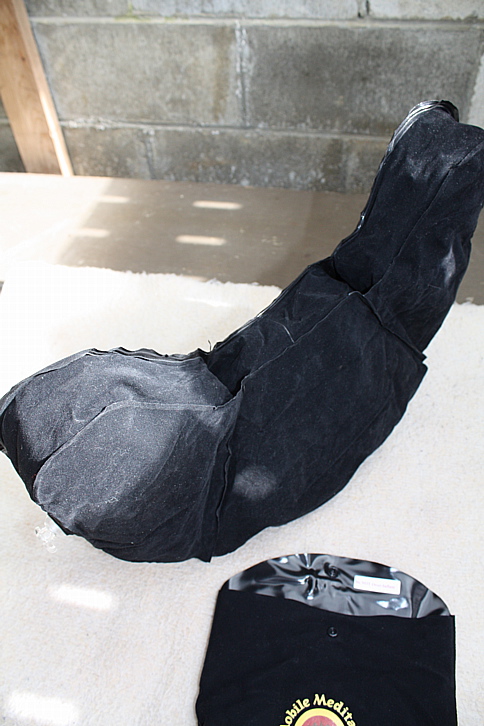
The zafu on its back.
To date, I've only come up with two criticisms of this otherwise excellent product. First, it's sweaty; after a long sit, my Enlightenment Base is wet and greasy. This is uncomfortable, but in all honesty, I can't imagine a way to make an inflatable zafu that doesn't do this. So I just place a folded towel on it before I sit, and that solves most of the problem. On the other hand, the company could easily do something about its limited colour choice. Right now the Mobile Meditator comes in two flashy Las Vegas versions (Very Red! and Very Orange!), as well as black. I'm happy; I like black. But they really ought to add a conservative blue, and maybe an earthy green and brown. Just sayin'.

I sure can't complain about the price. At $24.95, a person could be forgiven for assuming it's cheap junk. But it's not; it's cheap quality.

I don't really know exactly how tough this thing is yet, as I've only just got it. However, in a few days I'm going into the woods to meditate for a hundred days, which is why I bought the Mobile Meditator in the first place. Of course I won't do anything stupid, like jump on it or use it directly on the ground or shove it into a bear's mouth to save my life. But I think we can safely assume that this summer will be the Mobile Meditator equivalent of a Timex commercial.

I'll let you know how it goes.

UPDATE, September 2011:

Not well, as it happens. The zafu popped on the third day out, and I ended up rolling up my closed-cell sleeping pad each day to serve as a cushion. I wouldn't read too much into this, though; the conditions were extremely challenging for anything inflatable. By way of comparison, my Thermarest pad, which I used as a zabuton, also developed a leak, and the Mobile Meditator is nowhere near as sturdy as that is.

So the Mobile Meditator is not great for exterior hermitry, at least not as-is. I suspect you could make a cover for it of leather or some artificial material (the stuff they make industrial hoses out of comes to mind), and that would probably keep it alive in abrasive conditions.

Before I leave this topic, let me also say that I cut the side chambers out (only the big middle one popped) and used one for my pillow at night and the other as knee support with the rolled-mat zafu. Both served throughout the ango with no further complications, and are still perfectly airtight. The knee support was particularly welcome, since the little cushion could be adjusted with a pinch, and sitting on that hard foam roll increased joint stress rather a lot. 

Thursday, 7 April 2011

I Get Off With A Warning

So it's midnight, and I'm meditating on the lower deck when my fat lamp suddenly goes out. With only twenty minutes to go, I decide to sit tight. (No pun intended.)


Until something literally almost climbs into my lap. I yell, and it scatters. After collecting a flashlight, I see this.


It's the night shift. (Note my zafu and zabuton in the upper right.)


They scope me out, more from procedure than concern.


"Don't look like much."


"Don't smell like much, neither."


"No worries, guys. It's just a big Buddhist monkey."


And they continue their rounds, as if no one were there.

No one important, anyway.