Thursday, 3 November 2011

Good Book: The Zen Path Through Depression

Depression is the elephant in the meditation hall. Virtually all Zenners suffer from it; nobody becomes a monk because he's happy. But Zen has a macho tradition, and since depression is an illness without visible wounds, the old right-wing arithmetic applies:

machismo + (unauthorised suffering) = rejection.

Thus the institutional response to depressed Zenners ranges from supportive assistance, to conditional acceptance, to outright insult. Students are as likely to be told that they're "attached," that they have the "wrong perspective," or that they're just plain lazy, as to receive useful, scientifically-valid teaching.

In short, depression is our evolution, and our response to it sometimes amounts to creationism: a crap alibi against having to admit that our founders didn't fully understand something.

Fudo-esque confrontation of that heritage is just one strength of Philip Martin's The Zen Path Through Depression. In sensible, measured tones, he accompanies the reader, in the Franciscan sense of the word, through the myriad symptoms of depression: disabling lack of energy; paralysing panic; rumination; pointless rage; guilt and self-recrimination.

Physical symptoms of a disease as physical as diabetes, albeit not yet as well-understood.

I should say that I approached this book with trepidation, and wouldn't have approached it at all if I hadn't been desperate. I had beaten depression with Zen seven years before, and been a monk ever since – it was the first thing I found that could bully the bully.

But two years ago I got nailed again, and this time my Zen practice wasn't up to it. Even admitting that took months. When I finally ordered Martin's book I was afraid I'd either get a pop-psy puff piece with some trendy Zen around the edges, or a traditional Zen treatise that flipped a few koans at me and said, "Stop being depressed."

Happily, what I actually received was a scholarly catalogue of the medical symptoms at one chapter each, along with what modern science knows about their origins. Just that helps a lot, to put things in context and demonstrate that you're neither crazy nor irresponsible. This is followed up by square, monastic-grade Zen analysis of the case.

In essence, Martin says, "This is your mind. This is your mind on depression." And that was as effective as the medication in retuning my mind.

Depression is a lonely hell; shame and embarrassment convince you it's all your fault. Martin proves that it's not. "In our depression," he writes,
…we can start to heal by accepting that a great part of our becoming depressed, as well as much of getting over it, may not be within our control. In doing so, we can let ourselves off the hook, and stop taking the blame.
The next move is genius: once his orthodox Zen prescription to accept what is takes the pressure off, he scratches a few questions on the last page of each chapter. You don't have to consider them; only if you want to.

Dig:
Examine your beliefs about suffering. Do you believe it is inevitable? Or that it builds character? Is suffering connected with struggle for you? Would there be no life without suffering?
Seems pretty anodyne now, but at the time, with my brain freshly stabilised by a few pills and recharged by Martin's explanations, this stuff was Drano. Note again his classic Zen: no answers. There aren't any wrong thoughts, you just have to be aware of what you're thinking.

Doesn't seem like it would work, but it does. The questions, as much as the teaching, flushed out my system.

It would be hard to imagine a writer better qualified for the job. Martin is a long-time student of Zen; a certified and experienced therapist; and most important, a sufferer of hardcore depression.

This guy doesn’t have a condescending bone in his body. He's a brother.

As the practice began to take, The Zen Path Through Depression felt so good that I started rationing it because I didn't want to run out. When I got low, I would ask myself, "OK, I feel bad, but is it Path-worthy?" And that alone motivated me to endure, to find the strength in my backbone, to haul myself up by my sandal straps.

And pop went the depression.

In the end, with a supportive family, coöperative doctors, my monastic practice, and Martin's book, I got back on my feet. I was even able eventually to stop taking the meds. (But if the depression comes back, I'm back on. Like, now. Don't be afraid of meds, brothers and sisters. They're undramatic drugs, no scarier than aspirin, for a sickness no more imaginary than migraines.)

And while you're up, get a copy of The Zen Path Through Depression. When I needed a lot of help, this book was a lot of help.

Monday, 24 October 2011

Straight From the Tahre Pits

Weird US Navy CH54 flew low up the beach this afternoon, exactly window-height at my house on the bluff. Reminds me of some giant prehistoric crane fly. Maybe that's why they call it a Sky Crane.


(Photo courtesy of Wikimedia and the US government. It's an Army helo, but you can't have everything; where would you put it?)

Thursday, 20 October 2011

Hermitcraft: Busting Dysentery

Oxalis
While on ango last summer, I got a visit from the Dysentery Fairy. I still haven't determined precisely what sort it was; we have a lot of Giardia around here, but it would be a true hail-mary for that to get into a rain barrel. On the other hand, if it was a bacterial infection, the symptoms were pretty giardesque. I'm not even certain it came from my drinking water; hygiene is a constant battle in the outback, where you're surrounded by faeces and wild water.

Anyway, I suffered an anxious week or two, dodging into the dark forest at 0300 and fearing the thing would drive me off the mountain. In the end I kicked its butt, thanks to the support of friends and family and, I believe, the tea I'm passing on in this post.

It's terrifying to find yourself sick and alone; once it's happened (and this wasn't the first time for me), you'll never trivialise someone else's misfortune. In this case, I spent about a day trying to hide from it.

Then I got mad. Fact is, a lifetime of relevant experience prepared me to confront this problem. Hell, I wrote a freakin' book on wild herbs, for Christ's sake!

I decided that if I was going to be forced off the mountain, I was really going to be forced. Surrender would only become an option when every last gun had been fired.

And I had several. To begin with, the Acres, where I lived, was busting with herbs in their best season. And my cache contained other possibles. So I got off my backside and raked together a tea calculated to firm things up and rain displeasure on my uninvited guests.

I put myself on a regimen of 3 rice bowls (twice the size of tea bowls) of this per day; most days I drank more. I gulped down each, then sucked, chewed, and spit out the leaves.

The tea itself actually tasted OK, but the cud-chewing was abominable. Still, I got better. Quickly.

Hemlock
The Recipe

Put a double measure of strong green tea leaves in the bottom of a rice bowl.

Add:

oxalis and/or sheep sorrel
New Douglas fir tips (see note below)
Blackberry rhizome
Blackberry leaf

Chop all ingredients well; I used a pair of scissors.

Fill the bowl with boiling water, cover, and steep for fifteen minutes, minimum.

Drink and enjoy.

The green tea provides tannins, which tighten up your bowels, and is acidic, which gut-bugs hate. Blackberry leaves bring more tannin, are scientifically proven to fight dysentery, and taste alright; the rhizomes bring nuclear amounts of tannin and taste unspeakably awful when chewed, but as an ingredient in a diverse tea mix like this one, are palatable. Tart components (oxalis or sorrel; cider vinegar or lemon if you've got it) contribute more acid while tasting good, which encourages you to drink more. Young Douglas fir needles are pleasant too, though the older ones are quite strong, and are effective against diarrhœa. Other conifers will also work if you don't have Pseudotsuga; I've used spruce and hemlock to good effect. Finally, I also just plain ate oxalis and Douglas fir, often, during those days.

Later, a friend and fellow hermit came out to check on me, and he suggested I add Prunella to my dose. Did it help? It didn't hurt. It's dreadful stuff all the same, but once again the oxalis and Douglas fir got it past my tongue. Similarly, I held willow in reserve, should tougher measures be necessary. Willow bark is the origin of aspirin and an excellent medicinal, as well as highly acidic. It's also the most God-awful revolting bile on the planet; like chewing an aspirin tablet. (Bit of a toss-up between this and blackberry rhizome.)

Fortunately, I never needed it that summer.

This concoction put a decisive end to the pyrotechnic dumps and secured me those all-important restful nights. Of course, it wasn't the only measure I took; I also went in for draconian hygiene, fastidious handling of water, mindful hydration habits, and careful monitoring of the quality and quantity of everything that came out of me. I also imposed a few dietary adjustments: chiefly, a well-curried bowl, boiled up with bullion (for the salt), and served with a sadistic squirt of sriracha. Intestinal microbes trend to Caucasian tastes, so I made sure things got nice and "ethnic" on the old beaver fever.

Whatever the reason, and whatever it was in the first place, the disease eventually pulled up stakes and left. (You might say, it just didn't have the guts.) Whether I beat it, or it just wasn't that scary to begin with, I'll never know. But the tea worked. One day I had dramatic digestion; then I drank the tea, and it was significantly gone the next. Then about a week later I stopped drinking it (thinking I was "cured"; yes, I knew well better than to do this) and the trouble came right back. So I drank the tea again, and it went away again.

Therefore I offer the recipe, in loving support of anyone else who might also fall into that pit. Brother, sister: drop this on your trouble.

And smile while you drink it.

For if you listen closely, you can hear the little bastards scream.


(Adapted from 100 Days on the Mountain,copyright RK Henderson.)

Wednesday, 19 October 2011

WW: Candid capture of my practice


(Glasses put down on the way back in from the beach, before a bundle of Chinese coins for making cemetery fudos; reflection of me in the left lens and my Buddha bowl in the right.)

Thursday, 13 October 2011

My Hermit Hut

I've been feeling a bit nostalgic about the old meditation shed I had down at the beach, and it struck me that I've never actually posted on it, though others' huts have appeared here several times. (I did upload a named exterior shot ten years ago on Wordless Wednesday, but the others that have appeared from time to time were illustrating other topics, and so not identified.)

So in the interest of completism, here it is.

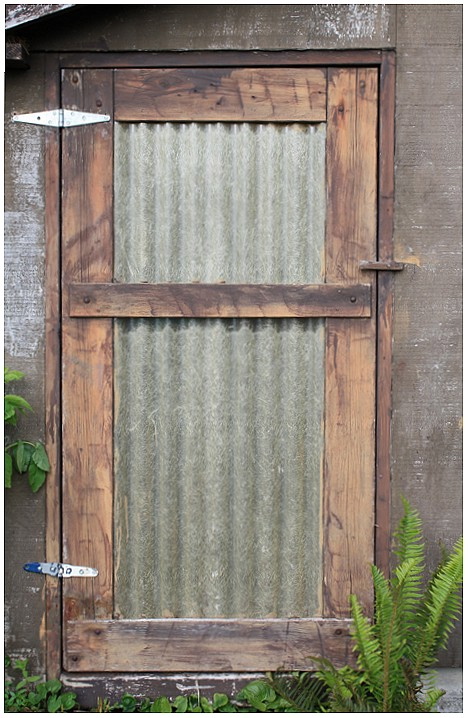
This tiny shack, the very picture of a true purist's definition of "hut", started life as my grandmother's potting shed. My grandfather carved it out of the slope below their house, where I lived for ten years during the formative period of my Zen practice. When I arrived, the house and grounds were both in dire condition; eventually I hacked my way down to this cinderblock shanty, re-opening a steep, eroded goat trail through impenetrable brush. The door, which had been kicked in by a winter storm years before, lay on floor inside; only the twisted wreckage of the lower hinge was still nominally attached.

In the intervening years blackberry and honeysuckle had invaded and filled the interior, along with bracken, lady fern, and infant trees, and the roof and wooden parts had rotted in places. Its concrete floor was completely saturated, covered with standing water and mud from infiltrated silt.

I really didn't need a place to sit, as the house – high on a bluff above the grey Pacific, with few neighbours – was already the best hermit hut in history. But rehabilitating one of my grandmother's work stations was an attractive premise, and the place would provide ground-level, fundamentally outdoor meditation, which I always prefer when available.

So I set-to, and after a lot of concentrated effort and scrounging of materials, ended up with this serviceable little squat. I even once sat an all-night sesshin there, hoping to glimpse the bear that left scat in front of it. (I didn't, but I did relearn, not for the last time, that spring nights on the North Pacific are bitterly winter-cold.)

So here it is, my own hermit hut. Or to be perfectly accurate, my monastic playhouse. It might not have been strictly necessary, but I learned a lot of Zen there.